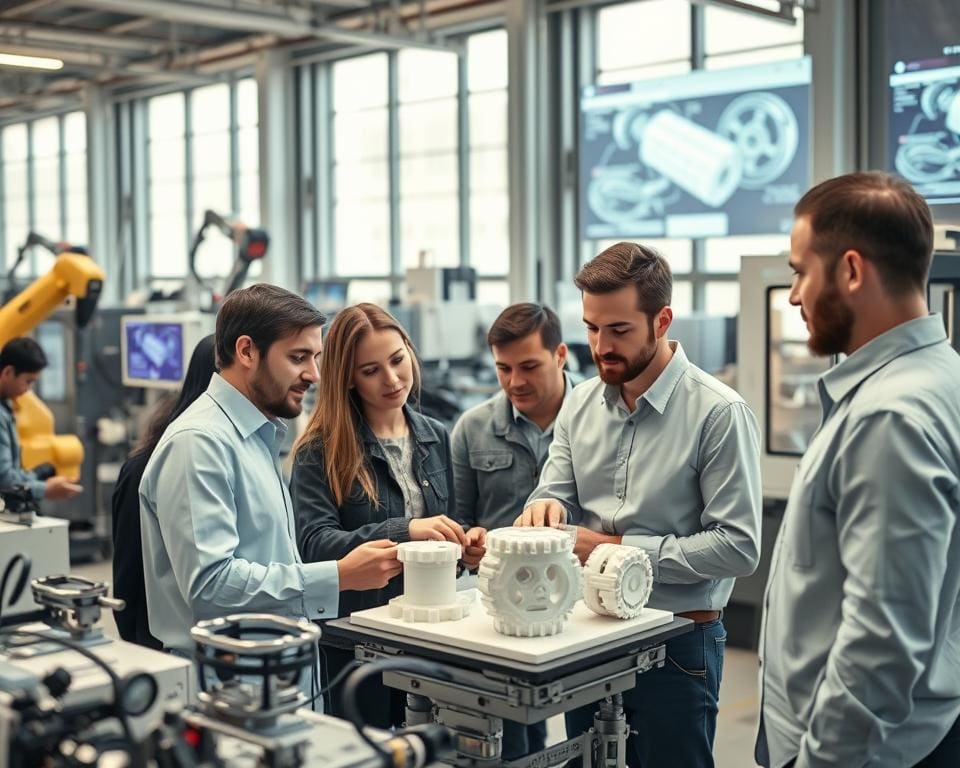

Mechanical engineering innovations are reshaping how products are designed, built and maintained across the UK and beyond. This section sets the scene for a practical look at what innovations are transforming mechanical engineering and why they matter to engineers, businesses and policy makers.
National priorities such as the UK Government’s industrial strategy and the drive to net zero, together with funding from UK Research and Innovation and partnerships between Imperial College London, University of Cambridge, University of Manchester and firms like Rolls‑Royce, BAE Systems and Jaguar Land Rover, are accelerating adoption of cutting-edge mechanical technologies.
Cross-cutting themes recur throughout this article: digitalisation, additive manufacturing, robotics, materials engineering, electrification and AI-driven manufacturing intelligence. These transformative engineering trends interact — for example, digital twins speed up design for additive manufacturing, while AI optimises energy use in electrified powertrains.
The intended readers include mechanical engineers, design leads, manufacturing managers, engineering students and policy stakeholders. Expect concise, actionable insight into benefits, real-world applications and guidance on skills and investments that support the engineering future UK seeks.
Measured impacts are clear: reduced time-to-market, lower production costs, improved product performance, decreased lifecycle carbon and safer, more productive workplaces. The following sections examine core innovations, future-ready materials and sustainable practices, and the role of data and AI in manufacturing intelligence.
What innovations are transforming mechanical engineering?
Mechanical engineering in the UK is shifting fast as new tools change how teams design, test and build. Additive techniques and digital systems sit beside smarter robotics to cut lead times, lower costs and unlock fresh product ideas.
Additive manufacturing and 3D printing advances
Advances in additive manufacturing UK and 3D printing engineering span polymer prototyping to metal additive manufacturing for flight‑critical parts. Rapid prototyping shortens iteration cycles, while topology optimisation and internal lattices enable part consolidation and lighter assemblies.
Industry adopters such as Rolls‑Royce, GE Aviation and Jaguar Land Rover use AM for spares, tooling and turbine components. Renishaw and EOS support the ecosystem with machines, materials and qualification work that help manufacturers move from prototype to certified production.
Design for additive manufacturing shifts CAD practices toward new constraints. Engineers learn DfAM principles to exploit complex geometries without adding cost, while hybrid routes combine AM with CNC finishing to meet tight tolerances.
Digital twins and predictive simulation
Digital twin engineering lets teams mirror assets in software for continuous insight. Predictive simulation and performance simulation reduce physical testing by validating behaviour before parts enter manufacture.
Virtual prototyping with CFD, FEA and multibody dynamics brings CAE trends into everyday practice. Platforms from Siemens, Dassault Systèmes and ANSYS integrate sensor data, so models update from the factory floor and feed condition‑based maintenance strategies.
Good model fidelity depends on data quality and governance. Organisations that combine physics‑based models with data analytics unlock faster root‑cause analysis and longer asset life through planned interventions.
Robotics, automation and collaborative robots (cobots)
Robotics in manufacturing now covers industrial robots for high‑speed tasks and lighter cobots UK that work safely alongside people. Factory automation uses vision, force sensing and compliant control to expand safe applications.
Logistics and assembly lines deploy autonomous systems, AMRs and PLC‑integrated cells to lift throughput and cut ergonomics risks. SMEs adopt cobots to automate bespoke runs without heavy investment in safety cages.
Successful adoption needs workforce upskilling and system integration. Engineers learn to design human–robot workflows, programme robots and maintain automated lines so technology becomes an enabler rather than a replacement.
Future-ready technologies and sustainable engineering practices
Modern mechanical engineering is shifting fast. Teams across the UK blend electrification mechanical engineering with material innovation to meet strict climate goals and market demands.
Electrification and advanced powertrains
Battery electric vehicles, hybrids and fuel-cell systems reshape vehicle and industrial design. Engineers work on electric powertrains, refining motors, power electronics and thermal management to raise efficiency and reliability.
Research into battery cell chemistries such as NMC and LFP, plus solid-state concepts, improves range and safety. The UK drive for battery technology UK includes gigafactory plans and OEM projects from Jaguar Land Rover and Nissan that accelerate e-mobility engineering.
Wide bandgap semiconductors like SiC and GaN boost inverter performance. Hydrogen powertrain development offers an option for heavy-duty uses where fast refuelling and energy density matter.
Lightweight materials and composites
Reducing mass remains central to efficiency. Lightweight engineering uses carbon fibre engineering, advanced alloys and hybrid systems to cut weight while keeping strength.
Composite materials UK efforts focus on scalable production, recycled feedstocks and thermoplastic routes. Organisations such as the National Composites Centre support manufacturing methods like automated fibre placement and out-of-autoclave curing.
Designers balance manufacturability, repair and lifecycle impacts. Material choices affect energy use, performance and total cost across transport and industrial machines.
Energy efficiency, circular design and sustainability
Sustainable mechanical engineering links product design with circular design and net zero engineering targets. Lifecycle assessment guides choices about materials, fuels and end-of-life routes.
Energy efficient engineering includes heat recovery, variable-speed drives and smart grid integration to reduce operational carbon. Circular approaches favour remanufacture, reuse and battery recycling to cut embodied emissions.
Skills must evolve to cover BMS, high-voltage safety and cross-disciplinary collaboration. Policy, incentives and industry leadership will steer practical adoption of these future-ready technologies.
Data, AI and manufacturing intelligence for mechanical engineers
Data and artificial intelligence are reshaping how mechanical engineers design, build and run products. Generative design tools and AI in manufacturing help teams cut mass and material use while keeping strength and function. Platforms such as Siemens MindSphere, PTC ThingWorx and Microsoft Azure IoT pair with TensorFlow or PyTorch to turn sensor streams into actionable insights for smart manufacturing.
Predictive maintenance driven by machine learning engineering uses vibration, temperature and operational data to forecast faults and reduce unplanned downtime. Manufacturing intelligence also powers computer vision inspection to raise yield and free staff from repetitive quality checks. In the UK, rail fleets and food processing sites are already proving the business case for industrial AI UK through lower lifecycle costs and higher consistency.
Ethics, provenance and GDPR-compliant data governance must sit at the heart of any rollout. High-quality, labelled data and explainable models reduce bias and build trust with regulators and customers. For leaders, a practical roadmap starts with clear use cases, small pilots with measurable KPIs and cross-functional teams that blend engineering and data science.
The future will see tighter fusion of digital twins, reinforcement learning and manufacturing execution systems to create adaptive, resilient factories. Embracing manufacturing intelligence and AI in manufacturing positions UK mechanical engineering to deliver sustainable, customisable products at scale while upskilling the workforce through apprenticeships and university courses in data analytics and digital engineering.