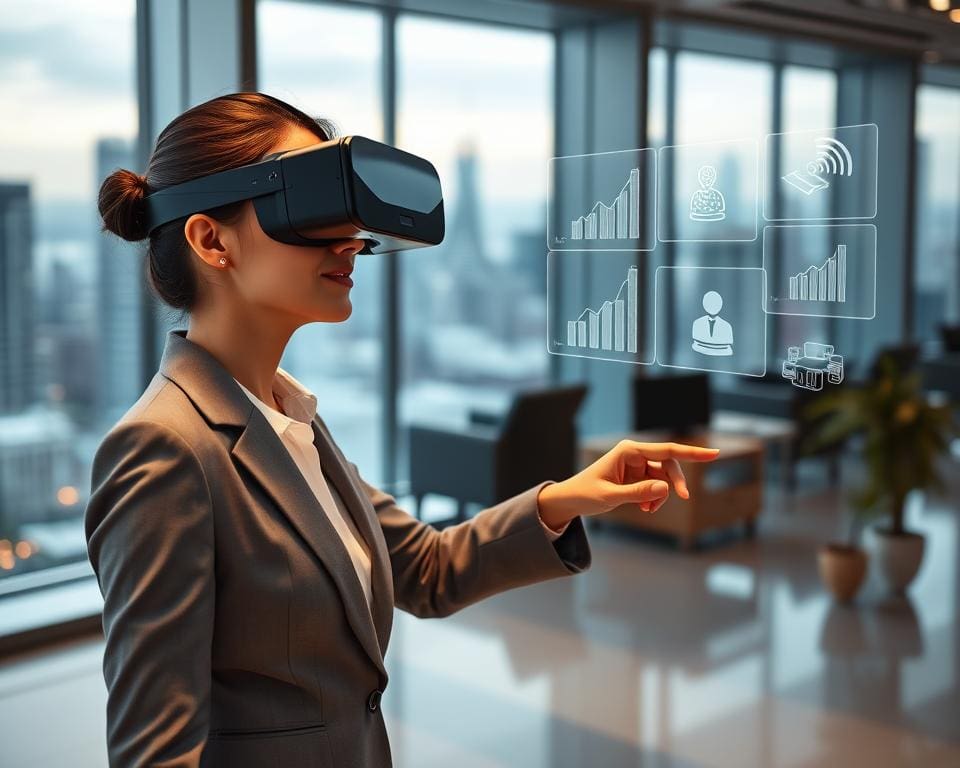

Virtual reality has moved beyond novelty to become a practical tool for UK firms. Leading studies from PwC show measurable learning and productivity gains, while companies such as Jaguar Land Rover and BAE Systems use VR for design and simulation. This shift reflects falling hardware costs and stronger enterprise VR solutions from Varjo, HTC Vive Business and Microsoft Mesh.
At its core, VR creates immersive, repeatable experiences that accelerate learning, increase empathy and showcase products in context. These virtual reality benefits business by shortening time-to-competence, supporting remote collaboration and providing controlled environments for high‑risk training. Standalone headsets like Meta Quest make VR for business UK deployment more attainable for small and large organisations alike.
For business leaders, HR managers and sales directors, VR is a strategic investment that supports digital transformation. The business VR advantages include shorter sales cycles, more memorable customer experiences and lower operational risk. Organisations must also consider data security and GDPR when capturing user interactions to ensure safe, compliant roll‑outs.
This article will explore training and skills development, customer engagement, cost efficiencies and immersive sales tools, and show how enterprise VR solutions deliver measurable ROI and practical next steps for UK businesses.
What are the benefits of virtual reality in business?
Virtual reality reshapes how companies train staff, engage customers and manage costs. Short immersive sessions build confidence and measurable skills without exposing people or machines to danger. Firms from PwC clients to aviation schools report faster learning curves and stronger retention when VR is part of the curriculum.
Enhanced employee training and skills development
Businesses use immersive training to let employees practise high-risk tasks in a safe setting. Medical teams rehearse procedures, technicians work on complex machinery and customer-facing staff roleplay difficult conversations with controlled branching scenarios.
Research by PwC and industry studies show learners complete training faster and score higher on assessments than with classroom or e-learning alone. Learning platforms such as Strivr and Talespin integrate performance analytics and link to LMSs to track completion times, error rates and certification pass rates.
Training types cover safety and compliance, soft skills, technical upskilling and onboarding. Clear metrics like reduced errors and faster certification help HR justify investment in VR training benefits.
Improved customer engagement and experience
Immersion deepens emotional connection and makes products easier to evaluate. Property firms offer virtual walkthroughs, carmakers provide test-drive simulations and retailers create in-store VR kiosks to let shoppers try before they buy.
Omnichannel strategies weave customer experience VR into online, in-store and event touchpoints. Brands such as IKEA and Audi use virtual showrooms to lower return rates and shorten decision time.
Well-designed experiences boost conversion and loyalty through personalised storytelling and extended engagement time. Accessibility choices and comfort settings reduce motion sickness and widen participation.
Cost efficiencies and reduced operational risk
VR cost savings appear quickly when travel and accommodation drop after virtual meetings and remote inspections replace site visits. Engineering teams inspect offshore platforms through VR to avoid mobilisation expenses.
Hazardous training in virtual settings cuts injuries and prevents equipment damage. Designers validate concepts in VR to spot flaws before physical production, lowering rework and shortening prototype cycles.
Key performance indicators include fewer workplace incidents, shorter development timelines and lower lifecycle costs. Pairing VR with digital twins and predictive analytics helps firms reduce operational risk with VR while tracking measurable savings.
Immersive presentations and sales tools that transform client interactions
Immersive presentations change how teams connect with clients. Well-crafted VR sales tools let buyers explore products at scale and in context. Experiences that focus on clear user journeys and storytelling make complex offerings simple to grasp.
Designers should combine high-quality 3D assets, spatial audio and photogrammetry to create believable scenes. Keep sessions short for first-time users and include intuitive controls plus clear calls to action. Integrate with Salesforce or HubSpot so sales teams can attach session analytics to opportunities and follow up with tailored proposals.
Designing persuasive VR sales experiences
Start by mapping the viewer’s path from discovery to decision. Use sensory cues and realistic scale to show product benefits that static media cannot. Include interactive elements such as toggles, configurators and guided narration to highlight value in context.
Use enterprise platforms like Unity or Unreal Engine for content and VIVE Business or Varjo for high-fidelity headsets when fidelity matters. Train salespeople to act as VR guides so they can steer conversations and close deals while tracking engagement metrics.
Use cases across industries
Real estate teams stage virtual showrooms and off-plan walkthroughs to accelerate buyer decisions and support remote purchasing. Automotive brands deploy virtual test drives and configurators to reduce prototype costs and speed purchase cycles.
Healthcare organisations use VR for clinician demonstrations and patient education to build trust. Retailers offer virtual try-ons to lower returns and boost cross-sell. Consultancies run scenario simulations to win stakeholder buy-in during workshops.
Examples of early adopters and trend analyses suggest strategic investment pays off. Read more about how enterprises are reshaping remote work with immersive tools at industry outlook.
Measuring ROI and performance metrics
Define sales KPIs up front: demo-to-deal conversion, average deal size and time-to-close. Track session duration, interaction depth and lead quality to understand engagement.
Combine heatmaps and interaction logs with customer feedback and NPS to measure impact. Use pilot projects with control groups to isolate effects on revenue and costs. Compare implementation and content production costs against savings from reduced travel, fewer prototypes and faster closures to estimate VR ROI.
- Sales KPIs: demo-to-deal conversion, time-to-close
- Operational KPIs: training completion, time to competency
- Analytics: heatmaps, interaction logs, session metrics
Operational advantages, collaboration and future-ready innovation
Virtual reality delivers clear operational advantages VR brings to field work and asset management. Utilities and energy firms now use 360° capture and digital twins VR to inspect towers and pipelines remotely, cutting travel and on-site risk. Teams can run virtual inspections and maintenance planning from an office, reducing downtime and speeding decision cycles.
VR collaboration reshapes how distributed teams work together. Immersive meetings with spatial audio, shared 3D models and virtual whiteboards recreate the feel of in-person workshops. Engineers, designers and commercial leads can align on the same immersive model to spot bottlenecks, test layout changes and approve designs faster than traditional review loops.
Linking VR to IoT and cloud platforms supports smarter asset lifecycle management. Visualising live sensor feeds inside a virtual model enables predictive maintenance and better resource allocation. Remote collaboration VR makes it simpler for geographically dispersed staff to participate equally, supporting flexible working and reducing the carbon footprint from travel.
Preparing for the future of VR in business means a staged approach: pilot, measure, then scale with governance for content, hardware lifecycle and training. Embrace interoperability standards like OpenXR, and consider synergies with AI, 5G and cloud rendering to expand capability. Firms that adopt these practices will gain faster product development, resilient distributed operations and an innovative employer brand that attracts talent.