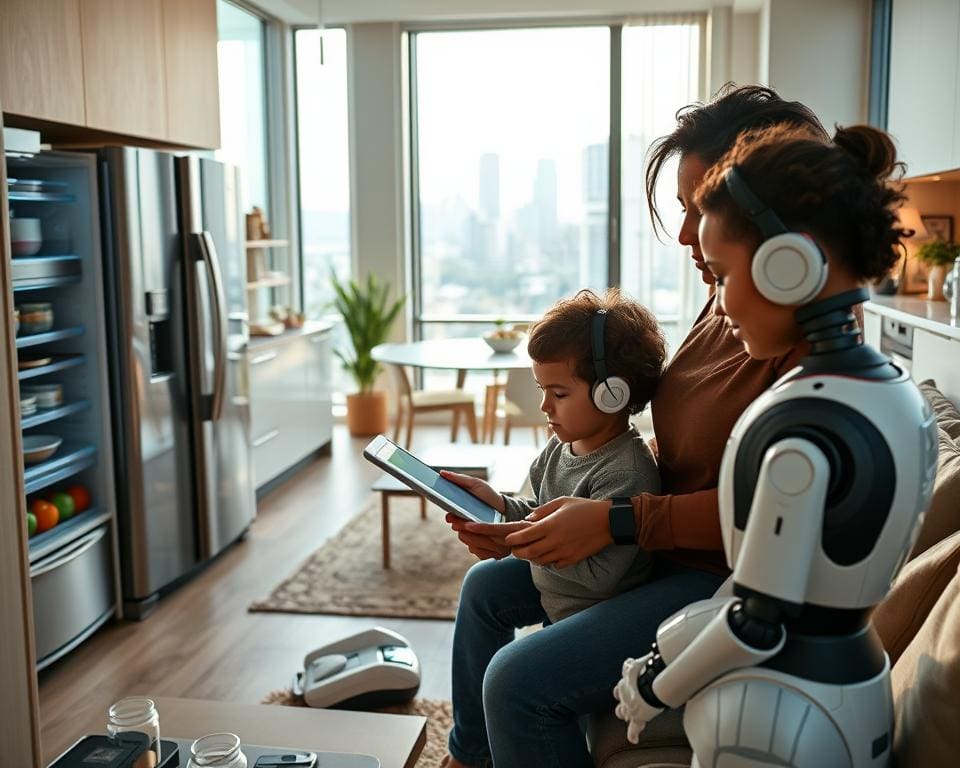

Artificial intelligence everyday life means systems that carry out tasks we once thought needed human thought. These include machine learning models that spot patterns, natural language processing that understands speech, and computer vision that reads images. AI in daily life now powers features from predictive text on Apple and Google phones to recommendation systems on Netflix and Spotify.
This article maps the AI impact UK readers can expect across homes, workplaces and civic services. It aims to show practical examples and explain how everyday AI applications are already reshaping routines. For consumers, that could be smarter thermostats, health apps giving personalised reminders, or workplace tools that speed up mundane tasks.
Recent drivers behind this shift include larger datasets, faster processors and transformer models. Cloud platforms such as Amazon Web Services, Microsoft Azure and Google Cloud have made commercial AI adoption easier for businesses of all sizes. These advances turn experimental research into real products for users.
In the UK the social and economic context matters. The government’s UK AI Strategy, rising private investment and growing consumer familiarity since the pandemic have accelerated acceptance. Businesses and public services are increasingly trialling everyday AI applications to improve service and cut cost.
The following sections explore practical benefits at home, changes at work, everyday interactions like travel and public services, and the ethics and privacy questions that follow. Each part builds from simple personal convenience to broader societal considerations of AI for consumers.
Practical benefits of artificial intelligence everyday life
AI is reshaping how people live at home, work and on the move. Everyday tools now blend convenience with meaningful savings and better safety. The next paragraphs show how smart devices, services and health tools make daily routines easier and more efficient.
Smarter homes and personal convenience
Voice platforms such as Amazon Echo (Alexa) and Google Nest connect lights, heating and entertainment through simple commands. Philips Hue bulbs and Nest thermostats link into an Internet of Things network that runs routines and reacts to geofencing. The thermostat can lower heating when you leave and warm the house before you return, cutting waste and lowering bills.
AI personal assistants manage calendars, set reminders and control connected devices. Cameras and doorbells from Ring and Nest Hello use motion detection and person recognition to reduce false alerts. These tools boost security and give families greater peace of mind while reducing unnecessary notifications.
Personalised services and recommendations
Recommendation engines from Netflix, Spotify and Amazon learn tastes and surface content that fits each user. That means less time searching and more time enjoying music, shows or products that match your preferences. Retailers and fintech firms use similar models to personalise offers and budgets.
Banks and challenger apps flag unusual transactions to prevent fraud and suggest tailored saving plans. Travel platforms such as Skyscanner and Trainline craft itineraries and show dynamic pricing that helps travellers find suitable options quickly. These personalised recommendations refine choices and save time.
Health and wellbeing at home
Wearables like Apple Watch and Fitbit log activity, sleep and heart rate. AI analyses can spot irregularities and nudge users toward healthier habits. Remote monitoring tools and telemedicine have expanded in the UK through NHS Digital projects, letting clinicians triage symptoms and oversee chronic conditions from afar.
AI healthcare apps and home wellbeing technology also include mental-health tools. Apps such as Headspace and Calm tailor meditation sessions, while chatbots offer early support and signpost professional help when needed. These digital aids complement clinical care and make support more accessible across the home.
Workplace transformation and productivity improvements
Artificial intelligence is reshaping how offices, shops and clinics operate. Firms in the UK and beyond are using smart systems to streamline processes, boost output and free staff to focus on more creative work. This shift changes daily routines and opens new paths for career growth while demanding careful oversight.
Automation of routine tasks
Robotic process automation and AI handle repetitive admin chores such as invoicing, data entry and scheduling. Banks and retailers deploy customer support chatbots to answer common queries, cutting wait times and lowering error rates.
Automated email triage sorts messages by priority. Document processing combines OCR with natural language processing to extract invoices and forms. These tools speed up workflows, provide 24/7 service and reduce operational bottlenecks, which improves automation in business outcomes.
Augmented decision-making
AI tools increasingly support professional judgement rather than replace it. Predictive analytics help sales teams forecast demand. Machine-learning models assist finance teams with risk scoring and aid clinicians with image interpretation in radiology.
Banks use AI decision support for credit-scoring models. Retailers apply demand forecasting to keep shelves stocked. NHS trusts pilot algorithms to flag urgent scans for review. Explainable systems and clear governance keep human oversight central and build trust.
New roles and skills for the workforce
Job profiles are shifting. Demand rises for data scientists, machine learning engineers and AI ethicists, while managers need AI literacy to lead mixed teams. Human-centred skills such as empathy, creativity and complex problem-solving gain value.
Workforce reskilling is essential. Government schemes, employer training and online platforms such as Coursera and FutureLearn offer routes to new skills. Policy measures can smooth transitions so that AI job transformation creates fair opportunities in the labour market.
Everyday interactions: communication, transport and public services
Artificial intelligence is reshaping how people move, how councils deliver services and how communities converse. Small advances in algorithms and interfaces add up to smoother journeys, faster replies from public bodies and more inclusive conversations across the UK.
Enhanced travel and mobility
Route-optimisation algorithms power platforms such as Uber and Deliveroo, cutting wait times and reducing empty miles. Cities use predictive traffic management and congestion modelling to adjust signals and ease flow during peak hours.
Public transport benefits from AI-driven timetabling and predictive maintenance for trains and buses, which lowers the risk of delays. Pilot projects for autonomous vehicles and delivery drones test new logistics for suburbs and rural routes.
Journey planning apps like CityMapper and Google Maps offer accessible routing for users with mobility needs. Better planning reduces emissions and supports greener travel choices across smart mobility UK initiatives.
Improved public services and civic engagement
Local councils and national agencies deploy machine learning to automate form processing and to power chatbots that answer questions about benefits. Data analytics help target interventions for homelessness prevention and public health campaigns.
The NHS uses AI to improve patient flow and support diagnostics, while some local authorities trial systems to optimise waste collection and energy efficiency. These tools appear within a broader move to modernise service delivery under AI public services.
Civic tech platforms apply sentiment analysis to public consultations and offer automated translation to widen participation. Digital tools enable participatory budgeting and community reporting, inviting clearer dialogue between residents and officials.
Communication and social interaction
Real-time translation and intelligent summarisation make meetings and emails easier to follow. Accessibility aids such as speech-to-text and text-to-speech lower barriers for people with hearing or visual impairments.
Social networks use AI to surface timely content and to detect harmful material, while firms invest in moderation systems to balance safety with free expression. These systems face ongoing challenges around accuracy and bias.
AI communication tools can strengthen connection when they augment human empathy. Technology that supports meaningful interactions will matter most when communities keep people, rather than machines, at the centre of conversation.
Ethics, privacy and preparing for an AI-driven future
Artificial intelligence brings real gains, but it also raises hard questions about fairness and accountability. Bias in models can amplify social inequalities, so explainable systems are vital in high‑stakes areas such as healthcare, criminal justice and lending. UK readers should note that AI ethics UK debates stress transparency, rigorous testing and clear lines of responsibility when automated decisions affect people’s lives.
Data protection sits at the heart of public trust. AI privacy concerns include excessive data collection, profiling and surveillance via cameras or location tracking. The Data Protection Act 2018 and GDPR set rules for lawful processing, purpose limitation and data minimisation, and they secure rights of access, rectification and erasure. Organisations must pair these legal duties with strong technical safeguards and secure data practices.
Preparing institutions and citizens means practical steps now. Firms can run AI ethics assessments and data protection impact assessments, embed human‑in‑the‑loop checks and invest in explainability and audit trails. Individuals should boost digital literacy, review privacy settings and consider privacy‑preserving tools. Public consultation and transparent governance help ensure responsible AI is not only an internal policy but a public commitment.
Policy makers, regulators and industry must work together to widen access and fund reskilling so benefits are shared. When designers centre inclusivity and oversight, the UK can lead on responsible AI and data protection. While artificial intelligence reshapes daily life with greater convenience and productivity, creating a fair and trustworthy future depends on conscious governance, education and public engagement — so participate, learn and help shape how AI joins everyday routines.