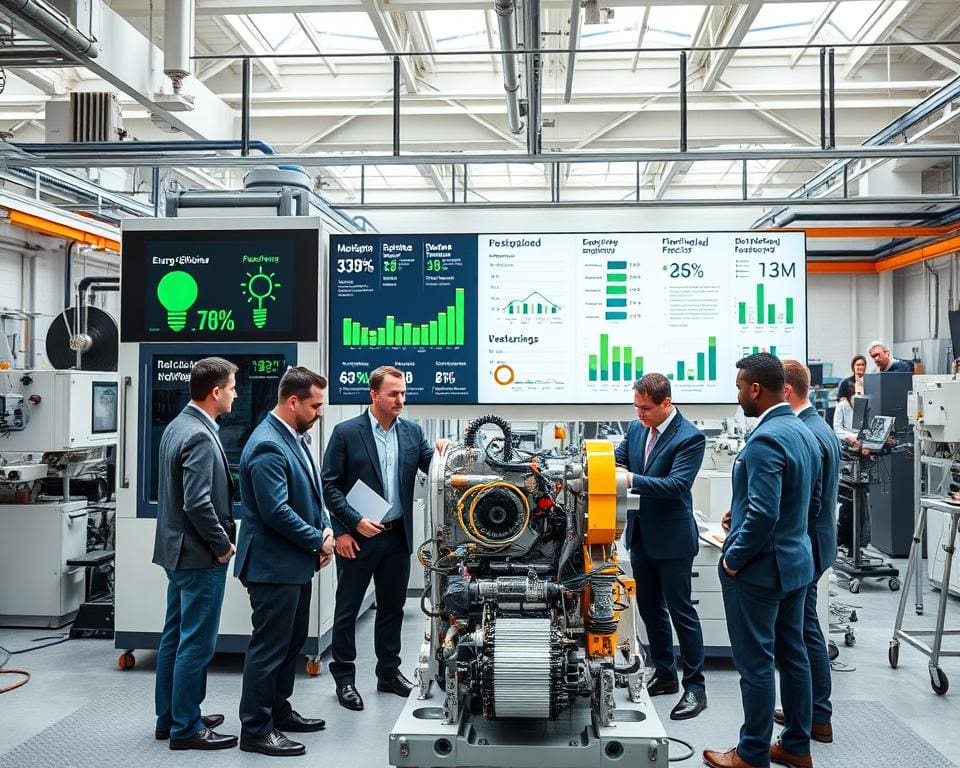

Engineers across the United Kingdom are asking a clear question: how are engineers improving energy efficiency in machines? The answer matters because machines consume a large share of industrial electricity and fuel in manufacturing, transport and building services. Small gains at the machine level add up, cutting emissions and lowering operating costs for businesses and public services.
Efforts to create energy-efficient machines span many fronts. Designers now adopt systems and lifecycle thinking to find savings from cradle to decommissioning. Advances in materials and lightweighting reduce moving mass. Improvements in motors, drives and actuation raise component efficiency, while digitalisation and data-driven optimisation let operators squeeze more output from the same energy input.
This work is closely linked to policy and funding. The UK government’s Net Zero ambitions, Ecodesign rules and minimum energy performance standards shape priorities, while BEIS programmes and UK Research and Innovation projects fund practical trials. Aligning machine energy optimisation with these frameworks makes investment decisions both compliant and future-proof.
The article that follows will move from design-level strategies through component innovations to digital and policy frameworks. It will show how engineers, manufacturers and operators can deliver measurable industrial energy efficiency gains and support sustainable engineering UK.
How are engineers improving energy efficiency in machines?
Engineers are reshaping how machines use energy by linking smart design with materials and control strategies. This section outlines practical approaches that cut operational demand, lower lifecycle impacts and make machines simpler to maintain.
Design optimisation and lifecycle thinking
Design optimisation begins with systems-level analysis to spot wasted energy across manufacture, operation and servicing. Teams use tools such as functional decomposition and failure mode and effects analysis to remove non-value processes and refine layouts.
Lifecycle assessment (LCA) gives a full picture of environmental impact from raw material to end-of-life. LCA helps decide when it is better to reduce operational consumption or to accept a small rise in embodied energy for long-term gains.
Design for maintainability extends service life and preserves efficiency. Modular components, standardised interfaces and easier access for condition monitoring all reduce downtime and slow efficiency decay.
Advanced materials and lightweighting
High-strength steels, aluminium alloys and carbon-fibre-reinforced polymers support lightweighting while keeping stiffness and safety. Lower mass cuts the energy needed for acceleration and rotation in transport and industrial equipment.
Materials selection embodied energy is part of every trade-off. Engineers weigh durability, recyclability and life-cycle carbon to choose options that save the most energy over a machine’s life.
Surface engineering matters. Low-friction coatings and advanced nitriding reduce wear and frictional losses, which means less energy spent and fewer interruptions for repairs.
Control systems and intelligent operation
Model-based control lets machines run near their most efficient point across changing loads. Reduced-order models and physics-based controllers improve part-load performance where big savings often hide.
Adaptive algorithms and on-board learning tune setpoints over time. When combined with predictive maintenance, based on vibration, oil analysis and thermal inspection, machines keep efficiency high and avoid unnecessary part replacement.
Practical steps include variable setpoint control for pumps and compressors and energy-aware PLC and SCADA schemes that coordinate subsystems for overall savings.
Innovations in motors, drives and actuation for energy savings
Engineers are reshaping electromechanical systems to cut energy use while lifting performance. Practical advances in motor design, smart drives and power conversion bring measurable savings across factories, buildings and transport. The emphasis is on matching power to need and recovering energy where possible.
High-efficiency electric motors and variable speed drives
Recent improvements in permanent magnet motors and synchronous reluctance motors have boosted torque density and trimmed losses compared with older induction designs. These gains matter when machines run at variable loads.
Variable frequency drives give precise speed and torque control so pumps, fans and compressors draw only the energy needed. Soft-start functions cut inrush energy and extend equipment life. Industrial standards such as IE3 and IE4, along with Ecodesign rules, push buyers towards retrofits that often repay investment within months.
Advanced actuation technologies
Electromechanical servos and direct-drive systems replace hydraulics where partial-load efficiency and tight control are vital. Removing constant hydraulic pressure eliminates background losses and leakage.
Energy recovery is becoming routine in many actuation cycles. Regenerative braking and recuperation in cranes, elevators and electric vehicles capture kinetic energy and feed it back to the DC bus or local storage. Hybrid cranes and servo-driven presses show clear operational savings in live installations.
Miniaturised actuators bring high precision to robotics while lowering power draw, helping manufacturers meet energy targets without sacrificing throughput.
Power electronics and conversion efficiency
Wide-bandgap semiconductors such as SiC and GaN cut switching losses in inverters and converters. Higher switching frequencies allow smaller passive components and improved inverter efficiency, shrinking system size and thermal load.
Optimised topologies and advanced control algorithms reduce harmonics and heat. Smart power management ties in peak shaving, bidirectional flow and local storage to smooth demand and improve plant-wide performance.
Major vendors including ABB, Siemens and Infineon are delivering hardware and software that speeds adoption across industry and transport, enabling next-generation drives and converters to be both compact and energy efficient.
Digitalisation, sensors and data-driven optimisation
Digital tools are transforming how engineers find and keep energy savings in machines. Small, affordable sensors feed continuous measurements into analytics platforms. That data lets teams spot waste, test fixes in simulation and roll out changes across sites with confidence.
Internet of Things for continuous efficiency monitoring
Placing current, vibration, temperature and flow sensors on equipment creates a live view of use and losses. IoT energy monitoring captures these signals so managers can rank inefficiencies and focus investments where returns are strongest.
Edge computing keeps control loops fast and reduces cloud bandwidth by handling anomalies and local decisions on site. Remote dashboards then aggregate readings for fleet-level comparison and prioritisation.
Machine learning and digital twins
Digital twin optimisation builds a virtual copy of a physical asset to test control changes before moving to the shop floor. Teams simulate what-if scenarios to check energy impact and avoid disruption.
Machine learning energy savings come from models that spot recurring patterns, predict overloads and propose setpoint tweaks. Reinforcement learning can find novel control sequences that lower consumption while meeting performance targets.
Data-driven maintenance and lifecycle extension
Predictive maintenance uses vibration spectra, oil analytics and thermal trends to intervene before efficiency drops or failures occur. That approach preserves performance and cuts embodied energy tied to spare parts and downtime.
Analytics also support fleet optimisation by modelling expected savings and payback for retrofits. UK manufacturers and research centres increasingly offer tailored services that help small and medium enterprises adopt these methods.
System-level strategies and policy-driven improvements
Engineers now look beyond individual machines to pursue system-level optimisation across plants and industrial clusters. By balancing loads and removing bottlenecks, teams reduce losses that would otherwise negate component-level gains. Holistic planning links heat recovery and cogeneration with storage and control systems to lift site energy utilisation.
Heat recovery and cogeneration capture waste heat from engines, compressors and process equipment and reuse it for heating or process work. In many UK sites, combined heat and power (CHP) and district heat networks cut fuel use and emissions while improving resilience. These measures pair well with smart grid strategies to match demand to cleaner supply.
Policy and incentive schemes accelerate uptake. UK energy policy, MEPS-style standards and labelling raise market minimums, while grant schemes, enhanced capital allowances and industrial decarbonisation funds lower the investment barrier. Clear measurement frameworks such as ESOS and ISO 50001 underpin credible reporting and public procurement can steer markets towards higher-efficiency machines.
Scaling impact depends on people as much as technology. Upskilling through apprenticeships and courses from bodies like the Energy Institute and CIBSE builds skills for energy efficiency across operations. When engineering teams combine technical measures with supportive policy and finance, industrial decarbonisation becomes a practical, investable pathway.