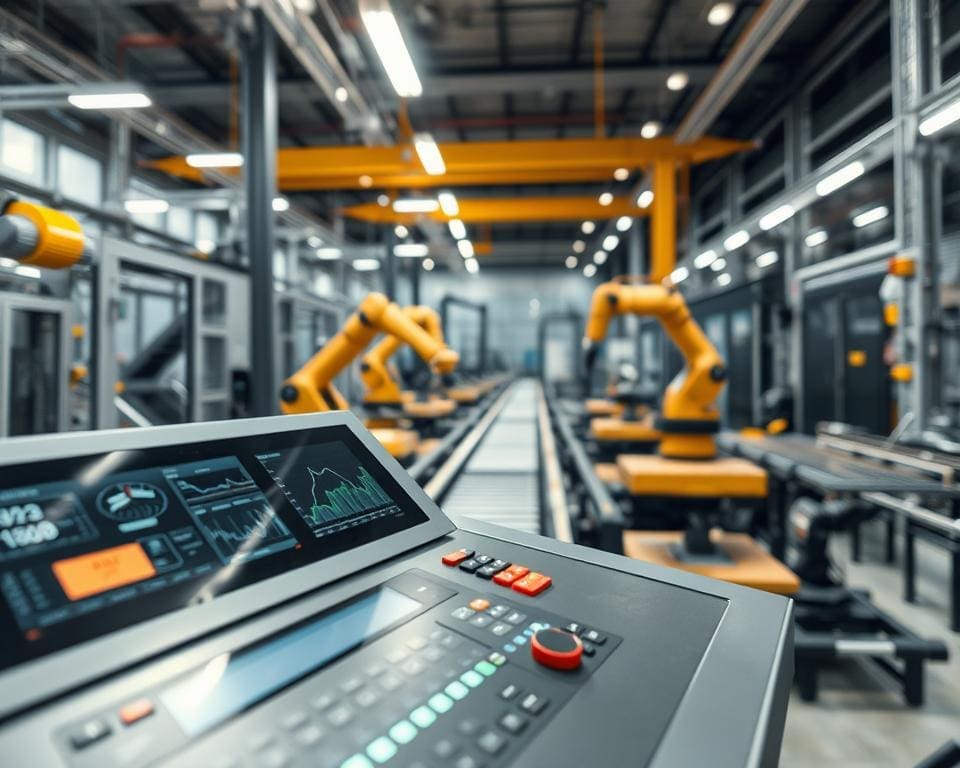
Control systems are the orchestral backbone of modern machines. In manufacturing, aerospace, energy and robotics, these systems coordinate sensors, controllers and actuators to keep equipment safe, efficient and predictable. Their role is to turn design intent into repeatable performance across varied operating conditions.
At an operational level, control systems aim for precise setpoint tracking, rapid disturbance rejection and robust fault detection. These objectives translate into measurable outcomes: higher throughput and yield, tighter positional accuracy, improved fuel efficiency and reliable uptime. Such results illustrate the control systems importance for day-to-day production and mission-critical tasks.
Stakeholders see tangible value from industrial control systems. Manufacturers gain productivity and lower lifecycle costs. Operators and maintenance teams benefit from reduced downtime and clearer diagnostics. End users enjoy safer products, while regulators, including EASA, CAA and standards such as IEC 61508 and ISO 13849, rely on well-engineered machinery control roles to demonstrate compliance.
For the UK, advanced control systems UK capability underpins competitiveness. British engineering firms that embed adaptive control and energy optimisation help meet net-zero targets and sustain export markets. Grounded in control theory fundamentals like feedback and stability, practical systems combine standards and field experience to meet the reliability expectations of heavy industry and high-tech sectors.
What role do control systems play in complex machinery?
Control systems form the invisible intelligence that keeps complex machines predictable, safe and efficient. This short section defines the components, outlines core tasks and gives concrete examples from manufacturing, aerospace and robotics. The aim is to make the technical accessible while showing how definition of control systems links directly to real‑world performance.
Defining control systems within industrial and mechanical contexts
A control system combines sensors, controllers and actuators to maintain desired behaviour by measuring outputs and adjusting inputs. In practice this splits into process control, which manages continuous variables such as temperature, pressure and flow, and motion or servo control that handles position, velocity and torque in machines.
Industry terms you will meet include setpoint, feedback and feedforward, disturbance, control loop, stability margin and robustness. Feedback control is the backbone of most loops, returning measured output to the controller so it can correct deviations from the setpoint.
Core functions: regulation, stabilisation and optimisation
Regulation keeps variables at their targets despite disturbances. A simple PID loop that controls reactor temperature or turbine speed shows how control system functions preserve steady operation under changing loads.
Stabilisation prevents runaway responses or oscillation. In aircraft pitch control engineers design for stability margins, using root‑locus and frequency response tools to ensure safe dynamic behaviour.
Optimisation improves efficiency and performance through advanced methods such as cascading control, gain scheduling, model predictive control and adaptive schemes. These approaches tune behaviour for nonlinearity and changing conditions while supervisory functions handle safety via interlocks, watchdogs and emergency shutdowns.
Examples from manufacturing, aerospace and robotics
In manufacturing, robotic welding arms pair motion control with vision feedback to raise repeatability. Process plants rely on distributed control systems to co‑ordinate hundreds of loops and maintain product quality; PLCs from Siemens and Rockwell Automation are common in such deployments.
Aerospace control systems use fly‑by‑wire with redundant sensors and fault‑tolerant controllers found on Airbus and Boeing aircraft. These systems blend feedback control with fault management to keep aircraft stable and responsive to pilot commands.
Robotics control ranges from collaborative robots that use force sensing and compliant control for safe human interaction to precision CNC machines that use closed‑loop servo control for micron accuracy. Each example shows how clear definition of control systems and well‑designed control system functions deliver tangible gains in safety and performance.
How control system architectures influence machine performance
Control system architectures shape how machines respond, adapt and achieve precision. Choosing the right balance between centralised control and edge intelligence affects resilience, cost and the ability to meet strict timing needs. Below are practical distinctions and design choices that guide engineers and plant managers toward reliable, high‑performance systems.
Open-loop vs closed-loop
Open-loop designs issue commands without feedback. They are simple, low-cost and suit predictable tasks such as timed conveyor indexing or basic irrigation schedules. Latency is minimal because no sensor processing interrupts the command path.
Closed-loop systems rely on sensors to correct errors. A PID temperature loop or a servo positioning system measures output and adjusts inputs to reduce deviation. Closed-loop control offers robustness against disturbance and better accuracy, but requires stability analysis and greater implementation effort.
Choosing between open-loop vs closed-loop is a trade-off: complexity and cost versus disturbance rejection and precision. Many applications combine both to exploit simplicity where possible and feedback where needed.
Distributed, hierarchical and centralised architectures
Centralised control places major decision-making in a single controller or control room. SCADA installations and early automation often follow this model. Benefits include unified oversight and straightforward operations for small plants.
Centralised control can create single points of failure and scale poorly as systems grow. Redundancy and robust communications become vital when uptime is critical.
Hierarchical architectures layer responsibilities from field controllers up to supervisory and enterprise systems. This structure suits manufacturing lines where local PLCs handle fast loops and a MES coordinates production planning.
Distributed control systems push intelligence to the edge: PLCs, motor drives and embedded controllers act locally to reduce response time and improve resilience. Modern trends favour distributed approaches with edge analytics for scalability and quicker fault isolation.
Hybrid approaches blend centralised supervision with local autonomy. They allow global optimisation while keeping control loops close to the hardware for speed and reliability.
Impact of real-time processing and latency on precision
Real-time control latency and determinism determine whether a system can synchronise motion or suppress vibration. Tasks like multi-axis robotics demand tight timing and predictable response from the network and controllers.
Industrial protocols such as EtherCAT, PROFINET IRT and Time-Sensitive Networking reduce jitter and lower latency. Select networks that match the control loop bandwidth to avoid phase lag and lost synchrony between axes.
Fast controllers using FPGAs or real-time operating systems and appropriate sampling rates help preserve stability margins. If latency grows, control bandwidth drops and stability can degrade, reducing final product quality.
Practical guidance: match architecture to scale, criticality and latency needs. For high-precision systems favour distributed control systems with deterministic networks. For smaller, less critical installations, centralised control or simple open-loop arrangements may suffice.
Key components and technologies behind modern control systems
Modern control systems rely on a precise mix of hardware and software to turn sensing into action. Each element must meet strict demands for accuracy, speed and reliability to keep complex machinery safe and productive.
Sensors and transducers for accurate measurement
Sensors provide the raw data that drives decision-making. Common types include encoders and resolvers for position, strain gauges and load cells for force, thermocouples and RTDs for temperature, pressure transducers and flow metres for fluids, plus LIDAR and machine-vision cameras for spatial awareness. Pick sensors by accuracy, resolution, bandwidth and noise performance. Environmental tolerance such as IP rating and calibration intervals matter for reliability in harsh UK and global sites.
Combining signals through sensor fusion improves robustness. Techniques like Kalman filters and complementary filters reduce noise and reconcile differing sample rates. Trusted manufacturers such as Sick, Keyence, Honeywell and Bosch Sensortec supply many proven sensor families used in manufacturing and robotics.
Controllers: PLCs, embedded systems and industrial PCs
PLCs remain the backbone for discrete and process control. Products such as Siemens SIMATIC and Rockwell Automation Allen‑Bradley offer rugged, deterministic platforms with extensive I/O and safety options. When tasks demand ultra-fast loops or specialised motor control, engineers choose embedded controllers and microcontrollers. FPGAs serve when sub‑millisecond latency is essential.
Industrial PCs running real‑time operating systems suit supervisory control, model-based strategies and heavy analytics. Selection criteria include I/O density, determinism, cycle time and safety certification like SIL under IEC 61508. Integration with enterprise systems supports maintenance, traceability and production planning.
Actuators, communication buses and field networks
Actuator choice depends on force, speed and precision. Electric motors—servo and stepper—handle precise positioning. Hydraulic cylinders and pneumatic actuators offer high force. Piezoelectric devices excel for very fine motion. Match the actuator to the dynamic demands of the machine.
Field networks link sensors, controllers and actuators. Options range from CAN and Modbus to Profibus, EtherCAT and PROFINET. OPC UA enables higher‑level interoperability and IIoT integration. Deterministic buses are vital for synchronised motion and safety protocols such as Safety over EtherCAT and PROFIsafe. Good cable management, EMC mitigation and redundancy planning reduce downtime risk.
Software stacks: control algorithms, model predictive control and adaptive systems
Control software spans simple PID loops to advanced state‑space, LQR and H‑infinity methods. Model predictive control excels for multivariable constrained optimisation in plants and energy systems. Toolchains like MATLAB/Simulink and commercial MPC packages help design and deploy these strategies on industrial hardware.
Adaptive control algorithms use online parameter estimation and gain scheduling to handle changing dynamics. Machine learning aids anomaly detection and supervisory tasks, provided validation and certification requirements are met for safety‑critical use. Best practice includes version control, formal verification where needed, and hardware‑in‑the‑loop testing to validate behaviour before commissioning.
Benefits, challenges and future trends in control systems for complex machinery
Modern control systems deliver measurable gains: higher throughput and yield, improved energy efficiency with a lower carbon footprint, and tighter product quality and consistency. Predictive maintenance driven by condition monitoring can extend asset life and cut unplanned downtime. For UK manufacturers this translates to reduced operating costs and faster time-to-market, helping firms from Rolls‑Royce to Jaguar Land Rover accelerate innovation cycles while meeting regulatory audits and safety standards.
Yet control systems challenges remain. Integrating legacy plant with modern platforms creates data silos and vendor interoperability issues. The rise of IIoT trends broadens the attack surface, making control system cybersecurity a top priority; organisations should adopt secure protocols, network segmentation and align with IEC 62443. Certification and validation for safety integrity levels in aerospace and medical sectors add further complexity, while a skills gap demands multidisciplinary engineers versed in control theory, software, networking and data science.
The future of industrial control points to edge intelligence and distributed autonomy, with controllers performing local analytics to reduce latency and support resilient, autonomous machinery. Convergence of AI and control will continue cautiously: hybrid model-based and learning controllers promise better handling of nonlinear systems but need rigorous validation. Digital twins and hardware-in-the-loop testing will shorten commissioning time and de-risk deployments, enabling engineers to trial strategies before touching hardware.
Practical steps for UK practitioners include deploying layered security, favouring open interoperable standards such as OPC UA and TSN, and investing in staff training. Pilot AI-assisted control in non‑safety‑critical applications, use digital twins for validation, and prioritise maintainability when choosing vendors. With the right approach, sophisticated control systems will underpin Britain’s engineering renaissance, delivering safer, greener and more productive machinery for the decades ahead.