
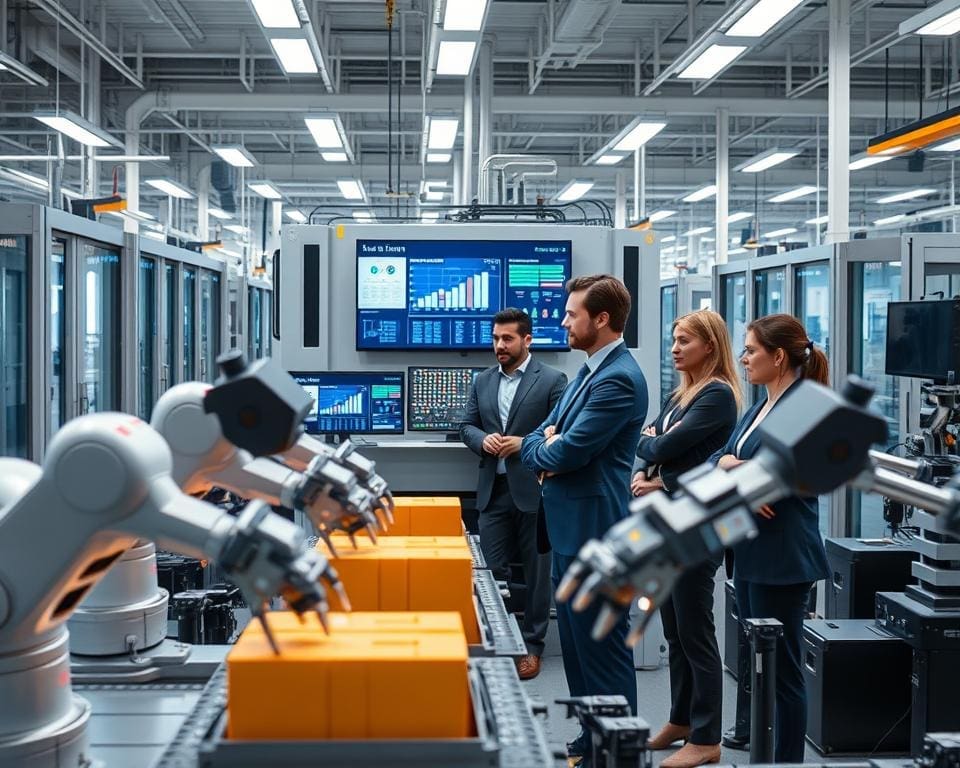
Smart manufacturing blends digital technologies, data analytics, automation and connectivity to reshape factory floors. This integration moves production away from rigid mass‑production models toward responsive, customisable and more sustainable operations.
For the UK, smart manufacturing effectiveness is a strategic priority. Programmes from the Department for Business and Trade and the Made Smarter initiative help firms adopt Industry 4.0 UK practices, fund pilots and build skills. These efforts support reshoring, raise competitiveness and help meet tighter environmental standards.
The benefits of smart manufacturing are measurable. Firms see higher overall equipment effectiveness (OEE), reduced mean time to repair (MTTR), fewer defects, quicker time‑to‑market, better energy efficiency and lower operating costs. Effectiveness combines financial return on investment with greater strategic resilience.
Successful manufacturing transformation depends on diverse stakeholders. Manufacturers, from SMEs to large OEMs, must work with technology vendors such as Siemens, Rockwell Automation and ABB, systems integrators, and research centres like the University of Cambridge Institute for Manufacturing. Policymakers play a crucial role in creating incentives and standards.
Foundations for success include leadership commitment, clear use cases, investment in digital infrastructure, workforce upskilling and robust data practices. A phased, outcomes‑driven approach reduces risk and speeds realisation of digital manufacturing advantages.
What makes smart manufacturing effective?
Smart manufacturing succeeds when technology, people and processes connect in a clear and scalable way. A strong foundation lets factories move from isolated machines to a truly connected factory that supports rapid decision making, safer operations and continual improvement.
Integrated digital infrastructure
A unified layer of connectivity must link shop-floor equipment, ERP and MES systems, cloud platforms and edge devices. OT/IT convergence and industrial protocols such as OPC UA and MQTT form common architectures for reliable data flow.
Platforms like Siemens MindSphere, PTC ThingWorx and Microsoft Azure IoT provide device management, data ingestion and app enablement, while open standards reduce the risk of vendor lock-in. Scalable networks based on industrial Ethernet and TSN deliver deterministic control and real-time monitoring.
Retrofitting legacy machines with gateways and IIoT sensors converts brownfield sites into modern sites. These steps underpin digital infrastructure manufacturing and make a connected factory feasible across varied plant estates.
Data-driven decision making
Continuous collection from machines, sensors and systems supports descriptive, diagnostic, predictive and prescriptive analytics. Historical reporting and condition monitoring remain important, but advanced models enable real-time adjustments.
Predictive maintenance models cut unplanned downtime. Process optimisation lowers energy use and scrap. Quality analytics help root-cause defects fast. Machine learning and statistical process control are common techniques in manufacturing data analytics.
Robust data pipelines, time-series storage and clear dashboarding give operators, engineers and managers role-based access to trusted information. Good labelling and consistent taxonomies increase confidence in results and speed action.
Automation and robotics
Fixed automation, collaborative robots and autonomous mobile robots boost throughput, repeatability and safety. High-volume assembly, precision welding, palletising and inspection are well suited to factory automation.
Robotics in production gains flexibility when combined with vision systems and force-sensing. That mix lets humans and robots collaborate on mixed tasks. Vendors such as Fanuc, KUKA and Universal Robots work with systems integrators to deliver turnkey solutions.
Automation frees skilled staff from repetitive tasks so they can focus on supervision, maintenance and process improvement. Effective change management and retraining ensure organisations capture the full value of robotics in production.
Key technologies powering modern production
Modern production draws strength from a handful of technologies that turn data into performance. Factories in the UK and beyond combine sensors, advanced algorithms and virtual models to cut waste, speed up launches and boost uptime. The three subsections below explain how each technology contributes to smarter, more resilient manufacturing.
Sensors such as vibration, temperature, current, pressure and optical vision capture the signals that matter. These devices feed condition monitoring systems with steady streams of asset and process data. Edge analytics can pre-process data at the machine, reducing latency and easing network loads.
Wireless sensor networks and battery-operated devices make retrofits and flexible layouts feasible on the shop floor. Regular calibration, careful placement and routine maintenance are essential to keep signals reliable and actionable.
Practical outcomes include early fault detection, energy monitoring, traceability and real-time inventory tracking. Industrial vendors and standards bodies work on interoperability so equipment from different makers can join the same IIoT ecosystem.
Artificial intelligence and machine learning
AI in factories converts raw streams into clear insight. Use-cases span anomaly detection, predictive maintenance, demand forecasting and quality inspection with computer vision. Natural language processing helps unlock value from maintenance logs and supplier notes.
Different models serve different tasks: supervised models for defect detection, unsupervised models for outlier discovery and reinforcement learning for adaptive control. The model lifecycle covers data preparation, training, validation, deployment and continuous retraining with live feedback.
Explainability and rigorous validation matter in regulated industries. When applied correctly, machine learning manufacturing can improve yield, reduce downtime and replace manual optical checks with higher consistency.
Digital twins and simulation
Digital twins are virtual replicas of equipment, production lines or whole plants that mirror real-time behaviour using live data. Teams use them to test scenarios, plan commissioning and explore capacity options without interrupting production.
Production simulation tools include discrete-event simulation, finite element analysis and process simulation. Vendors such as Siemens Simcenter and Dassault Systèmes provide suites that validate layout changes, optimise throughput and shorten commissioning time.
The digital twin benefits extend to risk reduction by trialling process changes in a virtual space, accelerating time to market and enabling immersive VR/AR training for staff.
Organisational factors that enhance effectiveness
Smart factories combine technology with people and processes. Success depends on the right skills, robust data practices and tight links across the supply chain. The paragraphs that follow outline practical steps manufacturers in the UK can take to build resilience and speed.
Skilled workforce and change management
Reskilling and upskilling are central to future-ready operations. Focus on digital literacy, data analytics, robotics programming and systems integration to sharpen manufacturing workforce skills.
Apprenticeship programmes and partnerships with universities strengthen talent pipelines. Initiatives such as the Made Smarter adoption programme and collaboration with The Manufacturing Technology Centre help firms deliver practical training.
Change management in industry 4.0 calls for visible leadership support and clear communication of benefits. Use pilot projects to win quick wins and form cross-functional teams that pair operations and IT expertise.
Retention improves when employers offer defined career pathways, continuous learning and on-the-job training. Tools like augmented reality for maintenance guidance make learning immediate and effective.
Data governance and cybersecurity
Data governance manufacturing needs a concise framework. Define data ownership, access controls, metadata standards and retention policies to meet UK GDPR and EU requirements where relevant.
High data quality and audit trails enable traceability across production. Establish standards for validation and regular reviews so decisions rest on reliable information.
Industrial cybersecurity must protect both OT and IT. Adopt network segmentation, secure remote access, patch management and endpoint protection for industrial controllers to reduce risk.
Prepare an incident response plan and perform vendor security assessments to limit third-party exposure. Follow guidance from the National Cyber Security Centre and reference IEC 62443 for technical controls.
Supply chain integration and collaboration
Digital supply chain integration boosts visibility and responsiveness. Shared data standards such as EDI and APIs enable demand sensing, inventory optimisation and coordinated production planning.
Transparency across suppliers, logistics and customers helps to dampen the bullwhip effect and improve fill rates. Real-time data supports faster decisions and reduced lead times.
Collaboration models range from vertical integration with suppliers to co-development with technology partners. Consortiums and shared testbeds accelerate innovation and lower implementation risk.
Sustainability gains flow from joint efforts to track carbon intensity. Use supplier data to target emissions reductions and meet regulatory requirements while enhancing corporate responsibility.
Measuring success and continuous improvement
Defining manufacturing KPIs starts with clear business aims. Core metrics such as Overall Equipment Effectiveness (OEE), first-pass yield, mean time between failures (MTBF), mean time to repair (MTTR), on-time delivery, inventory turns, energy consumption per unit and cost-per-unit each map directly to cost reduction, quality, delivery and sustainability goals. Establish baselines before digital projects and set short-, medium- and long-term targets that link improvements to financial value and operational resilience.
Design measurement systems that deliver real-time insight and role-based reporting. A layered architecture—edge sensors feeding central data stores with visual dashboards and automated alerts—lets teams act fast on shop-floor trends. Integration with BI tools like Power BI or Tableau helps combine operational KPIs and strategic manufacturing performance metrics for leadership review, while role-specific views keep teams focused on what matters most.
Continuous improvement Industry 4.0 relies on steady feedback loops. Use data to drive Plan-Do-Check-Act cycles, retrain predictive models and track OEE improvement over time. Start pilots on high-impact use-cases, validate outcomes, quantify ROI and build repeatable deployment templates to scale across sites. Governance is key: cross-functional review boards, standard operating procedures for safe experimentation and mechanisms for knowledge sharing keep roll-outs controlled and effective.
Long-term resilience comes from blending technology, people and process. Smart factory measurement that combines IoT-led monitoring, predictive maintenance and clear manufacturing KPIs strengthens competitiveness and environmental performance. For an example of how real-time data monitoring supports continuous improvement, see the practical case for data-led manufacturing here: data monitoring in modern manufacturing.