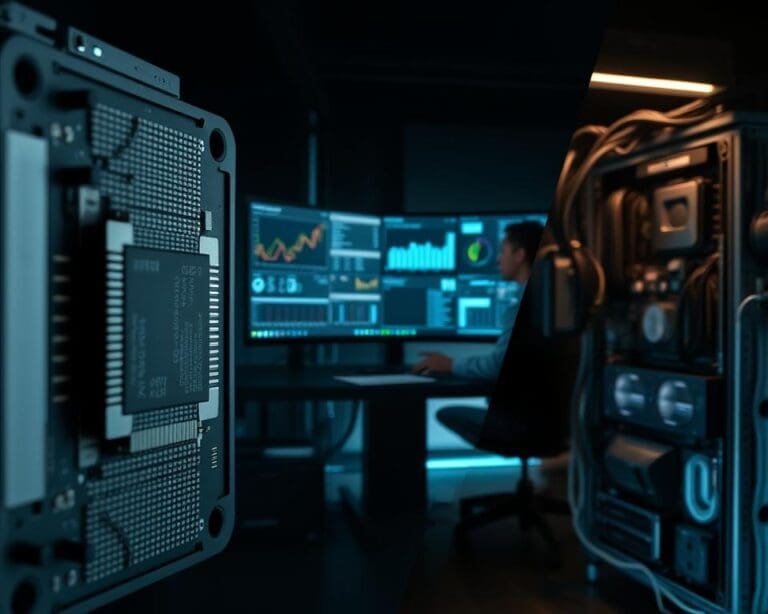

Understanding what makes high-performance hardware so powerful matters for professionals, researchers, gamers and enterprises across the United Kingdom. This high-performance hardware overview sets the stage by defining the parts that deliver modern computing muscle.
High-performance hardware means more than a fast CPU. It includes processors such as AMD EPYC, Ryzen, Intel Xeon and Core; GPUs like NVIDIA Hopper and Ada Lovelace; accelerators such as AMD Instinct, Google TPU and Intel Gaudi; high-speed memory (HBM, DDR5); NVMe SSDs; and high-bandwidth interconnects like PCIe 5.0/6.0, CXL and InfiniBand.
Performance is multi-dimensional: single-thread speed, parallel throughput, latency, I/O and sustained performance under load all matter. Energy efficiency and thermal headroom shape real-world results, while raw specs—clock speed, core counts and FLOPS—only tell part of the story. System-level harmony and cooling determine whether those numbers translate into usable power.
Market leaders illustrate these performance drivers in action. AMD and Intel set CPU benchmarks, NVIDIA and AMD push GPU throughput, and specialised accelerators redefine workloads in AI and HPC. For UK buyers and research labs, regional procurement and support ecosystems also affect choices and outcomes.
This section introduces the themes the article will explore: core components, architectural advances, thermal and power strategies, software and firmware ecosystems, and the build quality and scalability that sustain advantage over time.
What makes high-performance hardware so powerful?
High-performance systems blend raw silicon muscle with smart design. This mix creates platforms that tackle complex tasks, from AI training to real-time graphics. The following points unpack the technical elements that matter for UK organisations weighing upgrade choices.
Core components that drive raw performance
CPUs rely on core count, thread count and instructions per cycle to push single-thread and multi-thread work. Cache hierarchies — L1, L2 and L3 — and integrated memory controllers cut latency. AMD’s EPYC chiplet approach and Intel’s hybrid P‑cores and E‑cores show two paths to more efficient scaling.
GPUs deliver parallelism through thousands of CUDA or stream processors and include specialised units such as tensor cores or matrix engines for AI. NVIDIA’s Hopper and Ada Lovelace families illustrate how graphics and AI needs shape GPU design.
Accelerators can outpace general-purpose chips when workloads map to fixed pipelines. FPGAs from Xilinx/AMD Versal enable custom logic. ASICs such as Google’s TPU target machine learning training and inference with high efficiency, reflecting a shift in accelerator architecture toward domain-specific acceleration.
Memory and storage are critical. High-bandwidth memory (HBM2/3) reduces stalls for data-heavy tasks. DDR5 improves throughput for many server loads. NVMe SSDs and plenty of PCIe lanes keep I/O from becoming a bottleneck.
Interconnects tie it together. PCIe generations and emerging CXL permit coherent memory sharing. InfiniBand and Omni-Path remain central to HPC clusters where low latency and high throughput are essential.
Architectural advances and design philosophies
Chiplet and modular packaging let manufacturers scale core counts while improving yields. This brings trade-offs in inter-die latency and requires sophisticated on-die fabric to keep communications fast.
Heterogeneous computing mixes CPU, GPU and specialised accelerators in coherent platforms. That approach matches diverse workloads more efficiently and places emphasis on system-level orchestration and software.
Instruction set and microarchitecture innovations lift per-clock work. Vector extensions such as AVX2 or AVX‑512, tensor accelerators and speculative execution refinements change performance horizons and security posture.
Fabric and coherency models — mesh, ring or scalable fabric — govern how well designs scale. Memory coherence protocols determine the ease of sharing data across cores and accelerators.
Design choices reflect trade-offs: single-thread performance versus throughput, frequency versus power draw, and software complexity versus hardware specialisation. Picking the right balance matters for procurement and long‑term value.
Benchmarks and real-world workload relevance
Synthetic tests such as SPEC CPU, Cinebench, 3DMark and Geekbench isolate metrics like single-thread throughput or raw rendering speed. They remain useful for baseline comparisons but can miss sustained behaviour under load.
Application benchmarks give deeper insight. MLPerf targets AI training and inference. SPECjbb measures Java server tasks. TPC suites evaluate database throughput. These tests improve benchmark relevance when you match them to expected production loads.
Benchmarks have limits. Synthetic runs rarely reflect thermal throttling, power delivery limits or I/O-bound scenarios that affect long jobs. Real-world workload performance often differs from headline numbers.
UK organisations should select tests aligned with their use case: scientific computing, cloud services, media production or financial trading. That alignment helps interpret results and reduces risk when choosing between CPU vs GPU or when evaluating an accelerator architecture for a specific task.
Thermal management and power delivery optimised for endurance
Effective thermal management high-performance hardware changes how systems perform under long workloads. Small design choices in chassis airflow, heatsinks and datacentre layout decide whether a CPU or GPU can hold boost clocks or will throttle. Practical strategies range from multi-fan air cooling in workstations to direct-to-chip liquid systems in dense racks.
Cooling for servers must pair with environmental controls to keep efficiency high. Hot-aisle and cold-aisle containment combined with CRAC or CRAH units reduce recirculation and improve Power Usage Effectiveness. In the UK, free cooling from cooler ambient air can cut energy bills for hyperscalers and cloud providers.
Cooling solutions and their impact on sustained performance
Air cooling remains common in desktops and many servers because of simplicity and cost. Large heatsinks and high-flow fans give predictable results. Liquid cooling offers lower temperatures for demanding workloads, helping chips maintain turbo frequencies for longer. Immersion cooling delivers the strongest heat transfer and has proven useful in exascale projects and by Microsoft and Google for endurance tasks.
Design teams balance cooling for servers with operational complexity. Closed-loop AIO units suit many enterprise racks. Custom loops and rear-door heat exchangers appear where peak sustained performance matters most. Choosing the right path affects uptime and long-term throughput in AI training clusters or render farms.
Power delivery design and voltage regulation
Robust power delivery design underpins reliable performance. Multi-phase VRMs with high-quality MOSFETs and capacitors smooth transient loads and preserve boost behaviour on CPUs and GPUs. Rack-level distribution relies on PDUs, redundant PSUs and UPS systems to provide clean, continuous power.
Dynamic voltage and frequency scaling lets firmware and silicon adjust power use on the fly. Examples include Intel SpeedStep and AMD Precision Boost, which trade clock speed and voltage for efficiency. Clear limits such as TDP, PL1/PL2 and PPT define the line between short-term peaks and sustained throughput.
Efficiency metrics and cooling trade-offs
Measure choices with metrics that matter: PUE at the datacentre level, performance-per-watt for compute, and energy-to-solution for scientific runs. Higher clock speeds raise power draw and heat. Aggressive cooling reduces throttling but adds cost and complexity.
Procurement should consider total cost of ownership, including cooling infrastructure and long-term energy. Case studies show that careful pairing of cooling for servers and thoughtful power delivery design boosts sustained performance cooling and delivers better throughput per pound spent. Learn how next-generation boards and hybrid core architectures contribute by visiting unleashing potential with Intel innovations.
Software, firmware and ecosystem that amplify hardware capability
Hardware reaches its potential when the software and firmware around it are finely tuned. Careful firmware optimisation and regular microcode updates from Intel and AMD can unlock higher boost states, patch security flaws and improve stability. Enterprise deployments gain measurable benefit when vendors such as Dell EMC, HPE and Lenovo provide certified stacks that combine firmware, drivers and validated configurations for predictable results.
Drivers, microcode and firmware tuning
GPU drivers from NVIDIA and AMD expose capabilities like CUDA, cuDNN and ROCm. Driver tuning alters performance for compute and rendering workloads, sometimes changing throughput between releases. Storage controller firmware and accelerator microcode refine I/O paths and latency, which is vital for databases and virtualised environments. For UK organisations, certified hardware-software combinations and vendor support reduce risk during rollouts.
Compiler and application-level optimisation
Compilers such as GCC, Clang and Intel oneAPI generate vectorised code that uses AVX or SVE instructions. Compiler optimisation and tuned libraries—Intel MKL, NVIDIA cuBLAS, AMD MIOpen—give big wins in numerical workloads and machine learning. Application tuning for NUMA-aware scheduling, thread affinity and memory placement often raises real-world throughput more than raw clock speed changes.
Platform ecosystem: compatibility, tooling and support
A mature platform ecosystem high-performance hardware needs monitoring, orchestration and vendor backing. Tools like Prometheus, Grafana and NVIDIA DCGM provide observability, while Kubernetes device plugins enable scalable deployment. Good tooling and support, plus long-term update cadences and clear vendor roadmaps, make upgrades and compliance simpler for enterprises concerned about supply chain and data sovereignty.
Small changes in driver tuning, compiler optimisation and firmware optimisation add up. When organisations treat hardware, software and ecosystem as a single system, performance multiplies and resilience improves.
Build quality, scalability and future-proofing for sustained advantage
High build quality in high-performance hardware starts with enterprise-grade components. Server-grade motherboards, ECC memory from Samsung or Micron and enterprise SSDs from Samsung, Western Digital or Intel reduce error rates and extend hardware longevity. Mechanical design matters too; chassis airflow, vibration resistance and industrial-grade fans or pumps cut failure rates and protect connectors over time.
Scalability future-proofing relies on modular choices that let infrastructure grow without full replacement. Blade servers, disaggregated architectures and emerging standards such as CXL enable flexible memory pooling and improve upgradeability. Networking plans should include headroom for 100GbE or 200/400GbE fabrics so clusters can expand with minimal rework.
Software and vendor strategy make the hardware pay off. Stateless application design, containerisation and orchestration let teams leverage new capacity without rewriting code. Prefer vendors who commit to open standards like PCIe and CXL and provide open-source drivers; this reduces lock-in and eases integration of accelerators and future memory standards.
For sustained advantage, align total cost of ownership with lifecycle management. Factor in warranties, extended support and facility costs such as power and cooling. Perform workload profiling and proof-of-concept testing with suppliers to confirm expected gains. For further insight into how engineering practice supports these choices, see this practical guide on hardware careers and industry approaches: hardware engineering careers.