
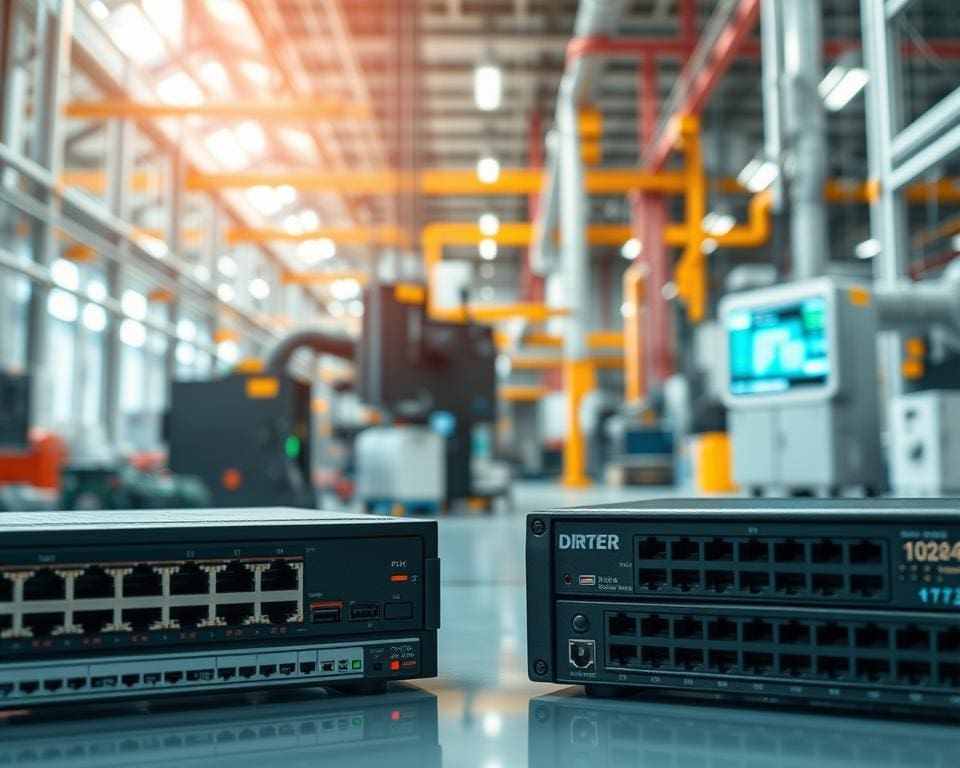
This article reviews what hardware supports industrial communication for professionals across the United Kingdom. It defines industrial communication as the exchange of control, monitoring and telemetry data between controllers, I/O, HMIs, SCADA, edge devices and enterprise systems.
Industrial communication hardware must meet deterministic and real‑time needs in manufacturing, process plants, logistics and utilities. Readers will see how industrial automation hardware delivers low latency, predictable timing and robust signal integrity to maintain production and safety targets.
The product‑review format compares major device classes: Ethernet switches and routers, programmable logic controllers (PLCs), industrial wireless access points and gateways, fieldbus and serial devices, I/O modules and sensors, network security appliances, and edge computers and protocol gateways. Expect commentary on ruggedness, redundancy and latency, plus common vendors and standards relevant to OT communication devices.
Special attention is given to industrial networking UK—regulation, Industry 4.0 uptake and widespread legacy systems in British plants. The aim is to help maintenance engineers, automation managers and IT/OT integrators choose reliable, maintainable industrial communication hardware that supports uptime and compliance goals.
What hardware supports industrial communication?
Industrial plants depend on layered hardware to keep control systems running and data flowing. Clear roles for each device help engineers plan resilient networks that meet production goals and maintain uptime in automation.
Overview of hardware roles in industrial networks
At the centre of a plant network are core routers and high‑capacity switches that form the backbone. Distribution switches aggregate traffic from production lines. Access devices link PLCs, HMIs, sensors and actuators to the network.
Specialist equipment fills essential roles. Programmable Logic Controllers act as control and local communication hubs. Industrial gateways translate protocols such as Modbus to EtherNet/IP. Edge computers provide local analytics and buffering. Firewalls and VPN appliances protect the OT/IT boundary and support secure remote access.
Integration with SCADA, historians and MES occurs via OPC UA, MQTT and established protocols. Thoughtful placement of these elements clarifies industrial network roles and simplifies troubleshooting.
How hardware selection affects reliability and uptime
Choosing appropriate devices can raise mean time between failures and reduce repair times. Metrics like MTBF and MTTR, plus certifications and IP ratings, are central to hardware selection industrial reliability.
Environmental factors decide if IT gear will survive on the shop floor. Temperature ranges, vibration tolerance, EMI shielding and conformal coating are practical criteria. Industrial‑grade hardware often outperforms standard equipment under these stresses.
Maintainability improves service continuity. Hot‑swappable modules, redundant power supplies and remote management via SNMP or serial console speed recovery. Availability of spare parts and manufacturer support in the UK market also affects uptime in automation.
Key performance indicators to consider for hardware
Latency and jitter determine suitability for real‑time control loops. Throughput and packets per second capacity matter when systems exchange large volumes of data. Port density and PoE support influence field device deployment. These are core KPI network hardware measurements.
Reliability KPIs include MTBF, percentage availability and failover times for redundancy schemes such as PRP, HSR or RSTP. Security KPIs cover support for IPsec tunnels, strong authentication and patching cadence. Power consumption and physical footprint are important for panel or DIN‑rail installations.
Monitoring these indicators provides a clear view of industrial communication performance. That visibility guides procurement and keeps production targets within reach.
Industrial Ethernet switches and routers for automation
Choosing the right hardware turns an automated plant into a resilient, efficient system. Industrial Ethernet switches and industrial routers form the backbone of control networks. They steer traffic, enforce security, and keep PLCs and HMIs talking without interruption.
Managed vs unmanaged switches: when to use each
Unmanaged switches suit simple segments where plug-and-play and low cost matter most. Use them for test benches, temporary setups or non-critical aggregation points.
Managed vs unmanaged switches becomes a critical decision in production zones. Managed switches deliver VLANs, QoS, IGMP snooping, SNMP monitoring and remote configuration. These functions allow deterministic traffic control and secure segmentation needed for modern control systems.
Brands commonly deployed across UK sites include Cisco Industrial Ethernet, Rockwell Automation (Allen‑Bradley Stratix), Hirschmann (Belden), Moxa and Westermo. Choose managed devices where uptime and visibility are priorities.
Ruggedised designs for harsh environments
Ruggedised network devices are engineered for extremes. Expect wide operating ranges from −40°C to +75°C, conformal coating, DIN‑rail mounting and shock and vibration ratings to IEC 60068.
Look for IP‑rated enclosures from IP20 to IP67, surge protection, wide DC input ranges and redundant power inputs. Galvanic isolation helps where electrical noise is present. Hardened switches with extended temperature ranges and IP65 housings provide examples of capability without naming specific models.
Redundancy protocols and high-availability features
Redundancy protocols PRP HSR RSTP are essential for critical control networks. RSTP and classic STP prevent loops and offer rapid convergence when topology changes. PRP and HSR enable seamless, zero‑loss failover for time‑sensitive traffic.
Other options include Media Redundancy Protocol and ring topologies for fast recovery. Industrial routers complement switches by offering static routing, OSPF or BGP where required, VPN termination, NAT and QoS classification to prioritise control packets.
Never assume vendor specs meet your SLA. Test failover times on site and verify devices support deterministic failover requirements for control systems.
Programmable Logic Controllers (PLCs) as communication hubs
PLCs form the backbone of modern factory networks. They bridge field devices, supervisory systems and cloud platforms while handling real‑time control. Choosing the right hardware and architecture helps teams meet uptime targets and enables future expansion.
Contemporary PLCs offer a mix of Ethernet and serial interfaces to connect diverse equipment. Typical protocols include Ethernet/IP, PROFINET, Modbus TCP/RTU, OPC UA and CANopen. Many manufacturers add multiple Ethernet ports for ring topologies and RS‑232/RS‑485 serial ports for legacy devices.
Embedded web servers, MQTT clients and OPC UA Pub/Sub features are now common. These functions expand IIoT reach while preserving deterministic control. Leading lines found across industrial controllers UK include Siemens SIMATIC S7, Schneider Electric Modicon, Rockwell Automation CompactLogix and Mitsubishi MELSEC.
Expansion modules and remote I/O integration
Modular I/O racks and remote I/O PLC systems let engineers place inputs and outputs close to sensors and actuators. This reduces cabling costs and simplifies maintenance. Field networks such as EtherNet/IP, PROFINET and Modbus enable distributed I/O across a plant.
Hot‑swappable digital, analogue and motion modules speed repairs and cut downtime. Communication modules and safety I/O integrate into the same rack. Gateways and I/O concentrators help fold fieldbus nodes and serial devices into a unified control topology.
Scalability considerations for different plant sizes
Smaller sites often run compact PLCs with built‑in I/O. Larger facilities favour modular racks, multiple controllers and hierarchical control layers to handle complexity. Designing with scalable PLC systems in mind reduces rework as capacity grows.
Critical plants may use redundant CPUs or hot‑standby controllers to protect production. Centralised programming tools and lifecycle management simplify multi‑site deployments and keep maintenance consistent across industrial controllers UK.
Industrial wireless hardware: access points and gateways
Industrial sites demand resilient wireless design that blends performance with ruggedness. Choosing between industrial wireless access points and compact wireless gateways shapes how devices, sensors and operators connect. Brands such as Cisco Industrial Wireless, HPE Aruba, Siemens Scalance Wireless, Moxa and Pepperl+Fuchs lead with proven hardware for heavy industry and process plants.
Wi‑Fi industrial gives high throughput for operator tablets, CCTV and mobile HMIs. Use 802.11ac or 802.11ax APs where bandwidth matters. Industrial Bluetooth such as BLE fits asset tracking, beacons and low‑power sensors that need short‑range connectivity.
LoRaWAN and proprietary standards like ISA100.11a and WirelessHART serve wide‑area telemetry and deterministic sensor meshes. These options suit process instrumentation that requires low latency and predictable delivery.
Carry out a site survey industrial wireless before deployment. Professional RF surveys produce heatmaps, spectrum analysis and interference detection that reveal metal reflections and dead zones. Good surveys inform antenna selection, channel allocation and client capacity planning.
Choose antennas to match use cases: omnidirectional for broad coverage, directional for point‑to‑point links and sector or diversity antennas to reduce multipath. Mount APs at correct heights, keep clear line‑of‑sight and protect units in washdown or hazardous zones to sustain reliability.
Design for interference sources common in factories: motors, VFDs, microwave ovens and neighbouring Wi‑Fi. Tackle problems with careful channel planning, AP density, MIMO and shielding. Continuous spectrum monitoring helps spot rising interference before it affects control loops.
Enforce wireless security OT with WPA3 or WPA2 Enterprise, 802.1X authentication and certificate management. Segment wireless networks from control networks and apply role‑based access to limit exposure. Industrial wireless gateways can provide edge filtering and secure tunnelling to central controllers.
Plan redundancy and capacity from the outset. Balance access point placement with gateway throughput and backhaul needs. A pragmatic mix of Wi‑Fi industrial, industrial Bluetooth and deterministic wireless ensures scalable, secure connectivity across the plant.
Fieldbus and serial interface devices
Many UK sites still rely on robust serial and fieldbus systems to connect sensors, drives and instrumentation. Practical fieldbus hardware keeps production steady where replacement would be costly. This section outlines common networks, the supporting devices and sensible migration paths.
Common fieldbus hardware: PROFIBUS, Modbus, CANopen
PROFIBUS devices remain common in European plants for deterministic device-level control. Siemens offers a broad range of modules and couplers that integrate fieldbus masters and slaves with process instrumentation. For straightforward serial links, Modbus RTU hardware gives reliable, low-cost connectivity for meters and simple I/O.
CANopen nodes are popular in motion control and embedded device networks where fast, local messaging matters. Pepperl+Fuchs and Phoenix Contact supply fieldbus couplers and DP/PA segment couplers to bridge device-level buses with control systems. HMS/Anybus gateways provide bidirectional conversion when different buses must interoperate.
Serial converters, repeaters and isolators
Serial converters industrial models translate RS-232 or RS-485 devices to Ethernet for modern controllers. Serial-to-Ethernet gateways permit tunnelling of legacy instruments into SCADA systems without major rewiring.
Repeaters and line drivers extend bus length and preserve timing across long runs. Galvanic isolators and fibre converters mitigate ground-loop and surge risks, protecting sensitive units from transient faults. Proper termination, correct biasing for RS-485 and matching characteristic impedance are essential to avoid reflections and data loss.
When to use fieldbus over Ethernet in legacy systems
Retain fieldbus where a large installed base of sensors and actuators exists and replacement cost would disrupt production. Many sites favour keeping PROFIBUS devices or Modbus RTU hardware when deterministic timing and proven reliability are priorities.
Plan phased migration with gateways, remote I/O modules and edge devices. Use CANopen nodes or other fieldbus islands behind protocol gateways to the Ethernet backbone. Bridge to OPC UA or MQTT gradually so modern systems coexist with legacy assets while the plant modernises.
Industrial I/O modules and sensor connectivity
Reliable data begins at the sensor and moves through robust industrial I/O modules into control and analytics layers. Choose modules that match the measurement type, sampling need and environmental demands of UK sites. Clear sensor connectivity rules and good wiring practice cut faults and speed commissioning.
Digital I/O handles discrete on/off signals for switches, relays and simple status inputs. Analogue I/O captures continuous process variables such as 4–20 mA and 0–10 V. Match resolution (bits) and sampling rates to the task: tight control loops need higher sampling and resolution than periodic process monitoring.
Select modules based on accuracy, isolation and input filtering. Provide excitation for transducers, RTDs and thermocouples when required. Consider manufacturers such as Beckhoff, National Instruments, Siemens, Schneider Electric and Phoenix Contact for systems widely supported across UK industry.
Condition monitoring sensors and edge devices
Vibration sensors, accelerometers, ultrasonic sensors, temperature loggers and current clamps deliver early fault signals for preventative maintenance. Condition monitoring sensors must be mounted and calibrated to manufacturer guidance for reliable results.
Edge devices and IIoT gateways collect sensor telemetry, run local analytics like FFT and anomaly detection, then forward events via MQTT, OPC UA or REST APIs to MES and cloud platforms. Integrate outputs with CMMS to turn alerts into scheduled maintenance tasks.
Wiring standards, termination and surge protection
Use screened twisted pair for analogue signals and observe correct earthing practices to reduce noise. Follow BS EN wiring codes where applicable and document cable routes for maintainability. Label cables and keep as-built schematics up to date.
- Place termination resistors correctly for RS‑485 networks.
- Use proper cable glands and IP-rated conduits to protect sensors.
- Install surge protection industrial wiring devices to guard against lightning strikes and switching transients.
Routine inspections ensure connectors remain tight and protective measures stay effective. Good sensor connectivity, paired with well-chosen industrial I/O modules, keeps plants resilient and ready for digital diagnostics.
Network security and industrial firewall appliances
Industrial sites require practical, resilient defences that protect controllers, sensors and engineering systems. Choosing the right mix of hardware and software shapes OT network security and keeps production running under attack or fault conditions.
Hardware firewalls differ from server-based software protections in ways that matter to control engineers. Dedicated industrial firewall appliances are ruggedised for plant floors, offer deterministic throughput and deep packet inspection tuned for Modbus, PROFINET and other OT protocols. They often support fail-open or fail-closed modes, high-availability clustering and application whitelisting to reduce risk while preserving real‑time behaviour.
Software firewalls on general servers can be useful for non‑critical systems and lab environments. For production networks, physical appliances simplify deployment in control racks and deliver predictable performance. When comparing options, look for intrusion prevention systems, protocol-aware inspection and support from vendors such as Fortinet, Cisco and Palo Alto Networks, alongside specialist names like Claroty and Nozomi Networks.
Hardware firewalls vs software-based protections
Inspect features that matter to OT teams: deterministic latency, DPI for industrial protocols, HA clustering and clear fail states. Appliances reduce configuration drift. Software protections complement appliances by adding host‑level controls and endpoint detection.
Secure remote access gateways and VPN appliances
Remote vendor access must be controlled to meet UK guidance for critical infrastructure. Use secure remote access industrial gateways and VPN appliances industrial to avoid exposing controllers directly to the internet. Look for support for IPsec and TLS VPNs, clientless portals and integration with PAM systems for just‑in‑time privilege.
Session logging, audit trails and optional session capture answer compliance needs. Bastion hosts and jump servers should enforce strong MFA and role‑based access so service engineers access only what they need for a limited time.
Segmentation hardware and DMZ approaches for OT networks
Network segmentation OT reduces attack surfaces by zoning IT and OT domains. Use industrial switches with VLANs, ACLs and firewalls to enforce least privilege between zones. Place historians and engineering workstations in a DMZ to control bidirectional flows and limit lateral movement.
Design segmentation in line with IEC 62443. Confirm that segmentation hardware can pass required industrial protocols and perform inspection without breaking real‑time constraints. Small, layered changes to segmentation yield big gains in resilience.
For a short comparison of VPNs and firewalls in practice, review this guide: VPN vs Firewall: Which Offers Better Security
Edge computers and industrial gateways for protocol translation
Edge computers industrial and IIoT gateways sit at the boundary between the plant floor and the enterprise cloud. These rugged, often fanless units perform local aggregation, filtering and edge analytics to reduce downstream load. Devices from Siemens Industrial Edge, Advantech, HPE Edgeline, Dell EMC, Moxa and HMS/Anybus are common in UK deployments and show how industrial edge devices can handle protocol translation OPC UA MQTT while working in harsh environments.
Protocol gateways are the workhorses that bridge field protocols such as Modbus RTU, PROFIBUS and CANopen to IT protocols like OPC UA, MQTT and HTTP/REST. When choosing IIoT gateways consider CPU performance, serial and Ethernet I/O, storage and OS support for real‑time Linux or Windows IoT. Containerisation support for analytics, secure boot, TPM and encryption for data at rest and in transit are key for secure operation.
Placement and resilience matter. Fit gateways and industrial edge devices close to sensors to cut latency and cable runs, protect them in suitable enclosures and plan UPS or DC backup. Ensure devices support native OPC UA server/client, MQTT broker or client and REST APIs so protocol translation OPC UA MQTT runs with low latency and high interoperability.
Begin with a proof‑of‑concept to validate throughput, latency and integration with SCADA or MES before wider roll‑out. A phased modernisation, using edge computers industrial to bridge legacy fieldbus islands, aids predictive maintenance and simplifies migration to IIoT platforms. Confirm ongoing vendor support and spare‑parts availability in the UK to keep operations resilient and future‑proof.