
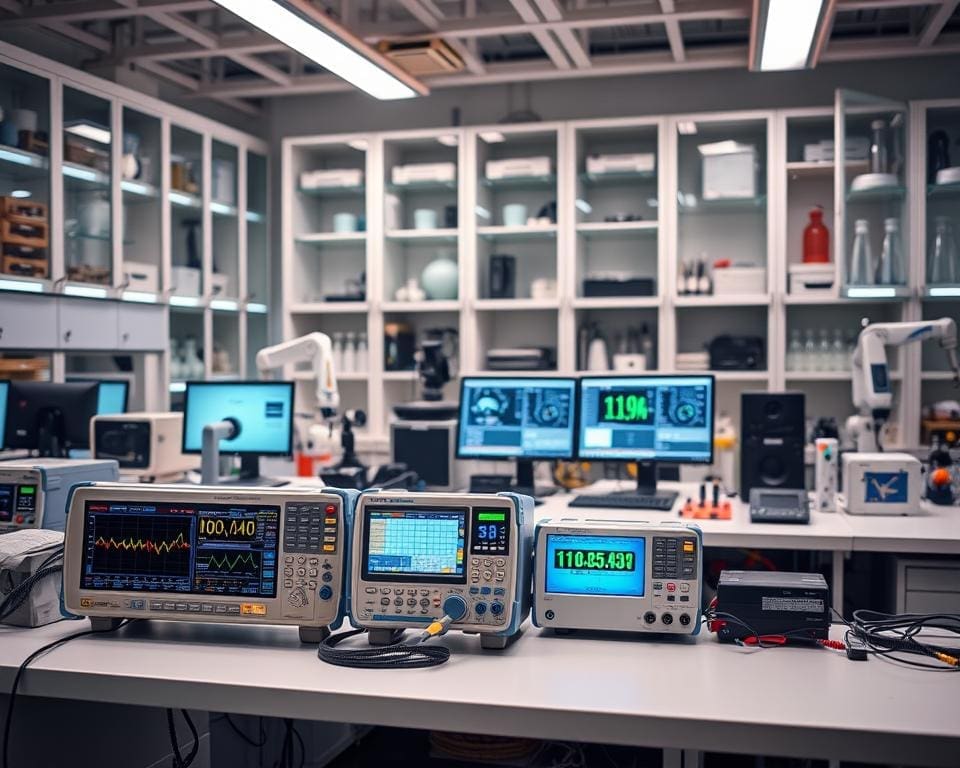
This article opens a product-style lab equipment review that maps the principal testing lab hardware found in modern UK and international facilities. It frames testing labs as places where test instruments and electronics test gear validate design intent, ensure regulatory conformity and reduce risk before product launch.
Selection of test instruments is driven by market rules and accreditation. CE/UKCA marking, ISO 17025 for calibration, the Medical Device Regulation and automotive standards such as UNECE and ISO 26262 all shape procurement. At the same time, physical instrumentation increasingly blends with software and cloud analytics to extend capability.
The piece covers core lab categories: electronics and PCB labs, software and network test centres, automotive and autonomous systems facilities, and medical and life‑science laboratories. Many centres are multidisciplinary, so cross‑compatible lab equipment review and interoperable network test hardware are essential.
Our review tone is practical and comparative. We assess devices by function, typical brands like Tektronix, Keysight, Rohde & Schwarz, National Instruments, Fluke, Cisco, Juniper, Anritsu, Bosch, AVL and Siemens Healthineers, performance metrics and total cost of ownership. The goal is to guide UK enterprises, R&D teams and university labs when choosing, maintaining and optimising automotive test equipment, medical testing devices and the wider suite of testing lab hardware.
What hardware is used in testing labs?
Testing labs rely on a clear set of equipment to deliver repeatable, verifiable results. This short guide outlines the main groups of instruments, how choice shifts by sector, and the metrics engineers use when they evaluate gear. Use of core test instruments and well-defined lab hardware categories helps teams scale tests and automate workflows.
Overview of core testing hardware
Core test instruments include measurement and analysis devices such as oscilloscopes from Tektronix and Keysight, spectrum analysers by Rohde & Schwarz, and handheld meters from Fluke. Environmental and mechanical rigs cover climatic chambers and vibration tables from Bosch and AVL. Data capture and control systems come from National Instruments and dSPACE. Network and compute infrastructure uses test servers, racks and switches for virtualised testbeds.
Lab hardware categories break down by form factor and interface. Modular benchtop units suit R&D benches. Rack-mount systems serve high-density test labs. Standard interfaces like SCPI, LXI, USB, GPIB and Ethernet ease automation and scripting with tools such as NI VeriStand.
How hardware choice varies by industry
Electronics and PCB work demands high-bandwidth oscilloscopes, precision multimeters and LCR meters. Production lines use automated test equipment and rework stations to maintain yields. Brands such as Keysight and Tektronix dominate in signal analysis.
Software, systems and network testing leans on dense test servers, virtualisation appliances and traffic generators. Vendors such as Spirent and Keysight (IXIA) supply traffic and load-testing appliances. Throughput and latency are primary concerns for these setups.
Automotive and autonomous testing requires HIL simulators, rugged DAQ and sensor emulators. dSPACE and National Instruments provide real‑time controllers and data acquisition platforms. Chassis dynamometers and ADAS imaging rigs test real-world behaviours under controlled conditions.
Medical and life‑science testing uses clinical analysers, biomedical imaging test equipment and cleanroom-compatible instruments from Siemens Healthineers, Roche and Thermo Fisher. Traceability, certification and contamination control shape procurement and lab layout.
Key performance metrics to evaluate lab hardware
Accuracy, precision and resolution determine whether measurement gear meets test needs. For oscilloscopes that means bandwidth and sample rate. For multimeters it means ppm or digit count. Choose instruments that match the required measurement envelope.
Throughput and latency matter for network appliances, load testers and HIL systems. Consider how many transactions per second a platform can sustain and the end-to-end delay under load.
Environmental tolerance, reliability and calibration intervals affect uptime and cost. Review MTBF figures and service options. Confirm calibration to NPL or UKAS standards when traceability is required.
Interoperability and automation capability reduce test cycle time. Check APIs, drivers and protocol support before purchase. Hardware selection criteria should weigh integration ease alongside performance.
Total cost of ownership covers acquisition, consumables, calibration and service contracts. Include bench space and power needs in any comparison. Lab performance metrics must be balanced against long-term operational costs to make a sound procurement decision.
Essential instrumentation for electronics and PCB testing
Testing electronics and PCBs demands a blend of precision instruments and rugged bench tools. Choose gear that matches your design complexity, production volume and certification goals. Clear workflows and traceable measurements help deliver reliable products to market.
Oscilloscopes and their role in signal analysis
Oscilloscopes capture voltage versus time to reveal signal shape, jitter and timing faults. Engineers use scopes to debug digital buses, validate high‑speed links such as PCIe and USB, and inspect analogue behaviour under load.
Key specifications include bandwidth, sample rate, analog channels and memory depth. Built‑in decoding for I2C, SPI and CAN speeds troubleshooting. Leading instruments from Tektronix, Keysight and Rohde & Schwarz span benchtop to lab‑grade suites, which feature remote control via SCPI and LXI for automated regression. For buyers comparing models, an oscilloscopes review that lists bandwidth and sample rate against cost is useful.
Multimeters, LCR meters and precision measurement tools
Multimeters remain the workhorses for voltage, current and resistance checks. LCR meters extend capabilities to capacitance and inductance. Precision DMMs and SMUs support calibration labs where traceability matters.
Look for resolution down to nV and nA, accuracy expressed in ppm, stable auto‑ranging and solid input impedance. Fluke, Keysight, Rohde & Schwarz, Hioki and Keithley provide instruments across price tiers. Emphasise multimeter precision when specifying test plans, and ensure UKAS calibration where legal or contractual traceability is required.
Spectrum analysers and RF testing equipment
Spectrum analysers reveal frequency content, harmonics and spurious emissions. Use them for RFI checks, RF front‑end characterisation and pre‑compliance EMC testing. VNAs complement analysers for S‑parameter work on antennas and filters.
Evaluate frequency range, DANL, phase noise and dynamic range. Rohde & Schwarz, Keysight and Anritsu offer options for bench and field use. For procurement in Britain, quotes that reference spectrum analyser UK availability and accessory kits such as attenuators, directional couplers and calibration sets speed setup. Anechoic chambers and antenna test ranges support full RF validation.
Environmental chambers for thermal and humidity stress testing
Environmental chambers reproduce temperature cycles, thermal shock and humidity to assess reliability. Burn‑in, climatic testing and automotive climate cycles expose latent failures before products ship.
Chamber types include benchtop units, walk‑in rooms and thermal shock systems. Compliance with IEC 60068 and automotive test methods guides profiles. Weiss Technik, Thermotron and ESPEC supply chambers with power feedthroughs and robust data logging. Plan wiring, fixture design and monitoring to integrate environmental stress testing into your PCB test equipment suite.
Hardware for software, systems and network testing
A purpose-built test lab blends compute, networking and specialised appliances to mirror production environments. Engineers rely on consistent hardware to reproduce bugs, validate deployments and run continuous integration pipelines. The right mix speeds debugging, reduces risk and supports repeatable results.
Test servers, racks and virtualisation appliances
Test servers for QA form the backbone of system validation. Blade servers, GPU systems from NVIDIA and dense rack nodes from Dell EMC, HPE and Lenovo enable workloads from CI builds to AI inference. Use of rack mount test equipment keeps cabling tidy and simplifies power and cooling planning.
Virtualisation appliances such as those running VMware ESXi, Proxmox or Microsoft Hyper‑V pair with container platforms like Kubernetes to host reproducible environments. Remote management tools like iDRAC and iLO help teams manage power, BIOS and firmware without visiting the lab.
Network switches, routers and traffic generators
Network hardware must emulate real topologies and failure modes. Enterprise switches and routers from Cisco, Juniper and Arista support realistic routing, QoS and SDN experiments. Programmable switches give test teams fine control over forwarding behaviour.
A network traffic generator is essential to stress and measure link behaviour. Tools from Spirent and Keysight create packet streams that reveal throughput limits, latency spikes and jitter. Metrics such as pps, concurrent sessions and latency distribution guide tuning and capacity planning.
Load testing hardware and dedicated appliance considerations
Load testing hardware simulates thousands of users with minimal host overhead. Dedicated appliances or clustered VMs generate realistic HTTP/2, TLS and WebSocket traffic to probe application stacks. Hardware-accelerated testers deliver deterministic results where timing matters.
Decide between on-premise appliances and cloud-based scale by weighing reproducibility against cost. Appliances offer repeatable, low-jitter testing ideal for telecoms and edge stacks. Cloud platforms such as AWS and Azure provide breadth and geographic distribution when peak scale is the priority.
- Consider noise, cooling and PDUs when placing rack mount test equipment.
- Segment lab networks to protect shared CI systems and ensure isolation.
- Automate provisioning with Jenkins or GitLab CI and orchestrate hardware via APIs.
Automotive and autonomous systems test hardware
Testing modern vehicles and autonomous systems demands a blend of precision, speed and reproducibility. Labs in the United Kingdom now pair advanced simulation with physical test rigs to validate software and hardware across the development cycle. That mix ensures ECU code, perception stacks and safety systems meet regulatory and performance targets.
Hardware-in-the-loop setups let engineers exercise control units without a complete vehicle. Real‑time controllers, FPGA acceleration and deterministic timing reproduce CAN, LIN, FlexRay and Automotive Ethernet traffic. Top vendors such as dSPACE, OPAL‑RT and National Instruments are common in HIL labs, while firms in the HIL simulators UK market tailor solutions to local test protocols and delivery timetables.
Realistic sensor feeds are critical. A robust sensor emulator supplies synthetic GPS, radar and camera inputs so perception and navigation stacks face lifelike stimuli. Camera rigs, lidar simulators and RF signal generators help create repeatable scenarios for ADAS validation. These methods reduce road testing while improving fault injection and edge‑case coverage.
Data capture must scale with modern vehicles. DAQ systems for automotive span compact modules for prototype benches to rack systems handling thousands of channels. National Instruments DAQmx, Dewetron and HBM hardware serve many test houses, while Bosch and Vector Informatik supply vehicle‑specific loggers. Precise timestamping via IEEE 1588 or GPS keeps multi‑sensor records in sync.
Safety verification relies on physical rigs and measurement suites. Sled rigs, crash barriers and high‑speed cameras combine with strain gauges, accelerometers and load cells to record transient loads. Accredited test labs follow EN and ISO procedures and Euro NCAP protocols when deploying crash test instrumentation for certification workflows.
- HIL and real‑time controllers: microsecond latency, model co‑simulation and deterministic I/O.
- DAQ and logging: high bandwidth, channel density and PTP/GPS synchronisation.
- Perception test hardware: sensor emulator rigs for camera, lidar and radar sources.
- Physical safety rigs: sled tests, dummy instrumentation and photogrammetry for deformation analysis.
Choosing the right combination of ADAS test hardware and measurement systems lets teams iterate faster and validate complex behaviours early. That approach lowers risk, tightens development cycles and prepares systems for the stringent demands of certification and public roads.
Medical and life‑science testing hardware
Medical and life‑science labs rely on a mix of precision instruments and robust processes to deliver reliable results. This short guide highlights the hardware that supports diagnostic accuracy, imaging quality and contamination control in the United Kingdom.
Clinical analysers power high‑throughput diagnostics. Automated chemistry analysers, haematology counters, PCR machines and ELISA plate readers from Siemens Healthineers, Roche Diagnostics and Abbott form the backbone of many hospital and private labs. These instruments shape reagent workflows, throughput planning and vendor service contracts for clinical analysers UK.
Mass spectrometers and dedicated imaging accessories support specialised assays. Biomedical imaging test gear such as MRI phantoms and CT calibration kits help teams validate spatial resolution, contrast and repeatability for routine quality assurance. GE Healthcare and Thermo Fisher Scientific supply much of this imaging hardware to life‑science teams.
Calibration equipment and standards
Traceable calibration is essential for regulatory compliance and patient safety. Calibration traceability UKAS ties measurements to national standards from NPL and underpins audit readiness for MHRA inspections and ISO 13485 reporting.
Common calibration tools include reference meters, voltage and current calibrators, temperature and humidity standards, optical calibration kits and mass/volume standards. Laboratories keep calibration certificates, uncertainty budgets and scheduled intervals to maintain confidence in results.
Cleanroom compatibility and contamination control
Cleanroom testing instruments and contamination control hardware preserve sample integrity. HEPA and ULPA filtration, laminar flow hoods and Class II/III biosafety cabinets reduce airborne risk. Particle counters and surface contamination monitors verify environmental performance.
Design matters for durability under frequent decontamination. Stainless steel surfaces and anti‑microbial finishes help instruments withstand cleaning agents. Suppliers such as Esco, Thermo Fisher and Ecolab provide validated solutions and consumables that align with gowning protocols.
The right investment in life‑science lab hardware, matched with robust calibration traceability UKAS and strict cleanroom testing instruments, transforms laboratory capability. Careful selection improves diagnostic sensitivity, imaging repeatability and long‑term operational resilience.
Selecting, maintaining and optimising lab hardware
Start by defining test objectives clearly: prototype R&D, production ATE, compliance testing or diagnostic work. When selecting lab equipment, match throughput, accuracy and regulatory needs to device specifications. Consider modular platforms such as PXI or LXI for scalability, and weigh capital expenditure against operational costs; refurbished, UKAS‑calibrated instruments can reduce total cost of ownership while meeting quality demands.
Evaluate vendors for local service presence in the United Kingdom, spare parts availability and software roadmaps. Build a calibration schedule and asset register using a CMMS or tagged inventory with QR or RFID. Robust lab hardware maintenance includes preventive checks, UKAS‑traceable calibration intervals and documented audit trails to demonstrate compliance and extend instrument lifecycle.
Protect uptime with service contracts that offer on‑site support, hot‑swap spares and extended warranties for critical instruments. Ensure environmental controls — stable power supplies, UPS and surge protection, ventilation, humidity control and vibration isolation — to reduce failures and help optimise test lab performance. Safety and compliance remain essential: confirm CE/UKCA marking and train staff in safe handling and emergency protocols.
Automate with common control frameworks such as SCPI, IVI, LabVIEW or Python pyvisa and centralise data in a LIMS or analytics platform for time‑synchronised captures. Future‑proof by choosing software‑defined instruments with remote diagnostics and cloud integration, and plan for end‑of‑life replacement. Use a final procurement checklist to verify interoperability, UK service support, calibration status and the long‑term costs of consumables and calibration to preserve instrument lifecycle.