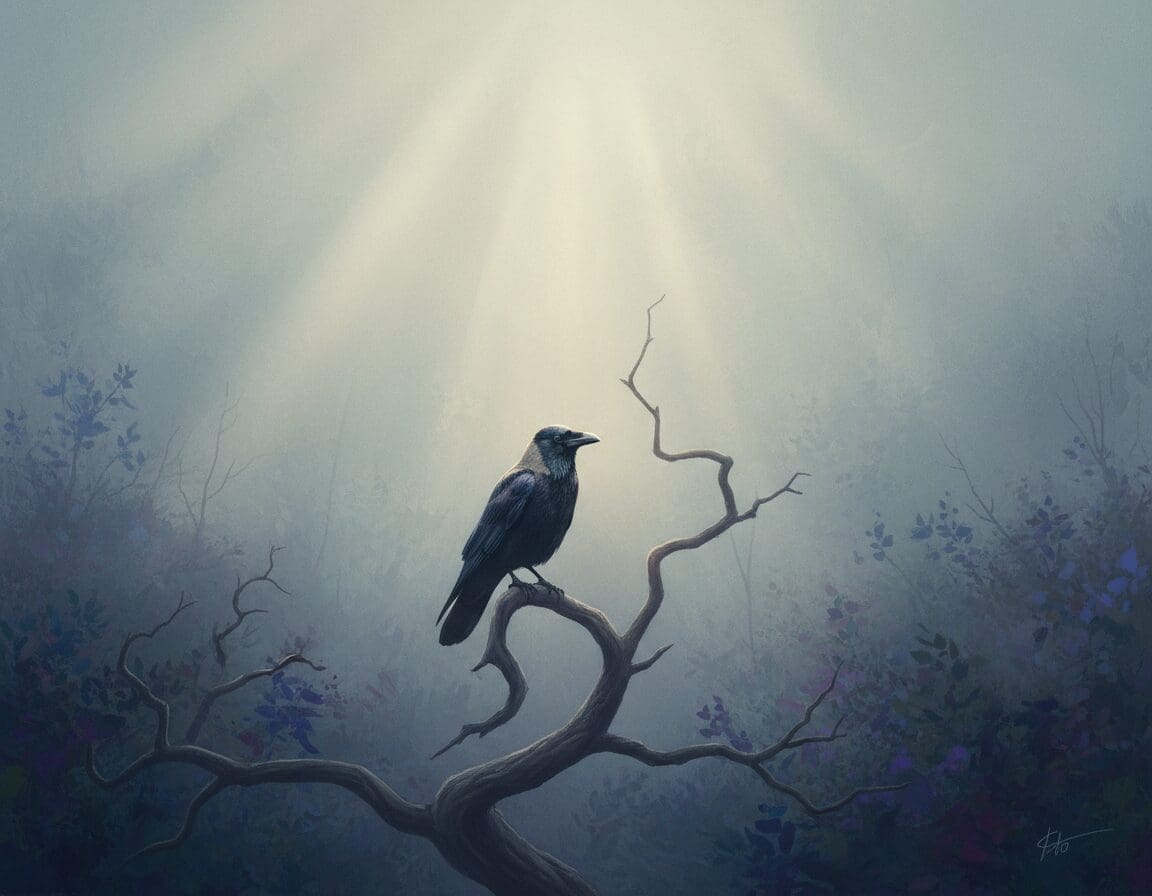
Crows belong to the Corvus genus and are among the most adaptable passerines found across the UK and around the world. They show striking social behaviour, gathering in communal roosts and using complex vocalisations to communicate. Studies of New Caledonian crows have revealed tool use and problem‑solving skills that underline their reputation for cleverness.
These observable traits—intelligence, adaptability and watchfulness—have long fed human imagination. Crow symbolism ranges from omens and messengers to psychopomps, tricksters, teachers and mirrors of change. Different societies read different meanings into the same bird, so crow meaning can be both positive and unsettling according to context.
This article offers a practical guide for readers in the United Kingdom exploring what does a crow mean when it appears in a dream, at the roadside, or in a painting. We start with a concise overview of crow symbolism, move through cultural histories, and finish with personal and spiritual interpretations tailored for modern life, including reflections on crow spiritual meaning and crow symbolism UK.
what does a crow mean
The crow often stands at thresholds in myth and mind. This brief introduction gives a crow symbolism overview that helps readers approach more detailed ideas. Think of the bird as a liminal figure tied to change, cleverness and hidden knowledge.
Overview of crow symbolism
Archetypes of the crow frame it as messenger, omen-bearer and keeper of shadow aspects. These archetypes of the crow place it between life and death, daylight and night, the ordinary and the sacred. The symbolic meaning of crows shifts by culture but shares core themes: secrecy, adaptability and a role as guide.
Common themes: intelligence, transformation and mystery
Crows show notable problem-solving skills in scientific studies. This evidence informs the crow intelligence meaning that appears in folklore and modern commentary. People often read the bird as teacher or trickster, prompting creativity and new strategies.
Crow transformation symbolism centres on endings that clear the way for renewal. The bird’s black plumage and loud call intensify human readings of death and rebirth. Crows function as agents of change, signalling that a phase is closing and something new may emerge.
Many find mysterious crow symbolism in the way the bird mirrors the unconscious. Crows can be seen as prompts for shadow work, asking us to attend to what we ignore. That sense of mystery underlies dreams and sudden daytime encounters.
Why crows appear in dreams and daily life
Crow in dreams meaning varies with context. In one dream the bird might stand for untapped wit, in another it might point to grief or a pending message. Interpreters separate literal, emotional and symbolic readings to match a dreamer’s situation.
Seeing a crow meaning in waking life blends practical cues and symbolic prompts. Note timing, number of birds and behaviour. A flock feeding by a hedge may be practical; a single calling crow outside a window can feel like a personal sign.
- Crow sighting interpretation depends on behaviour, setting and personal associations.
- Jungian views treat the crow as archetype and mirror for the shadow.
- Shamanic and animist approaches see the bird as messenger or ally.
- A secular reflective approach treats sightings as prompts for creativity or problem-solving.
Keeping a short journal of dreams and sightings makes patterns visible. That practice helps transform generic beliefs into a personal language of meaning and keeps the symbolic meaning of crows grounded in everyday life.
Historical and cultural meanings of the crow across the world
The crow has woven itself into human stories from bog to city. Across time and place this bird serves as omen, guide and mirror to our fears and hopes. The brief passages below trace how distinct cultures have folded corvids into ritual, myth and everyday life.
Celtic and British traditions
In Irish myth the Morrígan appears as a battle-shaping presence who sometimes takes the form of a black bird. The Morrigan crow meaning links fate, war and prophecy, with tales in which crows gather over fields before combat. Rural Britain keeps a mixed ledger of beliefs about the species. A British folklore crow on a roof might be read as a harbinger of loss, yet some counties tell of crows that guard homesteads or act as companions to wise women. Medieval bestiaries and chroniclers record crows as trickster and sage in turn, while proverbs and place-names retain the bird’s ambiguous reputation.
Indigenous North American meanings
Tribal traditions vary widely across the continent. In Pacific Northwest cultures the raven is a creator and culture hero, central to Haida and Tlingit origin stories where the raven brings light to people. In Plains and Great Basin accounts the crow can play the role of teacher, messenger or trickster. Ethnographers have long noted these differences, and contemporary Indigenous authors and artists reclaim raven crow indigenous symbolism as part of cultural revival and resilience. Respect for tribal sovereignty means meanings remain context-specific and sometimes sacred.
Asian myths and ritual
South Asian practice links crows to ancestral rites. In Hindu custom feeding crows during shraddha honours departed relatives, underlining the Hindu crow meaning as messenger to the dead. East Asia offers a different palette. The Japanese Yatagarasu is a divine three-legged guide in myth and the Japanese crow myth presents the bird as both omen and heavenly messenger. Chinese lore at times places a three-legged crow in the sun, turning the corvid into a solar emblem. Across Southeast and Central Asia local agrarian cycles shape how communities see crows—as omens, mediators or embodiments of ancestral power.
Modern literature and visual culture
Writers and artists have pressed corvid imagery into new shapes. Edgar Allan Poe’s poem helped set a Western tone in which raven symbolism Poe links the bird to mourning and the uncanny. Poets such as Ted Hughes and Seamus Heaney use corvids to probe nature, grief and the human mind. In visual arts and film crows appear as motifs of mystery, urban wildlife and environmental resilience. Contemporary photographers and sculptors feature crows in works that comment on intelligence and adaptation, giving rise to crows in modern art as a common theme.
Urban encounters and changing views
Daily life has altered popular perception of corvids. Citizen scientists catalogue clever problem-solving, and social media amplifies striking footage of tool use and social learning. The crow Native American meaning and crow Celtic symbolism remain alive in stories, while new urban research leads many to admire rather than fear these birds. Public fascination now balances myth with observation, yielding richer, layered meanings for modern readers.
Personal and spiritual interpretations for the modern reader
When you seek a personal crow meaning, start with careful observation. Note where you saw the bird, how many there were, and what the crow did. Record your emotional response in a notebook; small details often unlock larger insight. This practical interpretive step helps you turn a fleeting sighting into a meaningful moment.
For those exploring the spiritual meaning of crow, establish respectful rituals that suit your life. Try journalling dreams and daytime encounters, and use a short seated meditation to consider the crow as teacher or guide. If you draw on ancestral or cultural practices, do so with sensitivity and, where appropriate, learn from local teachers rather than adopting rites without permission.
Grounded interpretations also matter. Seeing crow spiritual message can be reframed as everyday guidance: a prompt to problem-solve, an invitation to release old emotions, or a nudge towards community and curiosity. Use the crow as a symbol of resilience—write a short action list after an encounter, or set a small, achievable goal that honours the insight.
Finally, balance meaning with ethics and ecology. Respect corvids as living beings by supporting urban biodiversity and avoiding harm. Let scientific knowledge about crows inform your wonder, and allow your personal crow meaning to grow through mindful attention rather than superstition.