
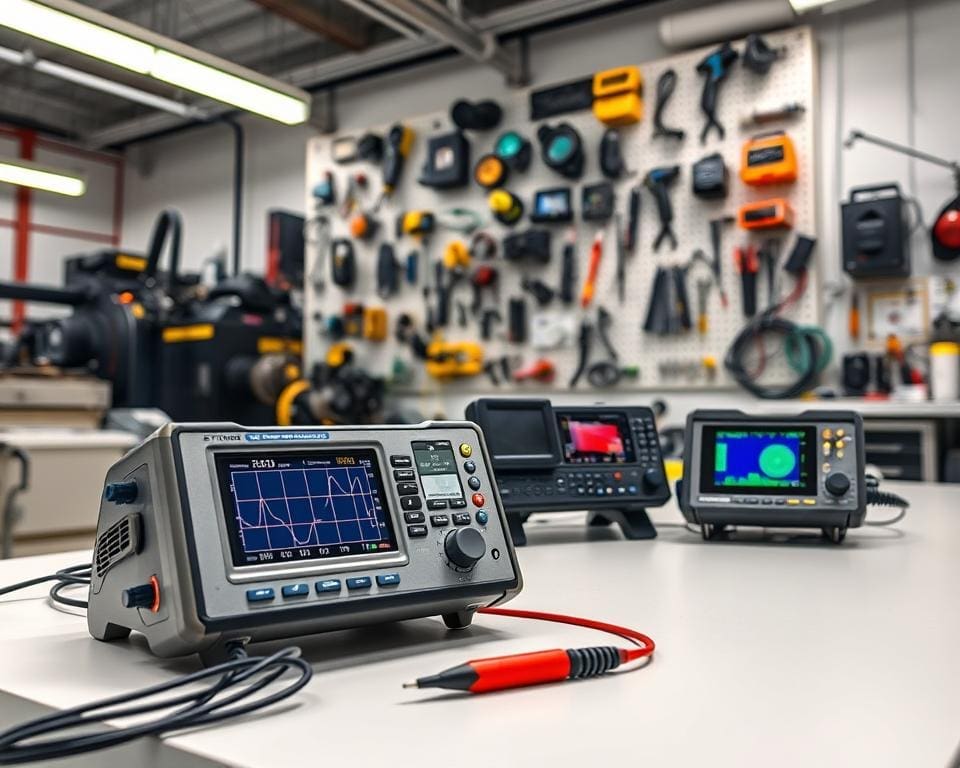
This article opens with a clear purpose: to catalogue and review the key machine diagnostics devices that keep UK workshops and industrial plants running. It explains what devices support machine diagnostics across automotive, industrial and plant environments, and it highlights the practical choices that matter for maintenance teams.
Readers will find concise guidance on portable diagnostic scanners, embedded sensors and IoT edge devices, tablets and smartphones used as diagnostic hubs, desktop workstations, wireless gateways and cloud platforms. The coverage focuses on interoperability, ruggedness, security and compliance so procurement and reliability engineers can make confident decisions.
The piece balances product-review detail with use‑case insight. It describes how diagnostic tools for machinery feed equipment condition monitoring systems, how live sensor data enables AI‑driven predictive maintenance, and why access to historical and real‑time data is vital for accurate fault detection.
For practical context and a deeper look at AI in predictive maintenance, see this primer on AI and predictive maintenance from SuperVivo: AI in predictive maintenance. The rest of the article will assess device categories, variation in capability, and selection criteria tailored to industrial diagnostics UK and on‑site workshop needs.
What devices support machine diagnostics?
Machine diagnostics rest on a spectrum of tools that range from simple handheld readers to cloud platforms. Choosing the right mix starts with understanding diagnostic device categories and how each supports fault detection, condition monitoring, data aggregation and centralised reporting. This section outlines those groups, contrasts capability levels and shows why correct selection shapes maintenance outcomes in UK operations.
Overview of device categories
The main groups include portable handheld scanners, embedded sensors and IoT edge devices, mobile hubs such as tablets and smartphones, desktop PC analysers, wireless and edge gateways, and cloud/server platforms. Handheld OBD and industrial scanners excel at episodic fault code reading and quick troubleshooting.
Embedded sensors and edge devices deliver continuous condition monitoring with local processing. Mobile hubs act as flexible interfaces, while desktop workstations provide deep analytics and reporting. Gateways move telemetry securely to cloud platforms for long‑term trend analysis and centralised dashboards.
How diagnostic capability varies by device
Devices differ by sampling rate, resolution and on‑device processing. Vibration accelerometers may sample at kilohertz rates for bearing analysis, while temperature probes sample far less often. Edge devices can run ML inference to flag anomalies near the source. Handheld scanners typically stream raw codes and limited live data for episodic checks.
Storage and local logging vary too. Some gateways buffer data during network outages, others rely on constant transmission. Protocol support spans CAN, CAN FD, OBD‑II, Modbus, OPC UA, EtherNet/IP and Profinet. Manufacturer ecosystems may favour proprietary formats or open standards, which affects integration.
Why choosing the right device matters for maintenance strategies
Picking suitable maintenance strategy devices impacts fault isolation speed, downtime and asset life. Devices geared for continuous monitoring enable predictive maintenance tools that predict failures before they escalate. Episodic tools suit ad‑hoc troubleshooting but cannot replace constant trend analysis.
Trade‑offs include cost versus capability, ease of deployment and scalability across multiple sites. UK considerations add environment ratings for ATEX or washdown areas, and data rules such as GDPR when telemetry touches personal data. Compatibility with existing PLC and SCADA infrastructure determines how smoothly new devices integrate into current workflows.
Portable diagnostic scanners for on-site troubleshooting
For engineers working in workshops and on plant floors, portable diagnostic scanners bring instant insight to equipment faults. These tools let technicians view live data, capture waveforms and clear codes at the point of failure. Choosing the right device reduces downtime and improves decision making during repairs.
Handheld OBD and industrial scanners: features and compatibility
Automotive diagnostics are dominated by manufacturers such as Autel, Launch and Snap‑On. Their handheld OBD scanners read fault codes, display live data, and offer ECU programming on supported models. Features to compare include extensive fault code libraries, live graphing, waveform capture and customisable templates.
For industrial contexts, brands like Fluke, Bosch and Pico Technology supply industrial fault scanners and analysers that link over CANbus, Modbus and serial interfaces. These handheld units focus on multi‑protocol support and on capturing signal integrity for motors, drives and control systems.
Battery life, ruggedness and IP ratings for field use
Battery capacity matters when continuous logging is required. Look for realistic runtime figures under constant load and options to hot‑swap or run from external power. A device that drains mid‑job adds risk to diagnostics.
Rugged diagnostic tools UK teams favour meet MIL‑STD‑810 for shock and vibration and carry IP65 to IP68 ratings for dust and water resistance. In hazardous areas check for ATEX or IECEx certification. Screen readability in sunlight, glove‑friendly interfaces and wide temperature ranges make a practical difference in British conditions.
Recommended models for UK workshops and plant engineers
Autel MaxiSys series suits garages needing broad vehicle coverage and ECU coding. Snap‑On MODIS and VersaEdge support workshop workflows with strong service networks. Fluke instruments, including the Fluke 3561 FC, combine power quality checks with thermal options for electrical teams.
PicoScope automotive kits excel at waveform analysis for intermittent faults. For process instrumentation, handheld calibrators from Fluke and Honeywell offer dependable field checks. When selecting recommended diagnostic scanner models, check local service availability, spare parts and whether licences are subscription or perpetual.
Embedded sensors and IoT edge devices for continuous monitoring
Small, smart sensors now provide constant insight into plant health. Embedded sensors for diagnostics sit on bearings, pumps and switchgear to deliver data that powers predictive maintenance and reduces unplanned downtime.
Types of sensors and typical applications
Vibration sensors use piezoelectric elements or MEMS accelerometers to spot bearing faults, shaft imbalance and resonance. Brands such as SKF supply proven vibration sensors for condition monitoring on rotating equipment.
Temperature measurement relies on RTDs and thermocouples to detect overheating in motors and bearings. Pressure is monitored with piezoresistive and strain‑gauge transducers to catch hydraulic leaks and pump cavitation. Current monitoring uses Hall‑effect sensors or Rogowski coils to reveal electrical imbalances and motor overloads.
Edge processing to reduce latency and data costs
Edge IoT devices from Siemens Industrial Edge, Advantech and HPE Edgeline run local analytics so only key features travel to the cloud. On‑device FFT analysis, event detection and lightweight ML models cut bandwidth use and enable faster alerts.
Techniques such as downsampling, local thresholding and compressed feature upload preserve battery life for wireless sensors and protect sensitive plant data while keeping teams informed in real time.
Integration with industrial control and supervisory systems
PLCs remain central to factory control, so robust PLC integration is essential. Common protocols include Modbus TCP/RTU, OPC UA, EtherNet/IP and Profinet for deterministic data exchange between sensors, controllers and HMIs.
Gateways translate signals from legacy PLCs into MQTT or REST for IT/OT convergence and feeding condition monitoring suites like Siemens MindSphere or PTC ThingWorx. Careful network segmentation and deterministic behaviour preserve control integrity while enabling richer SCADA diagnostics UK capabilities.
Learn how sensors improve predictive maintenance in
Portable tablets and smartphones as diagnostic hubs
Portable tablets and smartphones bring diagnostic power to the workshop floor and the plant gate. They run lightweight HMIs, collect logs, carry out calibrations and link technicians to cloud dashboards. Choosing the right device and app ecosystem turns a handheld screen into a versatile diagnostic hub.
App ecosystems and protocol support
Major vendors supply mobile toolkits that match professional needs. Bosch and Autel offer mobile versions of their diagnostic suites. PicoScope provides oscilloscope apps that pair with portable hardware. Specialist apps support Modbus/TCP and OPC UA clients for plant systems.
Android gives broad hardware compatibility and many third‑party toolchains. iOS delivers strict app signing and controlled provisioning. Enterprise teams should weigh device management and long‑term support when picking between platforms.
Smartphone diagnostic apps now handle CAN and CAN FD via Bluetooth adapters. Running Modbus on mobile is common for fast reads and remote tweaks. Ensure the chosen apps list protocol support clearly before deploying.
Accessories to enhance diagnostics
Reliable accessories make the difference between intermittent reads and consistent data. Bluetooth and Wi‑Fi OBD dongles include ELM327 variants and Bosch KTS wireless modules for vehicle work. CANbus dongles such as PEAK System PCAN‑USB and Kvaser models give robust CAN access for industrial buses.
Rugged tablet mounts, vehicle power adapters and magnetic or clamp sensors help with safe, repeatable measurements. Select certified, high‑quality adapters to avoid communication errors and protect investment over years of service.
Security and update considerations for mobile tools
Security must be planned from procurement through retirement. Mobile diagnostics security UK practices include device management (MDM), secure boot and app signing to guard endpoints. Strong authentication and VPNs protect remote access to plant networks.
Timely firmware and app updates are essential. Choose vendors with clear support and patching policies. For UK deployments, remember GDPR rules when telemetry may be linked to people and use encrypted storage and transmission accordingly.
Desktop diagnostic workstations and PC-based analysers
Desktop systems bring depth to machine diagnostics. They pair powerful hardware with specialised software to turn raw signals into clear insights. Engineers in UK workshops and manufacturing plants rely on these platforms for root cause work and long-term trend analysis.
Software suites for in-depth analysis and reporting
Choose diagnostic workstation software that offers configurable dashboards and automated report generation. National Instruments LabVIEW supports custom measurement flows. Flukeview and Fluke Connect simplify thermal and electrical reporting. SKF @ptitude Analyst excels at vibration analytics and PicoDiagnostics handles waveform capture with precision.
Look for spectral analysis tools such as FFT, envelope detection and statistical trend modules. Machine learning add-ons for predictive insights help spot patterns before faults escalate. Clear export options and templated reports make audits and handovers straightforward.
Hardware interfaces: USB, serial, and specialised I/O cards
Physical interfaces determine what you can capture. USB and RS-232/RS-485 keep legacy test rigs connected. CAN and OBD links serve vehicle ECUs. Industrial Ethernet fits plant networks and time-synchronised DAQ cards from National Instruments or Measurement Computing handle high sample rates across many channels.
Signal conditioning, galvanic isolation and anti-aliasing filters protect data integrity. Specialised I/O cards provide simultaneous analogue and digital capture for complex events. Consider synchronised capture when correlating vibration, current and process variables.
Data storage, backup and compliance for UK industries
Decide between on-premises, hybrid and UK-based cloud storage to meet retention needs. Asset audit trails and quality management drive storage policies. GDPR applies if telemetry includes personal data, so anonymise where possible and minimise PII collection.
Implement encrypted storage at rest and in transit. Use versioned reports to preserve traceability and regular backups for disaster recovery. Follow data backup compliance UK expectations by documenting retention rules and choosing providers with UK data residency options.
Wireless gateways, routers and edge gateways for diagnostics data
Reliable transport of diagnostics data starts with the right gateway. Installations range from plant floors to remote substations, each needing tailored choices for throughput, latency and power. Use a mix of wired and wireless links to match the use case and ensure continuous visibility.
Connectivity options: Wi‑Fi, LTE/5G, LoRaWAN and Ethernet
Ethernet gives deterministic, high‑bandwidth links ideal for control systems and bulk data. Wi‑Fi adds flexibility for movable test rigs and workshop zones. LTE/5G suits remote or mobile sites where carrier coverage from EE, Vodafone or O2 is available, enabling LTE diagnostics without fixed lines. LoRaWAN serves low‑power, long‑range use for sparse sensor farms with LoRaWAN sensors.
Hybrid approaches often work best. Pair Ethernet backbones with wireless edge nodes. Use SIM redundancy across carriers to keep telemetry flowing when one network drops.
Ensuring reliable transmission from remote sites and plant floors
Plan RF and perform site surveys before deployment. Correct antenna placement and cellular boosters improve signal on outdoor masts and inside brick buildings. Choose outdoor enclosures rated IP66+ for harsh conditions and fit UPS or battery packs for short outages.
Gateways should buffer data locally so diagnostics persist through brownouts. Configure QoS to prioritise time‑critical telemetry and health messages over bulk transfers. Dual‑SIM or multi‑carrier routers help maintain uptime on critical links.
Selecting gateways with built‑in security and VPN support
Pick devices with a hardware root of trust, secure boot and signed firmware updates. Look for TLS or MQTT over TLS and site‑to‑site VPN to keep machine telemetry confidential. Firewalls and role‑based access reduce attack surface.
Vendors such as Cisco, Sierra Wireless, Moxa and Advantech offer industrial routers UK customers can source with enterprise security features. Evaluate each supplier’s vulnerability disclosure and patch cadence when choosing secure edge gateways.
For practical tips on local wireless planning and simple diagnostics steps, consult a short guide at home networking tips for better Wi‑Fi. This helps when you calibrate Wi‑Fi zones or compare wired and wireless performance for onsite troubleshooting.
- Use industrial routers UK models for plant‑grade mounting and glanded cabling.
- Implement LTE diagnostics channels for mobile telemetry and failover.
- Deploy wireless gateways for diagnostics that offer local buffering and remote management.
- Integrate LoRaWAN sensors with gateways that bridge to MQTT or HTTPS backends.
Cloud platforms and server solutions for centralised diagnostics
Cloud platforms for diagnostics centralise telemetry from edge devices and gateways, turning raw streams into long‑term trend analytics and actionable dashboards. Typical architectures have edge devices pre‑process data, gateways forward payloads via MQTT or HTTPS, and cloud services ingest, store and analyse using time‑series stores and machine learning. A centralised diagnostic server offers role‑based access so engineers, managers and service teams across sites can view the same insights in real time.
Leading options for UK organisations include Siemens MindSphere, PTC ThingWorx, GE Digital offerings, Microsoft Azure IoT, AWS IoT and Google Cloud IoT. Choice between SaaS, private cloud or on‑premises servers depends on data residency, latency and security needs. For highly regulated data or ultra‑low latency control, private or on‑premises deployments make sense; for rapid scale and lower capital spend, a condition monitoring cloud or managed service is often better value.
Cloud analytics typically use time‑series databases such as InfluxDB or Azure Time Series Insights, combined with anomaly detection and predictive maintenance models. Integrating with CMMS platforms like IBM Maximo or Fiix enables automated work orders when models flag issues. Effective models are trained on historical labelled failure data and continually retrained to cut false positives and improve lead time to repair.
Security and compliance are essential: encrypt data in transit and at rest, enforce IAM and audit logging, and check certifications such as ISO 27001 and SOC 2. Address GDPR and UK data sovereignty by choosing UK/EU region storage and putting robust Data Processing Agreements in place. Evaluate licence models, integration costs and vendor SLAs to estimate total cost of ownership, then pilot with a specific asset class and measurable KPIs—reduced unplanned downtime and faster mean time to repair—to prove ROI before full roll‑out. For guidance on managed, 24/7 IT partnership models that complement an industrial diagnostics cloud UK approach, see this partnering resource.