This guide answers a simple, urgent question for UK readers: what devices enable remote system control and which remote system control devices suit your needs? We take a product-review approach that compares categories rather than single models, so you can pick solutions that match your home, small business or server room.
Across the article we review mobile apps from Apple and Samsung, dedicated remotes from Logitech, network hardware by Netgear, Ubiquiti and Cisco, and small controllers such as Raspberry Pi. We also cover industrial options from Siemens and Schneider Electric, voice platforms from Amazon and Google, audio control with Sonos and security kit like Hikvision. This mix shows the range of remote management hardware and remote access devices on offer in the UK market.
Expect practical buying guidance on remote control solutions UK buyers need to consider: compatibility, ease of setup, encryption and two‑factor authentication, latency and performance, manageability, maintenance and total cost of ownership. We flag UK-specific issues such as warranty terms, data protection regulations and broadband variability so your choices stay robust under local conditions.
The intended audience is homeowners, small business owners, IT managers and facilities staff seeking reliable remote control devices. Each section explains real-world use, security trade-offs and where remote control solutions UK users will see the biggest efficiency, accessibility and security gains.
What devices enable remote system control?
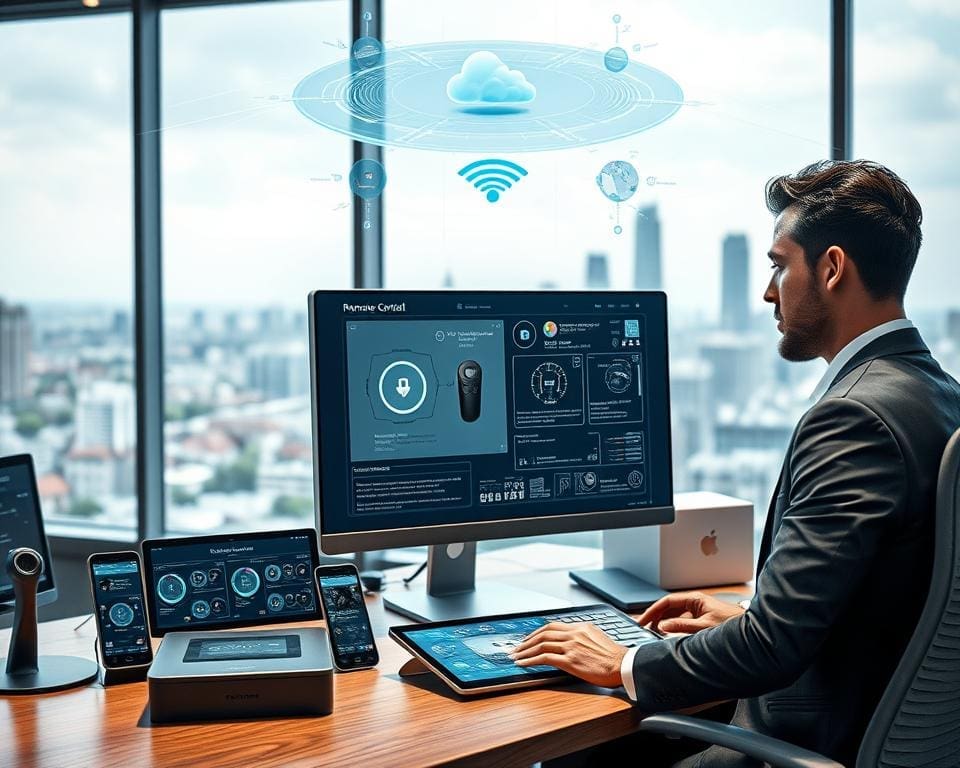
Remote system control brings together hardware and software that let an authorised person monitor, configure and command equipment from another place. This remote system control definition covers consumer smart-home gadgets, enterprise administration tools, industrial controllers and building management systems.
To understand the remote management scope, think beyond simple infrared remotes. The scope includes networked appliances, remote desktop clients, KVMs, PLCs, IoT platforms and access-control hardware. Gateways and hubs that translate between Zigbee, Z-Wave and Wi‑Fi sit inside this landscape.
Homes are a primary example of common remote control environments. Smart lighting such as Philips Hue, Nest thermostats, Arlo and Ring security cameras and Sonos or Roku entertainment systems are managed through smartphone apps and voice assistants.
Offices and small businesses use remote tools for server administration, VoIP systems, meeting-room control and building heating and ventilation. Smart locks and centralised access lists reduce the need for physical attendance and speed routine management.
Data centres rely on specialised devices within the same set of remote control environments. KVM over IP, PDUs from APC or Schneider and out-of-band management like iLO or iDRAC permit headless server control and quick recovery from faults.
Industrial sites extend the remote management scope with PLCs from Siemens or Rockwell and SCADA systems. These platforms enable remote monitoring and control of production lines and critical plant equipment.
For UK users, the benefits of remote control UK are clear. Efficiency rises through reduced travel, faster incident response and centralised automation that saves time on routine tasks.
Accessibility improves for distributed teams and hybrid working models. Remote maintenance keeps critical infrastructure online across multiple UK locations without the need for constant on-site presence.
Security is stronger when remote control is implemented correctly. Rapid patching, centralised logging and controlled access reduce exposure to threats. Careful configuration and adherence to GDPR and Cyber Essentials remain essential to manage risk and compliance.
Smartphones and tablets for mobile system management
Smartphones and tablets from Apple and Samsung have turned mobile devices into practical control panels. They offer touch-first interfaces and rich app ecosystems that make day-to-day management feel intuitive and immediate.
Choosing between a native app and a web portal often shapes the experience. The native app vs web interface debate centres on speed, features and reach. Native apps such as the Philips Hue, Amazon Alexa or Netgear Nighthawk apps deliver faster response, push notifications and access to hardware like Bluetooth. They suit users who want a polished, offline-capable experience.
Web interfaces work from any browser and simplify cross-platform access. Network appliances and enterprise dashboards often rely on web consoles for troubleshooting and broad compatibility. That makes web interfaces handy for remote teams who need instant access without installing software.
Native apps versus web interfaces: pros and cons
- Native apps: richer UX, hardware access, faster performance; require platform updates and can be platform-specific.
- Web interfaces: universal access, easy for remote troubleshooting; may lack full device features and depend on responsive design.
- Hybrid approaches blend both, giving users choice while keeping maintenance manageable.
Case studies: controlling smart home devices with mobile apps
Smart heating systems show clear benefits. The Nest thermostat, controlled via the Google Home app and web console, lets households set schedules and activate away modes during UK seasonal swings. That reduces fuel use and keeps homes comfortable.
Home entertainment setups use mobile apps to unify control. The Logitech Harmony approach and native apps for Roku and Sonos enable one-touch scene changes across TVs, receivers and multi-room audio. Security systems such as Arlo and Ring stream live video to phones and send motion alerts, allowing immediate checks and rapid response.
Smart plugs extend remote control to everyday appliances. They let users switch lamps, fans and heaters on or off from anywhere. For a practical primer, see this guide on smart plugs and how they simplify routines: smart plugs to simplify your daily.
Security considerations and best practices for mobile control
Mobile control security UK demands attention. Accounts tied to apps should use strong, unique passwords and two-factor authentication. That reduces the risk of unauthorised access.
Keep operating systems and apps updated to patch vulnerabilities. Prefer apps that offer end-to-end encryption for video and audio streams and review vendor privacy policies for cloud storage practices.
On the move, protect connections with a VPN and rely on trusted TLS links instead of public Wi‑Fi. Businesses benefit from mobile device management apps to enforce policies, push updates and enable remote wipe when devices are lost or compromised.
Adopting these habits strengthens resilience and builds trust in mobile workflows for both homes and organisations across the UK.
Dedicated remote control hardware and IR/RF remotes
Physical controllers remain essential for instant, tactile command of audio‑visual systems, lighting scenes and appliances. Dedicated remote control hardware gives low latency and predictable response, which suits living rooms, meeting rooms and professional AV setups. This blend of reliability and simplicity appeals to many UK households and businesses.
Universal remotes UK offerings from brands such as Logitech and Philips have long helped users replace multiple handsets with one device. High-end programmable controllers from Crestron and Control4 extend that idea into custom keypads and touchpanels for integrated homes and commercial installs.
Programmable controllers allow scenes and macros to run complex sequences with a single press. Installers favour these units where bespoke layouts and security integration are required. The ability to map buttons to activities simplifies operation for less tech‑savvy family members and staff.
Infrared and radio frequency technologies explained
Infrared uses line‑of‑sight pulses from an IR LED to a device. It works well for TVs, set‑top boxes and many consumer AV products but struggles with obstacles and ranges beyond about 10 metres.
Radio frequency signals travel through walls and offer larger coverage. RF is common in garage door openers, motorised blinds and some advanced remotes. Bluetooth, Zigbee and Z‑Wave sit alongside RF as alternative wireless methods, each offering pairing and two‑way communication for smart devices.
When to choose physical remotes over software solutions
Choose physical remotes when immediate tactile feedback matters or network dependency is a risk. Older users often prefer a familiar handset to a smartphone app. Conference rooms and living areas benefit from a single, simple controller that anyone can use.
Professional installations may require deterministic latency and dedicated interfaces that meet security policies. For those who want hybrid control, IR blasters and RF bridges such as Broadlink alternatives let smartphones send commands to legacy infra‑red devices, combining physical remote advantages with remote management.
Network-attached devices: routers, gateways and hubs
Smart homes and small offices rely on network-attached remote devices to make remote control simple and dependable. A clear architecture of routers, gateways and hubs keeps sensors, cameras and automation reliable. Choose equipment that supports local control where possible to reduce latency and improve privacy.
Hubs and gateways bridge the gap between wireless protocols and IP networks. Devices such as the Philips Hue Bridge, Samsung SmartThings Hub and Aeotec Smart Home Hub connect hubs and gateways Zigbee Z-Wave devices to your router. Zigbee and Z‑Wave form low-power mesh networks that suit battery sensors. Wi‑Fi gives higher bandwidth at the cost of greater power use.
Role of hubs and gateways in bridging protocols
Gateways translate messages between Zigbee, Z‑Wave and TCP/IP so a single app or controller can manage many device types. Local gateways can run automations without sending data to cloud servers. Enterprise-class gateways add provisioning, monitoring and central management for multiple sites.
Router settings and remote access
To reach devices from outside your network, router remote access dynamic DNS often provides a simple solution. DDNS services like No-IP map a changing public IP address to a steady hostname so you can connect remotely. Port forwarding can expose internal services, but it increases risk when misconfigured.
Use secure tunnels or VPNs instead of opening many ports. Vendor tools such as Ubiquiti UniFi remote access and Synology QuickConnect offer encrypted, managed connections without complex NAT changes. Disable UPnP on business networks to prevent automatic port openings that attackers could exploit.
Choosing hardware for reliability and remote manageability
Select reliable routers UK users trust, such as Netgear, TP‑Link, ASUS or Ubiquiti for prosumer needs. Look for dual-band Wi‑Fi 6, VLAN and QoS features, plus firmware update cadence and vendor security practices. For mission-critical remote control, prefer hardware VPNs, dual-WAN failover and clear firmware management paths.
Plan for power resilience. A small UPS for your router, hubs and critical gateways keeps remote access alive during short outages. For practical setup tips on placement, QoS and DNS settings, consult this guide: how to set up a fast and reliable home.
- Segregate IoT devices on a separate VLAN to limit exposure.
- Keep firmware current to sustain performance and security.
- Use network monitoring tools to spot issues before they interrupt remote access.
Remote desktop and KVM solutions
Remote access tools let teams manage machines without travel. In the United Kingdom, organisations balance convenience with strict policies. Choices range from software clients to hardware appliances that give deep control when systems fail.
Pick a tool that fits the use case. For routine support and desktop access, software options offer speed and low cost. For data centre maintenance and BIOS-level tasks, physical KVM units provide direct control.
Software-based remote desktop tools
Microsoft Remote Desktop Protocol (RDP) is built into Windows Server and Pro editions and supports encryption with network-level authentication when configured properly. VNC variants such as RealVNC and TightVNC work across platforms and suit simple support tasks, though they may need SSH tunnels for secure transport. Third-party SaaS products including TeamViewer, AnyDesk and LogMeIn simplify NAT traversal and setup, but require careful access control and subscription planning. Browser-based enterprise choices like Chrome Remote Desktop and Splashtop Business offer lightweight access for teams on the move.
KVM switches and remote hardware
KVM hardware gives direct keyboard, video and mouse control for servers and workstations. Local KVM switches are ideal for on-site racks and multiple headless servers. KVM over IP appliances from Avocent and Raritan enable out-of-band management and remote BIOS access, which proves invaluable when an operating system will not boot.
Performance, latency and security
Latency affects how a session feels. High-resolution video editing and gaming suffer with delay, while administrative tasks, command-line work and light office use perform well on typical broadband. Organisations should test latency and pick settings that match the workload.
Security must be enforced at every layer. Use VPNs for RDP where feasible, apply strong authentication, enable account lockout policies and patch remote-access software promptly. For remote support, audit sessions and enable single-sign-on integrations where available. Enterprise licences often include audit trails and controls that help meet UK compliance and governance demands.
Practical deployment notes
- Choose RDP and VNC tools for flexible desktop access, keeping encryption and authentication tight.
- Deploy KVM over IP for out-of-band server control when remote hands are not available.
- Monitor latency remote control security metrics and log remote sessions for audits.
IoT controllers and programmable logic controllers (PLCs)
Modern automation blends compact edge devices with robust industrial controllers to unlock remote control and insight. Small single-board computers and commercial gateways collect sensor data, run local rules and send selective telemetry to central dashboards. That local-first approach preserves privacy while enabling secure remote access when required.
Edge controllers such as Raspberry Pi, ESP32 modules and dedicated Advantech gateways gather inputs, run automation and manage actuators. Paired with platforms like Home Assistant, AWS IoT or Azure IoT, they support scheduled tasks, alerting and over-the-air updates. Use of MQTT and lightweight protocols makes telemetry efficient for constrained links.
Keeping control logic local reduces latency and outage risk. Operators can combine local automation with cloud integration for remote dashboards and long-term analytics without handing over raw data by default.
Industrial use: PLCs and SCADA systems for remote control
In factories and utilities, Siemens S7 and Allen‑Bradley controllers deliver deterministic I/O, safety interlocks and high availability. These PLCs integrate with SCADA systems such as FactoryTalk, Ignition by Inductive Automation or Wonderware to manage plant-wide operations and alarms.
SCADA systems UK deployments favour strict network segmentation, industrial firewalls and jump hosts for maintenance sessions. Organisations follow IEC 62443 guidance and sector-specific functional safety rules to reduce risk while retaining remote troubleshooting and control capability.
Integration with cloud platforms and analytics
Cloud integration IoT analytics unlocks predictive maintenance, asset fleet monitoring and centralised reporting for distributed sites. Vendors such as Siemens MindSphere and Schneider Electric EcoStruxure provide end-to-end stacks, while platform-agnostic solutions use MQTT to feed analytics engines.
When choosing cloud services for UK operations, consider data sovereignty and GDPR. Design solutions that separate sensitive control paths from telemetry channels, use encryption, and apply role-based access so teams gain insights without exposing critical control interfaces.
- Local-first edge controllers for resilience and privacy.
- PLCs and SCADA systems for deterministic industrial control.
- Cloud integration IoT analytics for predictive insight and fleet management.
Voice assistants and hands-free control devices
Voice control has matured from novelty to everyday utility. Devices from Amazon, Google and Apple sit in kitchens and living rooms, letting people manage lights, locks and heating without touching a switch. This shift opens new possibilities for accessibility and convenience across UK homes and workplaces.
Popular voice platforms and ecosystem compatibility
Amazon Echo, Google Nest and Apple HomePod are the common endpoints for many smart systems. Manufacturers like Philips Hue and Yale list which assistants they support, so checking Amazon Alexa Google Assistant compatibility is essential before buying hardware. Some products pair best with one ecosystem, while bridges and hubs broaden choices.
Designing voice-enabled workflows for accessibility and convenience
Good voice design starts with clear intents and short, natural commands. Create routines such as “Good night” to lock doors, lower the thermostat and switch off lights in one action.
Think about fallback responses and audible confirmations to prevent accidental activations. Use local processing on devices that offer edge capabilities to cut latency and keep simple commands private.
Voice control improves independence for people with mobility or visual impairment. Well-crafted voice workflows accessibility UK means testing with real users and building inclusive prompts.
Privacy, data handling and UK regulatory considerations
Voice assistants use always‑listening wake words and send recordings for processing when activated. Review vendor settings for recording retention and the option to disable storage of voice clips.
Businesses must consider GDPR when systems collect personal data. Inform users, obtain consent where required and carry out a data protection impact assessment for larger deployments.
Follow guidance from the Information Commissioner’s Office and remain aware of evolving voice privacy regulations. Practical steps include minimising cloud transfers, anonymising stored data and documenting processing activities.
Security appliances and access control devices
Security appliances remote control sits at the intersection of network management and physical protection. Networked CCTV/NVR systems from Hikvision and Dahua, cloud-managed services such as Arlo and Ring, and self-hosted NVRs from Synology or QNAP each offer different balances of convenience and data control. Choose devices and services that receive regular firmware updates and consider supply-chain provenance when selecting hardware.
Access control devices UK range from IP door entry systems by 2N and Akuvox to smart locks from Yale and August that enable remote door access and provide audit trails. For business use, opt for certified controllers that integrate with Active Directory and maintain compliant logs. Plan for fail-safe versus fail-secure behaviour, battery backups, and clear physical override procedures to avoid operational surprises.
Security gateways and edge firewalls from Sophos, Fortinet, Cisco Meraki and Ubiquiti deliver VPN termination, IDS/IPS and centralised logging. Deploy separate management networks, enforce multi-factor authentication for administrator access and feed events into a SIEM for incident response. These measures harden CCTV remote management and overall remote administration.
For practical resilience, adopt layered defences: network segmentation, hardened endpoints, routine firmware patching and strong operational procedures. Where remote viewing or interaction is needed, follow lawful CCTV guidance, use encrypted video streams and restrict management interfaces to VLANs or VPNs. For smart door interaction examples and live-streaming features, see this smart door camera overview 24/7 live-streaming smart door camera, and ensure procurement favours vendors offering timely patches and UK support.