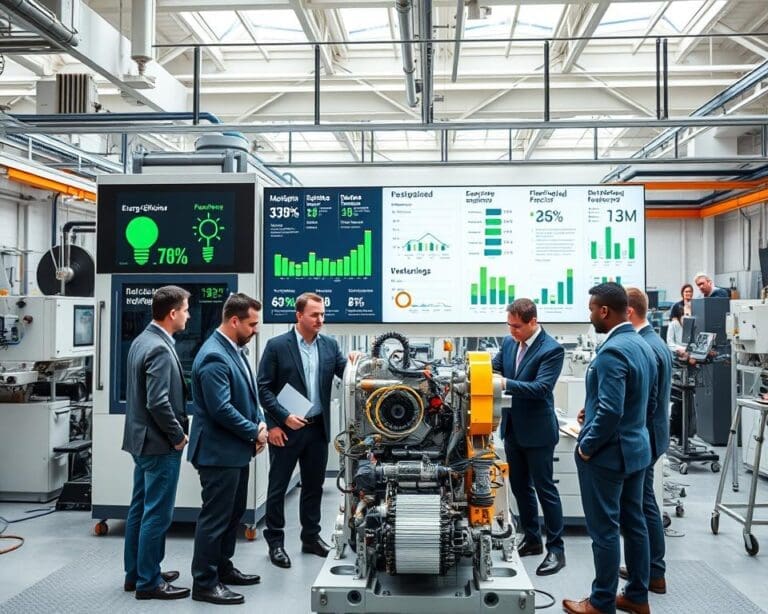

Industrial automation uses control systems, robotics, software and networks to run equipment and processes with minimal human intervention. This section sets out the scope and purpose: to explain how industrial automation reduces production costs for UK manufacturers while also boosting competitiveness, resilience and sustainable growth across supply chains.
Production costs include direct labour, materials, energy, maintenance, scrap, downtime and overheads. Reports from the Confederation of British Industry (CBI) and Make UK show productivity and competitiveness remain priorities for British industry, and government manufacturing strategies increasingly cite automation as central to industrial decarbonisation and long‑term growth.
At a high level, automation cuts costs in several ways: lowering labour expenditure through task automation and redeployment, increasing throughput and reducing cycle times, improving product quality to cut waste and rework, reducing downtime via predictive maintenance, and optimising energy use. These combined effects often generate a stronger automation ROI than isolated improvements.
Financial decisions weigh capital expenditure against lifetime operational savings. Key metrics include payback period, total cost of ownership and intangible gains such as faster lead times, improved on‑time delivery and better regulatory compliance. Studies by the Institution of Mechanical Engineers and analysis from the Manufacturing Technology Centre (MTC) typically find payback periods of 12–36 months depending on scope and sector.
Beyond direct savings, automation delivers strategic benefits: scalable capacity to meet demand peaks, workforce upskilling and retention, improved health and safety that reduces injury‑related costs, and lower carbon emissions that can cut regulatory and energy bills while enhancing brand value.
The rest of this article explores these points in detail. Section two examines specific cost‑reduction mechanisms and UK case studies; section three reviews the technologies that enable savings; and section four outlines practical steps for UK manufacturers to implement automation and realise measurable cost savings.
How does industrial automation reduce production costs?
Industrial automation reshapes cost structures by replacing repetitive labour with machines, tightening process control and lifting output without expanding the workforce. Practical gains come from combining robotics, control systems and software to cut hours on the line, raise throughput and limit material loss. This section outlines concrete mechanisms firms use to deliver measurable savings and better margins.
Lower labour costs through task automation
Automation substitutes or augments manual, repetitive and hazardous tasks such as material handling, assembly, inspection and packaging. That reduces direct labour hours and wage bills while letting skilled staff focus on supervision, quality and innovation. ONS data on manufacturing productivity and labour intensity shows scope for unit cost falls where robotics and conveyance systems are adopted in automotive and food and drink plants.
Firms cut overtime, shrink seasonal headcount needs and lower recruitment and training outlays. Error rates fall, so fewer corrections and warranty claims hit the ledger. Real savings often sit alongside investment in retraining and change management, with apprenticeships and MTC-led programmes helping workers transition into higher-value roles.
Increased throughput and reduced cycle times
Automation speeds lines and shortens cycle times through synchronised control with PLCs and MES, enabling near-continuous 24/7 production. Typical throughput increases reported in industry case studies range from around 20% to 50% depending on the baseline.
Higher units per hour lower the fixed-cost allocation per product. Fulfilment rates improve and buffer inventory needs fall, cutting warehousing costs. Firms must balance speed with quality by using takt‑time analysis and flow engineering to avoid bottlenecks and ensure consistent output.
Enhanced consistency and reduced waste
Robotics, vision inspection and precise process control deliver repeatability and tight tolerances. Automated vision systems detect faults early; robotic welding and dosing cut variation; precision dosing reduces overuse in food and chemical operations. Lines report scrap and rework reductions commonly between 10% and 40% after automation upgrades.
Lower scrap reduces material and disposal expenses while improving first-pass yield. Waste reduction manufacturing supports compliance with UK and EU environmental rules and helps brands meet sustainability targets.
Case studies from UK manufacturing sectors
UK manufacturing case studies show diverse benefits. Jaguar Land Rover and Nissan use robotics in assembly and paint shops to boost throughput and cut labour intensity. Princes Group and Walkers have automated packing and inspection to lower contamination risk, reduce labour costs and extend shelf life in line with FSA requirements.
Advanced aerospace and defence firms such as BAE Systems and Rolls‑Royce apply automation and additive techniques to reduce scrap and improve tolerances for complex parts. SMEs benefit from scalable solutions like cobots and modular conveyors, backed by MTC and Innovate UK pilots that demonstrate rapid payback.
Across sectors, the greatest gains come from integrated projects that combine machines, software and process redesign with clear change management. This integrated approach drives both labour cost reduction automation and throughput increase automation while improving automation efficiency and enabling measurable waste reduction manufacturing.
Key technologies driving cost reduction and efficiency
Manufacturers in the United Kingdom are cutting costs and boosting output by deploying a mix of advanced automation technologies UK. These tools work together to speed production, improve quality and free staff for higher‑value tasks. Early investment, supported by leasing and local finance schemes, helps firms scale without excessive capital outlay.
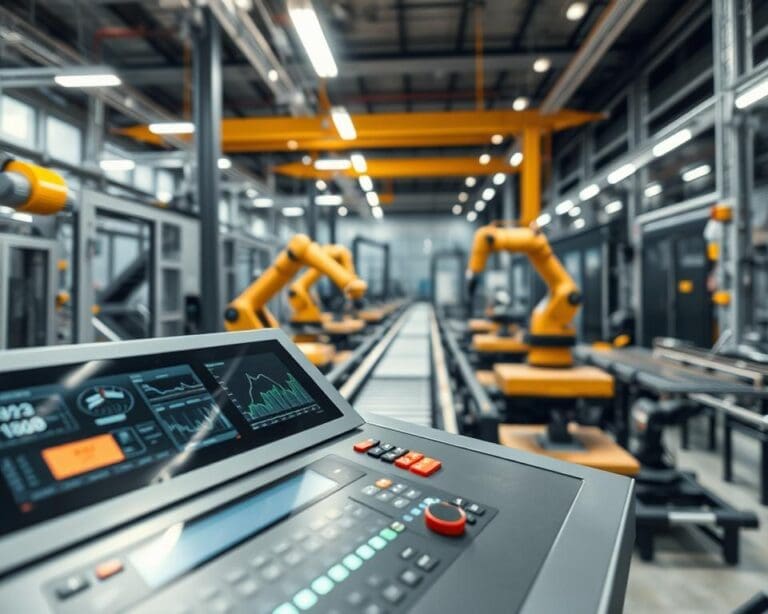
Robotics and cobots deliver precision, speed and flexibility across assembly, packing and machine tending. Articulated robots, SCARA and delta arms suit high‑speed, high‑volume work, while collaborative robots reduce footprint and safety infrastructure needs. Cobots can be redeployed between cells, cutting capital per task and lowering rework costs through tighter tolerances. ABB, Fanuc, KUKA and Universal Robots are widely used in UK plants, with finance and leasing options easing adoption.
Programmable logic controllers and smart sensors form the control backbone. PLC smart sensors feed granular data on temperature, pressure and speeds to control loops. That data enables faster changeovers, fewer faults and smaller scrap volumes. Siemens, Rockwell Automation and Schneider Electric support open protocols such as OPC UA to ensure interoperability across legacy and new kit.
Industrial Internet of Things and real‑time monitoring link edge devices, gateways and cloud platforms to create continuous visibility. IIoT manufacturing setups enable remote diagnostics, performance dashboards and energy optimisation. Pilot projects in UK manufacturing hubs and Innovate UK‑backed trials show measurable gains in OEE and reduced inventory through better demand signals.
Predictive maintenance using AI uses vibration, temperature and acoustic monitoring combined with machine learning to spot faults before they cause breakdowns. Predictive maintenance AI has reduced unplanned downtime by up to half in documented cases and lowered maintenance costs by 20–40%. Vendors such as Siemens, GE Digital and IBM work with UK research centres on applied programmes.
Integration platforms and MES connect shop floor operations with ERP and PLM systems. MES integration orchestrates workflows, tracks genealogy and enforces quality gates in real time. This reduces administrative overhead, cuts scheduling errors and limits recall costs. Solutions from SAP ME, Rockwell FactoryTalk and Siemens Opcenter are commonly adapted by integrators for SMEs.
Big savings appear when these elements are combined into a coherent stack: robotics cobots UK linked to PLC smart sensors, fed into IIoT manufacturing platforms, analysed by predictive maintenance AI and managed through MES integration. Robust cybersecurity and data governance keep that stack secure while local Catapult centres and LEPs offer guidance to lower adoption barriers.
Practical steps for UK manufacturers to implement automation and realise savings
Begin with a clear automation readiness assessment. Map current processes, labour costs, bottlenecks and quality issues, and review digital maturity. Set measurable objectives — for example reduce unit labour costs by a specific percentage, improve OEE, or cut scrap — and attach realistic timeframes. Independent audits or working with trusted integrators and institutions such as the Manufacturing Technology Centre or local Catapult centres can sharpen priorities and form an actionable automation roadmap.
Prioritise high‑impact, low‑complexity pilots to prove value fast. Typical manufacturing automation steps include pick‑and‑place, automated inspection and end‑of‑line packing. Track KPIs such as cycle time, throughput, labour hours, scrap rate, downtime, energy consumption and automation ROI. Early wins build confidence and supply evidence to scale, forming a practical SME automation guide for firms that need rapid payback.
Choose technologies and suppliers that support scalability and interoperability — look for OPC UA or MQTT support, strong local after‑sales service and sensible total cost of ownership. Consider collaborative robots for flexible tasks, modular conveyors for smaller plants, cloud‑enabled IIoT platforms for remote monitoring and MES for production control as you grow. Plan workforce transition with retraining, apprenticeships, T‑level links and college partnerships so roles shift to supervision, data analysis and higher‑value work.
Finance pilots through capital leasing, staged investments, vendor finance or grants such as Made Smarter adoption programmes and Innovate UK schemes. Build the business case around direct savings, reduced working capital and intangible gains like faster delivery and customer retention, and run sensitivity analysis. Use process mapping and Lean before automating, phase rollouts with robust testing, embed data collection for continuous improvement, and maintain cybersecurity and UK compliance. Start by commissioning an audit, engaging a local Catapult or integrator, and piloting a targeted project to implement automation UK and unlock measurable savings across sites and supply chains.