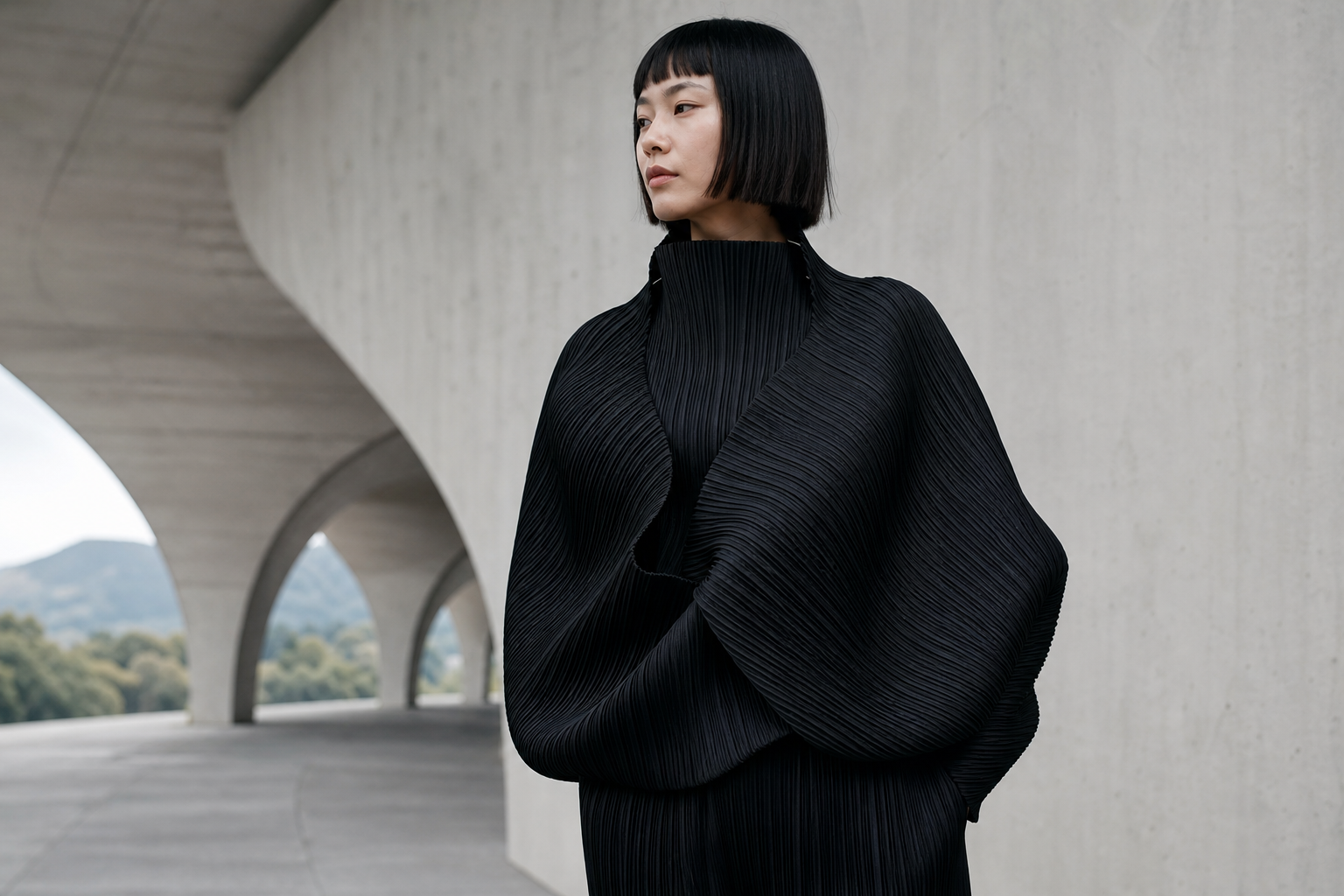

Issey Miyake was not merely a fashion designer; he was an architect of fabric. For B2B professionals in the textile, retail, and design sectors, understanding his approach provides a masterclass in how technical innovation can redefine a luxury market. His work challenged the traditional Western silhouette, replacing rigid tailoring with a philosophy centered on the relationship between the human body and the cloth that covers it.
The Philosophy of A Piece of Cloth
At the heart of Miyake's work is the concept of A-POC (A Piece of Cloth). While traditional garment construction involves cutting patterns from a fabric roll and sewing them together—which creates waste—Miyake sought a more holistic approach. He viewed the fabric as a continuous entity.
By focusing on the space between the body and the garment, known in Japanese as ma, Miyake created clothing that did not dictate the shape of the wearer. Instead, the garment took shape only when worn. This shift from "shaping the body" to "shaping the space" is a fundamental pillar of his legacy. For businesses looking at sustainable production, this approach to reducing textile waste remains highly influential.
Technical Innovation and Material Science
What defines the designs of Issey Miyake? Much of the answer lies in his obsession with technology. He did not view the sewing machine as his only tool; he integrated chemistry, industrial engineering, and computer programming into his atelier.
The Pleats Please Revolution
The most recognisable contribution to modern fashion is undoubtedly the "Pleats Please" line. Unlike traditional pleating, where fabric is pleated before being cut and sewn, Miyake reversed the process. He cut and sewed the garments first, then fed them through a heat press between layers of paper.
This technical pivot resulted in several commercial and functional advantages:
- Permanent Memory: The pleats do not lose their shape, even after repeated washing.
- Travel-Friendly: The garments are lightweight and do not crease, making them ideal for the global business traveller.
- Universal Fit: The elasticity of the pleats allows a single size to accommodate various body types comfortably.
Material Experimentation
Miyake frequently collaborated with scientists to develop new synthetic fibres. He moved beyond silk and wool to explore recycled polyesters and plastics. By treating fabric as a raw industrial material, he bridged the gap between high fashion and industrial design. This mindset allowed him to create structures that looked like sculptures but felt like sportswear.
The Intersection of Art and Utility
For the B2B design community, Miyake's work serves as a prime example of "functional art". He rejected the idea that avant-garde clothing had to be impractical. His designs were intended for the real world, focusing on ease of movement and durability.
His approach to colour was equally strategic. He often used bold, saturated hues that highlighted the geometric nature of his pleats. By removing the need for complex buttons, zippers, or restrictive seams, he streamlined the user experience of dressing. This minimalism was not about a lack of detail, but rather the removal of unnecessary obstacles.
The influence of his work extends into corporate branding and product design. The most famous example is his long-term collaboration with Steve Jobs, for whom he designed the iconic black turtleneck. This partnership highlighted Miyake's ability to create a "uniform" that communicated intelligence, simplicity, and a rejection of fleeting trends.
Legacy in Modern Sustainable Manufacturing
In today's market, where ESG (Environmental, Social, and Governance) criteria drive business decisions, Miyake's methods are more relevant than ever. His commitment to reducing fabric waste through seamless knitting and 3D weaving predates the current industry obsession with "zero-waste" patterns.
By automating the creation of garments through computer-programmed looms, he demonstrated that luxury could be achieved through precision engineering rather than just manual labour. This fusion of craftsmanship and automation provides a blueprint for modern brands attempting to scale sustainable production without sacrificing aesthetic quality.
Frequently Asked Questions
What is the main characteristic of Issey Miyake's style?
The main characteristic is the exploration of the space between the fabric and the body, often achieved through innovative pleating and seamless construction techniques.
How did Pleats Please change the fashion industry?
It introduced a revolutionary method of heat-pressing garments after they were sewn, creating permanent, machine-washable pleats that eliminated the need for ironing.
Did Issey Miyake focus on sustainable fashion?
Yes, through his A-POC concept and the use of recycled materials, he focused on reducing textile waste and streamlining the manufacturing process.
Why is the concept of 'ma' important in his work?
The concept of 'ma' refers to the void or space, allowing the garment to move independently of the body and providing the wearer with freedom.
What was his contribution to corporate attire?
He championed the idea of the functional uniform, most notably through his minimalist designs for Steve Jobs, which prioritised utility over traditional luxury.