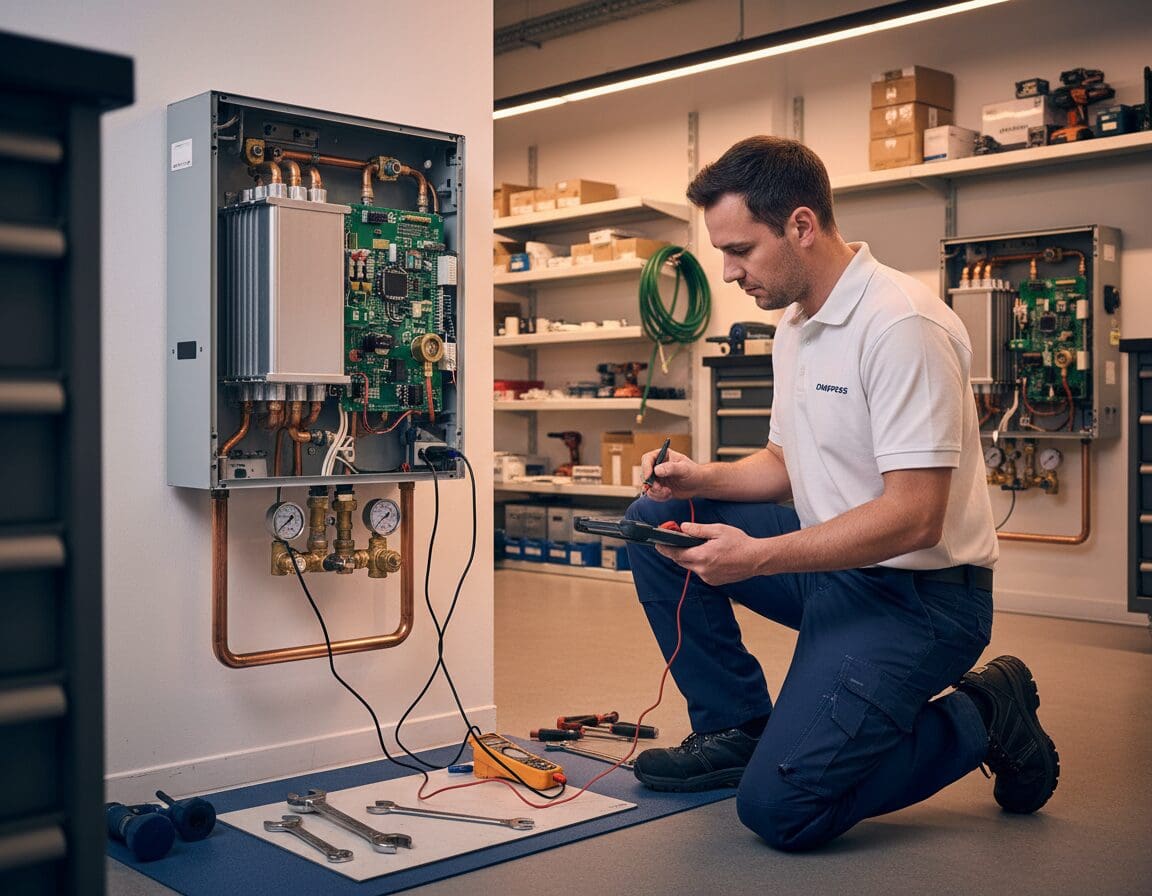

A Danfoss Heat Interface Unit (HIU) transfers heat from central plant to individual flats, providing heating and domestic hot water through in‑unit controls, heat exchangers, valves and sensors. Danfoss is a leading manufacturer of HIUs used across communal and multi‑occupancy buildings, and understanding repair and fault diagnosis is essential to keep systems safe, efficient and compliant.
Key components include plate or coil heat exchangers, motorised control valves such as mixing and diverting valves, differential pressure and thermostatic sensors, pump assemblies, control electronics, strainers and isolation valves. Each part influences HIU performance; a blocked strainer reduces flow, a failing sensor skews control, and a worn valve can cause poor temperature regulation.
Unaddressed faults lead to weak heating and hot water delivery, higher energy use and unhappy tenants. There are also health and safety risks: lowered loop temperatures can raise the chance of legionella growth, while persistent faults may damage boilers and central plant. Prompt Danfoss HIU repairs and fault diagnosis reduce downtime and limit long‑term repair costs.
This guidance is written for building owners, managing agents, facilities managers and maintenance teams in the United Kingdom who need reliable Danfoss HIU service and maintenance. With a proactive approach, professional Danfoss HIU engineers in London and beyond can restore comfort, cut carbon emissions and protect asset value.
The rest of the article explains how engineers carry out Danfoss HIU repairs and fault diagnosis, covers routine service, maintenance and component inspection for long‑term performance, and outlines best practices and specialist services for HIU performance optimisation and efficiency.
Danfoss HIU repairs and fault diagnosis
Danfoss heat interface units receive primary network water and transfer heat through a plate heat exchanger to domestic circuits. Valves, pumps and electronics control temperature and flow to meet demand. Early recognition of faults helps protect tenants and building managers while supporting HIU performance optimisation and efficiency.
Overview of Danfoss HIU systems and common failure modes
Typical failure modes include heat exchanger fouling and scaling that reduce heat transfer and flow. Valves may stick, leak or suffer actuator faults, producing poor temperature control or no flow. Pumps can fail or trap air, causing low circulation and noise. Sensors and thermostats give incorrect readings and electronic controllers can show communication errors.
Step-by-step fault diagnosis methodology used by engineers
Collect tenant reports, error codes and recent maintenance history before arrival. Perform a visual and audible inspection for leaks, corrosion and loose wiring. Carry out isolation and safety checks according to manufacturer guidance and verify electrical supply.
Follow sequential tests: verify primary and secondary flow and return temperatures and pressures. Test pump operation and bleed air. Inspect valves and measure differential pressure across the heat exchanger. Use the controller interface to read logs and setpoints, recalibrate or swap sensors where safe. Run a heat exchanger performance test by measuring the temperature delta at known flow.
Key diagnostic tools and software for accurate fault identification
Essential handheld tools include a multimeter, clamp meter, infrared thermometer and pressure gauges. Portable flow meters and calibrated thermometers provide accurate delta measurements. Specialist items such as vibration analysers, ultrasonic leak detectors and thermal imaging cameras reveal hidden faults.
Use Danfoss proprietary service tools and firmware interfaces to access diagnostic menus, read error logs and apply updates. Data logging and BMS integration help identify intermittent faults and correlate events with primary plant operation. Stock common spares to enable first‑time fixes.
When to call professional Danfoss HIU engineers in London
Call professional Danfoss HIU engineers in London when you face loss of hot water across multiple units, persistent controller fault codes, suspected heat exchanger failure or electrical faults with burning smells. Complex BMS integration issues and gross scaling also need specialist intervention.
Choose accredited contractors with manufacturer recognition and relevant industry certification. Local teams provide faster response times and understand the specific demands of HIU maintenance within communal heating systems. When specialist Danfoss HIU service is required, experienced providers such as R&B London HIU Engineers deliver clear fault diagnosis, transparent pricing and practical advice on repairs, cleaning or component replacement to support long-term reliability.
Routine service, maintenance and component inspection for long-term performance
Regular care keeps communal HIUs running well and lowers the chance of costly breakdowns. Planned Danfoss HIU service and maintenance preserves heat transfer efficiency, controls energy bills and extends component life. Tenants enjoy steadier hot water and heating when engineers follow a timed servicing plan.
Importance of regular Danfoss HIU service and maintenance
Scheduled visits reduce emergency callouts and support warranty claims. Routine checks restore performance, cut CO2 emissions and make long‑term asset planning more predictable. Annual or biannual visits suit most sites; high‑use blocks or hard water locations can need more frequent attention.
Danfoss HIU component inspection and cleaning: valves, heat exchanger and sensors
Technicians should inspect valves, heat exchanger and sensors for leaks, scaling and drift. Temperature delta and flow checks reveal fouling early. Strainers and filters must be cleaned and isolation valves tested to keep maintenance access safe.
Cleaning options range from controlled chemical descaling to mechanical cleaning. Chemical use must match unit materials and require trained contractors. If fouling returns or heat transfer loss persists, proceed to replacement.
HIU servicing for heating and hot water systems in communal buildings
Communal schemes need coordinated maintenance windows and tenant notices to minimise disruption. Good record‑keeping of part replacements and performance logs protects billing accuracy and regulatory compliance for metering systems.
Specialist teams offering HIU servicing for heating and hot water systems should carry trained technicians and suitable parts stock. Danfoss HIU service by R&B London HIU Engineers is an example of a local provider experienced in block maintenance and integration with building management systems.
HIU heat exchanger and valve replacement: signs, process and costs
Replace components when cleaning fails to restore the temperature delta, or when visible corrosion, cracks or repeated valve failure occur. Frequent emergency callouts tied to the same part signal the need for replacement.
Replacement follows diagnostics and client approval. Engineers isolate the unit, depressurise safely, remove the faulty heat exchanger or valve and fit manufacturer‑approved parts. Work includes pressure testing, flushing, commissioning and calibration before issuing a service report.
Costs depend on the part, labour, access complexity and any extra pipework or control upgrades. Replacement is usually costlier than cleaning but essential to restore HIU performance optimisation and efficiency. Aftercare should include warranty confirmation and scheduled follow‑up servicing to protect the new component.
Good maintenance and targeted Danfoss HIU repairs and fault diagnosis improve reliability. Regular Danfoss HIU component inspection and cleaning combined with timely HIU heat exchanger and valve replacement: signs, process and costs guide owners towards lasting system performance.
Improving efficiency and repair outcomes: best practices and specialist services
Adopting a risk‑based maintenance plan is the quickest route to improving HIU efficiency and system performance. Prioritise high‑use or high‑risk units for more frequent inspections and combine routine checks with condition monitoring through data logging and BMS integration. These steps help spot gradual declines before they become faults and support HIU performance optimisation and efficiency across a portfolio.
Follow Danfoss technical guidance and use genuine parts during every intervention to protect warranties and maintain output. Small upgrades, such as higher‑efficiency pumps, refined control algorithms or electronic actuators, often cut running hours and energy use. Insulating pipework and cupboards and specifying higher‑performance heat exchangers where feasible will improve delta‑T and reduce system stress.
Specialist services add measurable value: thermal imaging surveys, water quality analysis and bespoke flushing or descaling restore heat exchanger performance quickly. Planned preventative maintenance contracts with guaranteed response times and fixed pricing reduce emergency callouts and stabilise budgets. Training packages for in‑house engineers and facilities managers raise first‑line capability and shorten repair cycles for Danfoss HIU repairs and fault diagnosis.
Long‑term partnerships with accredited Danfoss service providers lower lifecycle costs, improve tenant comfort and ensure compliance with UK communal heating standards. Local London specialists can offer rapid response, aggregated servicing for multiple sites and tailored optimisation programmes. Regular performance reviews, backed by data, make the business case for investment by showing restored temperature delivery, reduced energy consumption and extended equipment life from focused Danfoss HIU service and maintenance.