
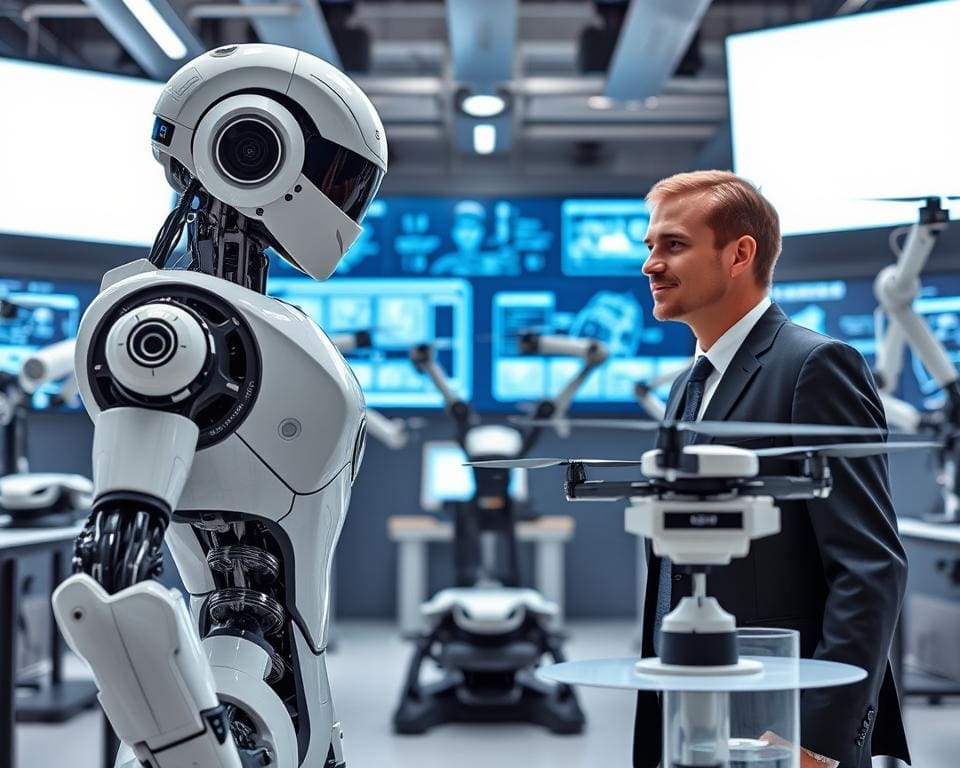
Robotics is moving from laboratory experiments into everyday life, and the question “What are the latest breakthroughs in robotics?” matters now more than ever. Rapid improvements in sensing, learning and actuation are unlocking new commercial use cases across healthcare, industry and the home.
This piece surveys three core pillars of progress: perception and sensing, learning and autonomy, and actuation and mobility. We will show how advances by teams such as DeepMind and OpenAI in learning, and companies like NVIDIA and Intel with RealSense in sensing, combine with actuation work from Soft Robotics Inc. and Festo to produce genuinely cutting-edge robotics.
Applied examples make the gains tangible. Boston Dynamics and Agility Robotics are redefining legged mobility, while Intuitive Surgical, Ekso Bionics and ReWalk lead in surgical and rehabilitation robotics. Readers in the UK will recognise strong research from the University of Oxford, Imperial College London and the University of Cambridge, plus growing testing clusters in the Midlands and Scotland that support skills and trials.
The article will unpack robotics advancements 2026 and likely robotics future trends, exploring practical implications for business leaders, clinicians, policymakers and educators. For a glimpse of household automation and how robots integrate into daily life, see this overview on robotic home helpers at robotic home assistants.
Throughout, we highlight robot innovation UK and global R&D that together shape a clearer, more inspiring roadmap to the next wave of cutting-edge robotics.
What are the latest breakthroughs in robotics?
Robotics is moving faster than many expect, with research and industry pushing motor, sensor and software limits. This section outlines three technical pillars that drive modern machines: how they perceive the world, how they learn to act within it, and how they move and touch objects. Expect concrete advances that enable more capable, adaptable robots in everyday settings.
Advances in robot perception and sensing
Vision systems now combine event cameras and neuromorphic sensors with conventional cameras to lower latency and power use. These sensors mimic biological processing to detect rapid changes and sparse scenes. That change fuels clearer scene understanding for drones, inspection robots and autonomous vehicles.
Tactile sensing has improved through thin, flexible skins and high-resolution sensor arrays. Robots can now feel texture, slip and pressure with a sensitivity close to human touch. This capability helps robotic hands handle fragile items and improves safety when robots work alongside humans.
Progress in learning and autonomy
Reinforcement learning robotics has scaled from labs to real-world tasks by using better simulators and data pipelines. Researchers use sim-to-real transfer methods to bridge the gap between virtual training and physical deployment. That workflow reduces wear on hardware while enabling complex manipulation and decision-making.
Hybrid systems pair model-based control with learned policies to improve reliability. Companies such as DeepMind and OpenAI advance sample-efficient algorithms, while universities refine transfer techniques to make autonomy robust under changing conditions.
Breakthroughs in actuation and mobility
Soft robotics brings compliant, safe motion into areas where rigid machines once dominated. Silicone actuators and variable-stiffness materials allow robots to squeeze, grip and adapt to irregular shapes without damaging them. This trend opens new uses in handling produce and in-home assistance.
Legged robots show major progress in agility, balance and energy efficiency. Platforms from Boston Dynamics and Unitree demonstrate dynamic walking, running and recovery from disturbances. Better joint actuators and control algorithms give these robots the ability to traverse uneven terrain for inspection and rescue missions.
Robotics innovations transforming healthcare and assistive technology
Robotics is reshaping care across hospitals, clinics and homes in the United Kingdom. New devices enhance precision, widen access and reduce recovery times. This section highlights concrete applications and practical benefits for patients, clinicians and health systems.
Surgical and hospital robotics
Robot-assisted theatres now host systems from Intuitive Surgical and CMR Surgical that support complex procedures with smaller incisions. Surgical robotics help reduce blood loss, shorten stays and improve outcomes for cancer and cardiac cases.
Teleoperated surgery platforms permit specialists to advise or operate remotely during emergencies and routine care. These systems expand access in rural areas and create new models for specialist outreach across NHS networks.
Rehabilitation and prosthetics
Clinics use exoskeletons UK projects to restore mobility after stroke or injury. Lightweight frames aid gait training and speed up recovery by repeating safe, precise movements under therapist supervision.
Personalised rehabilitation plans now pair wearable robotics with data analytics to tune therapy to each patient. This approach boosts engagement and offers measurable progress at a faster pace.
Neuroprosthetics bring prosthetic limbs closer to natural control by linking sensors to neural signals. These advances improve dexterity and give users finer control of daily tasks.
Companion and assistive robots
Assistive robots eldercare are appearing in care homes and private houses to support daily living. Robots handle reminders, medication prompts and simple physical assistance while easing staff workloads.
Social robots complement human carers by offering conversation, cognitive exercises and fall detection. Pilots in the UK show improved wellbeing and reduced isolation for older adults.
- Reduced pressure on wards through smarter task allocation
- Improved patient independence with adaptive devices
- Better continuity of care using remote monitoring tools
Industrial and commercial breakthroughs accelerating productivity
Recent robotics advances are reshaping UK industry, lifting throughput and cutting downtime. Businesses from small manufacturers to large fulfilment centres are trialling new systems that blend precision, speed and safety. The focus shifts from single machines to connected fleets and service models that scale with demand.
Collaborative robots and human–robot interaction
Collaborative robots now work side-by-side with operators on assembly lines and packing benches. These cobots UK deployments reduce repetitive strain and let skilled workers focus on complex tasks. Easy programming and safe force-limited designs mean teams can adapt cells quickly for changing products.
Manufacturers such as Universal Robots and FANUC offer platforms that integrate with existing tooling. That shortens setup times and raises overall equipment effectiveness. Training programmes from vocational colleges help the workforce embrace these changes.
Automation in logistics, warehousing and manufacturing
Warehouse automation is moving beyond pallet movers to intelligent pick-and-place and dynamic shelving. Automated guided vehicles pair with vision systems to handle high-mix orders. Fleet coordination software keeps traffic flowing and prevents bottlenecks.
UK retailers and third-party logistics firms see clear returns from these upgrades. Faster fulfilment and fewer errors improve customer satisfaction and lower operating costs. Modular systems let sites expand capabilities without large upfront capital.
Robotics-as-a-Service and commercialisation trends
Robotics-as-a-Service (RaaS) is changing how companies access automation. Subscription models reduce capital barriers and include maintenance and upgrades. This makes cutting-edge robots reachable for SMEs and seasonal businesses.
Cloud robotics and shared data platforms allow suppliers to monitor performance and push updates remotely. That keeps fleets performing at peak levels and shortens response times for faults. New value chains are forming around installation, analytics and operator training.
- Flexible contracts speed adoption for tight-margin sectors.
- Outcome-based pricing ties vendor rewards to uptime and throughput.
- Partnerships between integrators and cloud providers strengthen support networks.
Frontier research and ethical, societal implications
Emerging work in swarm robotics and environmental robotics is pushing science toward systems that scale, collaborate and monitor fragile ecosystems. UK research labs are testing distributed agent designs that mimic insect colonies to map flood zones or monitor biodiversity. These approaches promise resilience and low cost, but they also raise fresh policy questions.
Ethical AI robotics sits at the heart of the debate. Engineers, ethicists and institutions such as the Alan Turing Institute are shaping norms for transparency, fairness and accountability in robot behaviour. That work must sit alongside a robust regulatory framework robotics UK can adopt to govern testing, deployment and data use without stifling innovation.
Society must also confront workforce reskilling robotics will demand. The labour market needs clear pathways for technicians, operators and designers to move from legacy roles into higher‑skill positions. Government programmes, universities and trade organisations can coordinate apprenticeships and short courses to reduce displacement and boost productivity.
Finally, public trust will depend on clear governance, open research and environmental stewardship. By blending technical advances with ethical oversight and practical regulation, the UK can steward robotics so that breakthroughs benefit communities, protect nature and sustain long‑term prosperity.