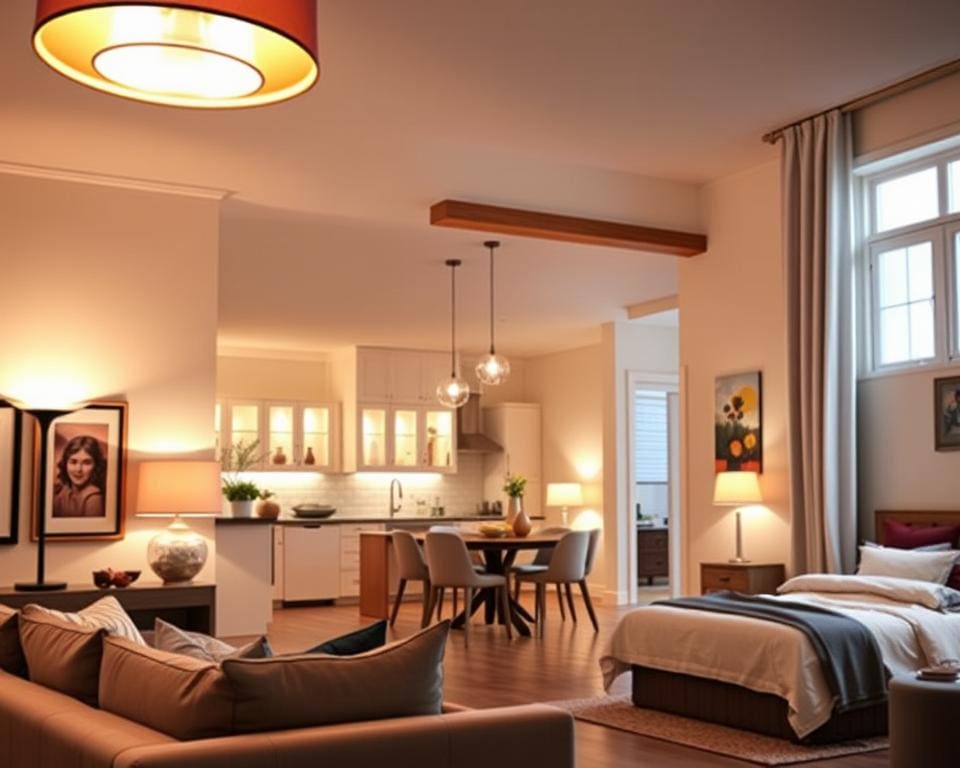

Good lighting shapes how a home feels and works. In this room lighting guide we explain why light matters for function, mood and style across British homes.
Practical needs such as reading, cooking and grooming must sit alongside emotional aims like relaxation or focus. Lighting also highlights architectural details and finishes to lift a room’s appearance.
At the planning stage, consider room size and ceiling height, natural light, furniture layout, wall and floor colours, and the occupants’ lifestyle. These factors help you choose lighting for rooms that are safe, comfortable and attractive.
This article will show how to understand each room’s purpose, master layered lighting, and select colour temperature and efficient lamps. You will then find tailored advice for living rooms, kitchens, bedrooms and bathrooms, followed by practical controls and styling tips.
For UK readers, we note typical ceiling heights in period and modern properties, bathroom and external lighting rules such as IP ratings, and the ready availability of LED retrofit options from retailers like John Lewis, B&Q and specialists such as Lightology and LuxxBox. Simple updates can be DIY, but rewiring should use a NICEIC-registered electrician.
Read on for practical, stylish and energy-smart home lighting tips that help you decide how to choose lighting for each room and transform your spaces.
How do you choose lighting for each room?
Good lighting begins with purpose. Think about how each room will be used and map activity zones. A living room centres on socialising and relaxation, a kitchen supports food preparation and social hubs, a bedroom focuses on sleeping and dressing, and a study needs focused work. List tasks in each zone to set target lux levels and guide fixture choice.
Understand the primary purpose of each room
Start by noting the room lighting purpose for every space. Sketch a floor plan and mark where people sit, cook, read or groom. Use typical lux guidelines: living rooms 100–300 lux, kitchen worktops 300–750 lux, bathroom mirrors 500–1000 lux, home offices 300–500 lux.
Place lights to suit furniture and focal points. Art, fireplaces and shelving need different emphasis to seating or worktops. Mapping zones makes it simple to match light levels to activity.
Layering light: ambient, task and accent
Follow basic lighting principles by building three layers. Ambient lighting gives general illumination with ceiling fittings, cove lights or recessed downlights. Task lighting adds targeted brightness where you read, cook or apply make-up. Accent lighting highlights architecture, artwork or textured walls.
Combine layers in a living room: a central pendant for ambient, a floor lamp beside a reading chair for task, and adjustable spotlights or LED strips to accent a feature wall. Aim for even distribution, minimise glare and position task lights to avoid casting shadows.
Consider colour temperature and mood
Use a colour temperature guide to set mood. Warm light at 2700–3000K creates a cosy, intimate feel for living rooms and bedrooms. Neutral white at 3000–3500K suits kitchens and dining areas. Cool daylight at 4000–5000K improves focus in utility rooms and task zones.
Check Colour Rendering Index (CRI) when colour accuracy matters. Choose CRI 80+ for most rooms and CRI 90+ for art displays or make-up. Try mixed-temperature strategies, such as warm ambient light with cooler task fittings in a kitchen, to balance atmosphere and clarity.
Energy efficiency and lamp types
Decide on lamp technology by weighing lifetime, efficiency and light quality. LEDs offer high efficiency, long life and a wide range of colour temperatures. CFLs are mostly superseded and contain mercury. Halogen gives strong colour rendering but lacks efficiency and faces phase-out. Incandescent lamps are now largely obsolete.
Think in lumens rather than watts: 800 lm roughly equals a 60W incandescent. Use LED-compatible dimmers for smooth control and consider smart bulbs from trusted brands such as Philips Hue, IKEA, Osram or Megaman for scene setting. Compare LED vs halogen where colour rendering is important but energy use matters more.
Designing lighting for specific rooms and layouts
Good lighting turns a house into a home. Think about how each space will be used and arrange layers that suit function and mood. Use zones and scenes to adapt light to daily life and to varied layouts.
Living room strategies
Create a flexible, layered scheme that supports socialising, TV time and quiet reading. Start with a central pendant or chandelier sized to the room: add the room length and width in metres, convert that sum to centimetres and use that figure as a guide for fixture diameter. Pair ambient light with recessed downlights or cove lighting to avoid flatness.
Introduce task fixtures such as adjustable floor lamps and table lamps beside sofas and armchairs. Place reading lights where people sit most often. Use accent fittings—picture lights, wall grazers and LED strips behind TV units—to add depth and reduce eye strain. For open-plan spaces, define dining and seating areas with lighting zones and separate circuits or dimmable scenes.
Kitchen and utility areas
Prioritise clear, shadow-free illumination over worktops. Under-cabinet LED strips and recessed linear lights deliver even coverage for food preparation. Aim for high CRI and a colour temperature between 3000–4000K to show true colours when cooking.
Over islands, pick pendants that provide focused task light and a strong style note. Hang them roughly 75–90cm above the surface for best results. Add recessed downlights for overall coverage and install dedicated illumination inside pantry and utility cupboards. Choose hardwearing, easy-clean fittings and check the bathroom lighting IP rating for damp zones near sinks and wet utility areas.
Bedroom ambience and practicality
Design a calming scheme that supports sleep and waking. Use warm ambient lighting from dimmable ceiling fixtures or recessed lights. Fit bedside task lamps or wall-mounted swing arms with switches that are easy to reach from the bed for reading.
Create a dressing-area plan with vanity lights that have high CRI and symmetrical placement to reduce shadowing. Add low-level night lights—warm LED strips—to guide movement without glare. Consider smart controls that offer gradual brightening for wake-up routines and warm dimming in the evening to support circadian rhythms.
Bathroom considerations
Match fittings to legal safety requirements and wet-zone conditions. Select fixtures with the correct bathroom lighting IP rating for their position. Use IP44 or higher where splashes are likely and choose greater protection near showers or baths.
Prioritise mirror lighting that gives even, shadow-free illumination at eye level. Fit vertical lights either side of the mirror or a horizontal strip across the top and aim for 300–1000 lux when detailed tasks are expected. Install extractor fans with integrated lighting where needed and opt for moisture-resistant LED downlights designed specifically for bathrooms.
Practical tips, controls and styling to enhance each room
Begin with lighting controls to make rooms both beautiful and efficient. Use dimmers and scenes to set mood and save energy, and fit traditional dimmer switches that are LED‑compatible. For whole‑home control consider retrofit smart switches such as Lutron Caseta or Hive, and smart bulbs from Philips Hue or LIFX for app and voice operation with Amazon Alexa, Google Home or Apple HomeKit. Zone‑based schedules and holiday modes work well in UK homes when integrated with heating and other smart systems.
Careful light positioning reduces glare and improves function. Place task lights so they do not cast shadows across worktops — left of the workspace for left‑handed users and right for right‑handed users — and use diffusers or frosted glass to soften harsh beams. Aim downlights away from reflective surfaces, keep fittings dust‑free and ensure bulbs are reachable for replacement. Test emergency and exterior lights annually and replace LED drivers with manufacturer‑recommended spares when needed.
Styling lighting ties a scheme together. Match fixtures to the architecture — a period pendant for older houses or minimalist track lighting for contemporary spaces — and coordinate finishes such as brass, chrome or matte black with taps and hardware. Use uplighters to reveal cornices, cove lighting to accent ceilings and LED strips to show off shelving. Try smart bulbs temporarily to trial colour temperature and dimming ranges before committing to a permanent fitting and visit showrooms like John Lewis or Habitat to preview effects.
Budget for fixtures, bulbs and installation from the start and choose registered electricians from NICEIC, NAPIT or ECA for rewiring or new circuits. For complex schemes, a lighting designer can maximise the return on budget; for simpler upgrades, work room by room to spread cost. Thoughtful choices in lighting controls, dimmers and scenes, styling lighting and precise light positioning tips will transform everyday life, boost wellbeing and add value to your UK home.