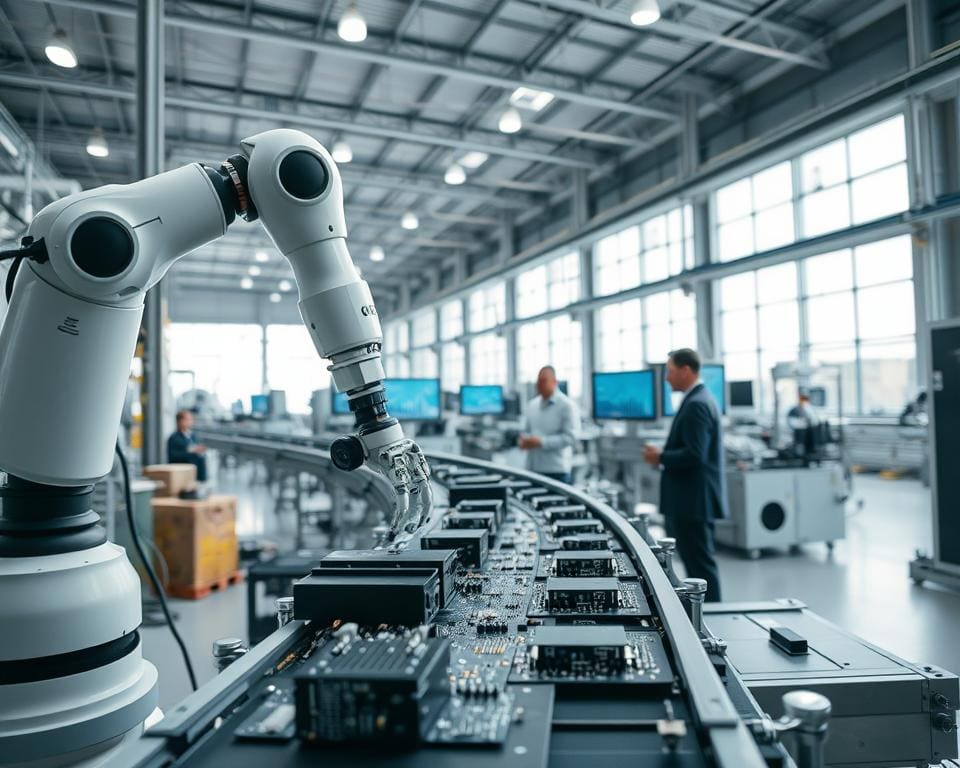

Industrial leaders now ask a simple question: why is automation reshaping industrial production worldwide? This article treats automation as a suite of products and solutions — robots, collaborative robots, IIoT platforms, AI software, sensors and digital-twin services — and assesses how they work together to change factory floors.
Macro drivers are clear. Global competition and rising labour costs in some markets push manufacturers to seek consistency and scale. Demand for mass customisation and the supply-chain fragility exposed by recent disruptions make agility essential. Regulatory pressure for sustainability and tighter quality control adds further urgency.
Analysts at McKinsey and the International Federation of Robotics report that adoption rates and productivity gains are rising, underlining the broader manufacturing automation trends. For UK plants, industrial automation UK is not just a technical upgrade; it is a strategic choice that affects resilience and long-term competitiveness.
The article aims to inspire factory managers, operations directors and procurement teams to evaluate automation products strategically. It stresses balancing productivity gains, workforce implications, resilience and compliance, rather than treating automation as a single fix.
Readers can expect a structured guide: an overview of trends, economic benefits, enabling technologies, workforce and skills implications, supply-chain resilience, regulatory and ethical considerations, and a practical buyer’s guide to selecting automation solutions tailored to UK manufacturers and focused on automation benefits manufacturing.
Why is automation reshaping industrial production worldwide?
Manufacturers from Birmingham to Shenzhen are rewriting production playbooks. Growth in industrial robot installations, wider use of collaborative robots in small and medium-sized enterprises and rising investment in IIoT platforms show a clear shift. These global automation trends reflect practical choices by firms aiming for speed, quality and resilience.
Overview of global trends in industrial automation
Recent data from the International Federation of Robotics shows steady gains in robot deployments across automotive, electronics, pharmaceuticals and food and beverage sectors. Discrete manufacturers and SMEs are adopting lower-cost cobots and cloud-based SaaS tools. Europe and Asia lead investment in connected manufacturing, while nearshoring and reshoring in the UK and mainland Europe drive local automation projects.
Key drivers behind the rapid adoption of automation
Pressures on margins push firms to cut unit costs and boost throughput. Automation reduces repetitive labour, improves consistency and supports energy efficiency targets. Demand for customisation is rising, so firms choose modular, reprogrammable equipment that enables fast changeovers. Automation also strengthens supply-chain resilience by lowering reliance on variable labour and improving responsiveness.
Role of automation in modern manufacturing strategies
Automation now sits at the heart of lean production, just-in-time schedules and digital transformation programmes. Lights-out operations suit high-volume lines, while human–robot collaboration fits mixed workflows that need dexterity and judgement. Platform-based automation bundles hardware with cloud analytics and service contracts from vendors such as ABB, Fanuc and KUKA, helping firms apply smart manufacturing strategies and meet Industry 4.0 UK benchmarks.
- Sector focus: automotive and electronics continue to lead adoption.
- SME access: cloud SaaS and cobots lower barriers to entry.
- Strategic balance: full automation for scale, collaboration for flexibility.
Economic benefits and productivity gains from automation
Automation drives visible cost and output improvements across British factories. Clear mechanisms explain how firms reduce waste, shorten cycle times and lift throughput. These changes underpin stronger automation ROI and sustained productivity gains automation.
How automation reduces unit costs and improves throughput
Precise motion control cuts scrap and rework, raising yield while lowering variable labour costs. Continuous operation with fewer shift losses keeps lines running, while modular tooling enables faster changeovers. Many manufacturers report labour-related variable cost drops in the order of 20–40% and yield improvements of 5–15% when introducing targeted robotic systems.
Throughput improvement robotics often delivers line-speed gains of 10–60%, depending on process complexity. Electronics and packaging lines, for example, typically see automated pick-and-place reduce cycle times by 30–50%.
Impact on operational efficiency and cycle times
Automated handling and in-line inspection remove non-value-add tasks that slow production. Conveyorised systems and robots cut manual transfer time and smooth takt, reducing overall cycle times.
IIoT-enabled monitoring shortens downtime through predictive maintenance and real-time OEE dashboards. Firms using condition monitoring report fewer unplanned stops and quicker mean time to repair, which supports higher productivity gains automation across the plant.
Return on investment (ROI) examples and payback periods
A midsized UK food-packaging line that adopts a collaborative robot for palletising may achieve payback within 12–24 months when labour savings and throughput gains are included. An automotive stamping cell that combines robots with predictive maintenance commonly realises automation ROI within 2–4 years.
- Cost items to include in ROI: capital expenditure on hardware, systems integration, software licences, training and change-management.
- Ongoing costs: maintenance, spare parts and cloud subscriptions versus savings from reduced labour, lower scrap and improved throughput.
- Financing options: leasing, equipment-as-a-service and vendor financing can reduce upfront cash requirements and accelerate adoption.
Careful modelling that captures reduced unit costs manufacturing, expected uptime gains and realistic service costs helps decision-makers compare scenarios. Transparent assumptions improve confidence in projected automation ROI and guide the scale of investment.
Technologies powering the automation transformation
Industry 4.0 rests on a handful of technologies that change how factories operate. These tools work together to speed production, cut defects and make work safer. Below we outline the core elements that British manufacturers are adopting today.
Traditional industrial robots deliver high speed, tight precision and heavy payload capacity. Cobots offer a different promise: safe human–robot collaboration and simpler programming. Major vendors such as ABB, Fanuc, Universal Robots and KUKA supply both classes of machines. Advances in end-effectors and machine vision expand tasks from arc welding and material handling to assembly, inspection and palletising. The result is less cycle variability and better ergonomics for shopfloor teams across the UK.
Industrial Internet of Things and connected sensors
Factories now use layered IoT architectures: edge devices gather signals, gateways route data and cloud platforms host analytics. Common devices include vibration, temperature, force and proximity sensors. Protocols such as OPC UA and MQTT keep devices speaking the same language. Continuous streams from IIoT sensors manufacturing environments enable real-time condition monitoring, process optimisation and sharper supply-chain visibility.
Artificial intelligence, machine learning and predictive maintenance
Machine learning models mine sensor streams to spot patterns that escape human notice. These models predict bearing failure, flag quality drift and highlight bottlenecks before they escalate. Commercial suites from Siemens and GE Digital sit alongside newer analytics vendors to deliver actionable alerts. Anomaly detection, computer vision for inspection and reinforcement learning for process tuning each play a part in robust AI predictive maintenance strategies.
Advanced manufacturing: additive manufacturing and digital twins
Additive manufacturing speeds prototyping, enables bespoke toolmaking and supports low-volume parts runs. Industrial players like Stratasys and EOS serve aerospace, automotive and tooling needs. Digital twins create live virtual replicas of machines and lines for simulation and root-cause analysis. Platforms from Siemens and Dassault Systèmes let engineers run what-if scenarios and refine layouts without stopping production, linking simulation to reality.
- Robots and cobots expand task flexibility while lowering risk to people.
- IIoT sensors manufacturing gives continuous data that drives smarter decisions.
- AI predictive maintenance shifts servicing from calendar-based to condition-led.
- Digital twin additive manufacturing shortens the design loop and reduces waste.
Workforce implications and skills evolution
Automation is reshaping roles across British industry. Routine manual tasks are falling as machines take on repetitive work. New technical roles are growing for robot programmers, systems maintenance technicians, data analysts and process engineers. Employers value problem-solving, supervision and cross-disciplinary knowledge that blends mechanical, electrical and software skills.
Shifts in job roles: from repetitive tasks to higher-skilled work
On the factory floor, cobots and automated lines change day-to-day duties. Staff who once carried out repetitive operations now oversee cell performance and intervene on exceptions. Roles evolve toward calibration, troubleshooting and optimisation of human–robot collaboration jobs.
Reskilling and upskilling programmes for British manufacturers
The UK offers practical pathways to help workers adapt. Government-backed apprenticeships and the Made Smarter initiative fund training in automation and digital skills. Providers such as the Manufacturing Technology Centre and university-industry partnerships deliver courses in automation, robotics and data analytics.
Companies should invest in bespoke training, vendor-led onboarding and apprenticeships. Collaboration with local colleges builds a steady talent pipeline. These measures support effective reskilling manufacturing and nurture long-term capability within firms.
Strategies to manage workforce transition and social responsibility
Adopt phased roll-outs to limit disruption and allow time for redeployment. Clear, transparent communication and early employee consultation ease anxieties. Offer retraining and aim for guaranteed redeployment where possible to protect livelihoods.
- Redeploy staff into supervision, maintenance or quality roles linked to automation.
- Negotiate collaborative agreements with unions to secure fair outcomes.
- Use automation to remove hazardous or ergonomically harmful tasks, raising job quality.
These measures support sustainable change and maintain social licence while enabling the benefits of workforce automation UK and the success of upskilling programmes British industry.
Supply chain resilience and automation-driven agility
Automation gives manufacturers a sharper edge when demand shifts. Modular production lines and rapid robot reprogramming let teams change SKUs faster and run smaller batches without long downtime. Cloud orchestration links sites and suppliers so scheduling adapts in real time to sales signals.
Real-time data feeds enable demand-sensing that tightens alignment between orders and output. Dynamic scheduling reduces lead times and cuts waste, which supports supply chain automation strategies across factories and distribution hubs.
How automation improves responsiveness to demand fluctuations
- Modular lines and reprogrammable robots shorten changeover times.
- Cloud-based orchestration synchronises production and logistics instantly.
- Demand-sensing algorithms trigger automatic schedule updates to match market trends.
Inventory optimisation and just-in-time production enabled by automation
Automated warehousing tools, such as AMRs and AS/RS, speed picking and reduce errors. When ERP and MES systems share live data, teams can cut safety stock while keeping service levels high.
- Inventory optimisation automation lowers carrying costs and speeds fulfilment.
- Just-in-time automated production pairs lean thinking with visibility to keep buffers small but resilient.
- Contingency routines in software maintain flow if a node becomes constrained.
Case examples of automated supply chains recovering from disruption
During the pandemic, logistics operators used robotics and analytics to reroute fulfilment and handle peak volumes. Automotive suppliers leaned on local automated micro-factories to replace distant parts that were delayed.
These approaches show how diversification, rapid retooling and automation-led visibility supported faster recovery. Firms that invested in supply chain automation and inventory optimisation automation managed service levels better and helped create more resilient supply chains UK.
Regulatory, safety and ethical considerations in automated production
Manufacturers in the United Kingdom must balance bold innovation with careful oversight. This section outlines key standards, cyber precautions and ethical practices that make automation safe, resilient and trustworthy. Clear policies help teams adopt new systems while meeting regulatory compliance manufacturing goals.
Health and safety standards for human–robot collaboration
Follow recognised standards such as ISO 10218 and ISO/TS 15066 together with Health and Safety Executive guidance to manage risks around robots. Practical steps include formal risk assessments, fitted safeguarding, speed and separation monitoring, and certified safety controllers to reduce harm.
Use written procedures for on‑site maintenance, and ensure staff training covers emergency stop, lock‑out procedures and safe interaction zones. Regular audits keep systems aligned with safety human-robot collaboration expectations.
Data privacy, cybersecurity and compliance in industrial systems
Connected kit introduces threats like unauthorised access, data exfiltration and operational disruption. Adopt guidance from the National Cyber Security Centre and IEC 62443 to protect control systems.
Best practice includes network segmentation, secure remote access, scheduled patching, asset inventory and supplier security clauses in contracts. These measures support robust industrial cybersecurity UK postures and help demonstrate regulatory compliance manufacturing to auditors.
Ethical implications: decision-making, transparency and accountability
Automated systems may make operational calls about quality or order priority. Set policies that keep a human in the loop for critical exceptions and document algorithm logic so decisions remain auditable.
Maintain traceability of automated actions and create governance that assigns responsibility for system behaviour. Clear records and transparent controls address automation ethics concerns and build trust with customers and regulators.
Practical adoption combines these threads into a single compliance plan. Risk assessments, cyber hygiene and ethical governance form the backbone of safe, scalable automation in modern manufacturing.
How to evaluate and choose automation solutions for your factory
Start with a clear needs assessment that maps current processes, pinpoints bottlenecks, quality issues and ergonomics or safety hazards, and quantifies expected gains in throughput, yield and cost reduction. Use an automation procurement checklist to record objectives, baseline data and target KPIs such as OEE, cycle time and defect rate. This step ensures you choose automation solutions that solve real problems rather than adding complexity.
Match technology to product mix and volumes when you evaluate cobots UK, flexible robotic cells, fixed automation, IIoT platforms and software. Consider workforce skills and the degree of variability in production: cobots suit mixed lines and close human collaboration, while fixed systems work for high-volume repeatable tasks. A concise factory automation vendor selection process should weigh sector-specific case studies, after-sales support, training and cybersecurity posture.
Begin with a pilot or proof of concept on a representative line and define success metrics before wide rollout. Build full total cost of ownership and ROI models that include capital, integration, training, commissioning downtime and subscription fees. Explore financing options and government grants available through UK industry support schemes to reduce upfront risk and improve payback.
Plan change management and workforce reskilling from day one, defining new roles, timelines and communication with staff and unions. Ensure contracts include data governance, cybersecurity clauses and compliance with ISO and HSE standards. View automation as an enabler: measured, human-centred adoption—backed by the right products, training and governance—delivers resilience, higher-value work and long-term competitiveness for UK manufacturers.