
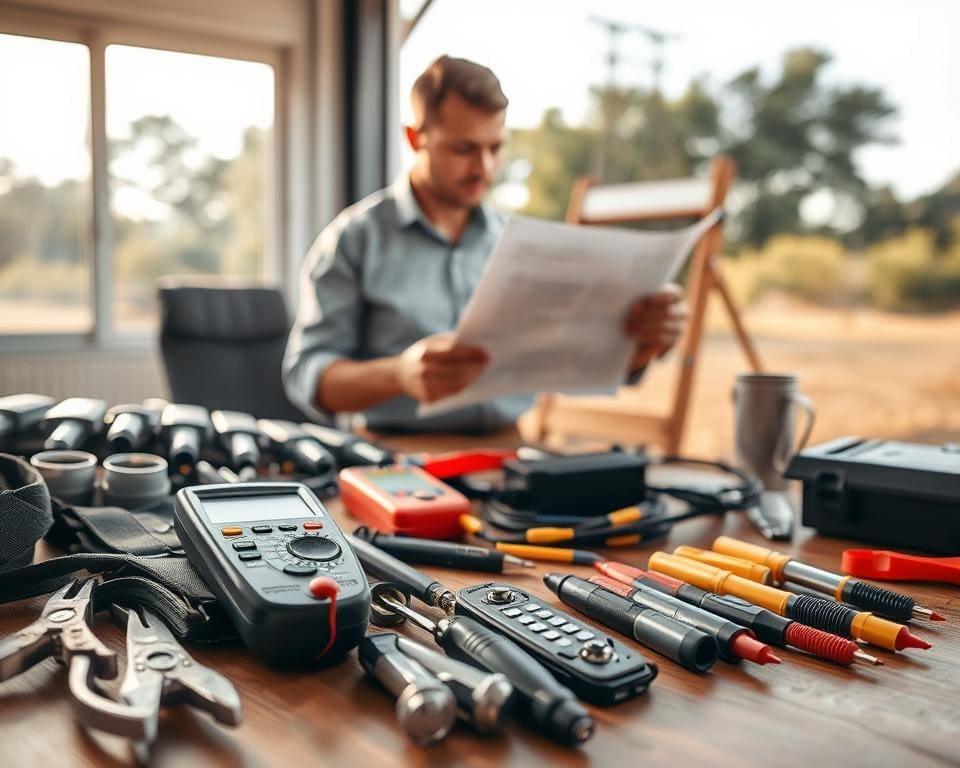
For engineers and technicians working across the UK, choosing the right kit is part craft and part identity. This guide asks a clear question: what tools do field technicians carry to stay efficient, safe and compliant on site?
We cover field technician tools from hand tools to diagnostic instruments, power solutions and PPE. Expect reviews and practical advice on the essential kit for engineers in electrical, HVAC, telecoms, IT infrastructure and mechanical service roles.
The article examines leading brands such as Bosch, DeWalt, Fluke, Klein Tools, Milwaukee, Ridgid, Makita, Snap‑On, Pelican and Hilti. It also considers UK specifics: CE/UKCA markings, BS EN standards, weatherproofing for British conditions and working‑at‑height rules.
Readers will find clear sections on hand tools and small essentials, diagnostic meters and imagers, cordless power and charging, safety equipment, storage and transport, plus software and mobile devices that underpin modern field work.
With a focus on reliable, portable UK field service equipment, this piece aims to inspire confidence. The right tools for onsite repairs reduce downtime, improve safety and strengthen customer trust.
What tools do field technicians carry?
Tools for field work span much more than a simple spanner. The term covers hand tools and power tools, diagnostic test gear, personal protective equipment, storage and transport solutions, plus the software and mobile devices used for documentation and remote diagnostics. That broad view helps teams prepare the right kit for every visit.
Typical job tasks shape the selection: installation, fault‑finding, preventative maintenance, calibration, testing and emergency repair each demand specific items. For most calls, a core list keeps work efficient and safe.
- Multi‑position screwdriver and bit set
- Digital multimeter and clamp meter
- Cordless drill with spare batteries
- Insulated pliers and cutters
- Torch and headlamp
- PPE: gloves, hi‑vis vest and safety boots
- Rugged tablet or smartphone for reports
Think of a standard technician toolbox as a dependable foundation. That box holds the essentials for a basic service call. Trades customise from there. An electrical engineer will prioritise insulated tools, test leads and a clamp meter to meet NICEIC expectations.
Network specialists need cable certifiers, tone generators and patch leads. Mechanical engineers favour torque wrenches, impact drivers and calibrated sockets. This modular approach keeps the essential field technician kit compact while enabling targeted add‑ons for specialist tasks.
Contractual and regulatory rules often influence what technicians carry. Client site policies, insurance conditions and sector schemes such as Gas Safe shape tool lists and PPE standards. Teams who align their kit with these requirements reduce delays and protect both staff and clients.
Adopt a core plus strategy: maintain a compact, reliable core set for routine visits and attach trade‑specific modules for complex jobs. That method answers the question what to pack for site visits with balance and foresight, while keeping the standard technician toolbox light and ready.
Hand tools and small essentials for onsite repairs
Fieldwork demands a compact kit that blends durability, comfort and accuracy. Quality hand tools for technicians reduce fatigue on long shifts and protect against mistakes on live systems. Pack items that deliver precision and safety, from insulated screwdrivers to robust pliers, so every callout ends with confidence.
Screwdrivers, nutdrivers and bit sets
Choose screwdriver sets from trusted makers like Wiha, Wera and Stanley for longevity and repeatable performance. VDE‑rated insulated screwdrivers are essential for live‑work compliance when working on electrical panels.
Carry a mix of Phillips, Pozidriv and slotted tips plus Torx and hex bit sets. Multi‑bit ratcheting systems and magnetic bit holders speed up repetitive tasks. Compact bit organisers and quick‑change handles save space in a toolbox.
For a practical overview on assembling a balanced kit, consult a helpful guide such as this toolset primer.
Pliers and cutters for electrical and mechanical tasks
Include combination pliers, long‑nose pliers, diagonal cutters and linesman pliers for everyday jobs. Brands like Klein Tools, Knipex and Channellock offer the grip and build quality needed on site.
Insulated pliers protect against shocks when working near live conductors. For heavier cable work, carry bolt cutters or dedicated cable cutters. Crimping pliers and wire‑strippers with adjustable stops such as those from Ideal Industries keep terminations neat and reliable.
Torque wrenches and adjustable spanners
A torque wrench for fieldwork is vital where tightening to specification affects safety or warranty. Click‑type and preset torque wrenches from Snap‑On, Facom or Teng Tools deliver consistent results.
Complement torque tools with high‑quality adjustable spanners and a set of combination spanners in both metric and imperial sizes to cover varied UK sites. Store torque instruments in foam trays and have a calibration plan to protect accuracy.
Inspection mirrors and magnetic pick‑up tools
Compact telescopic mirrors and magnetic retrievers save time when fasteners fall into tight spaces. LED inspection lights and borescope cameras such as Depstech or Teslong reveal hidden faults in confined areas.
Choose inspection tools rated for dust and water resistance. Prioritise versatile items like a Leatherman multi‑tool and keep frequently used bits and blades in quick‑access pockets for efficient onsite repairs.
Diagnostic instruments and test equipment
Fast, reliable diagnostics are the backbone of fieldwork. The right diagnostic tools for field technicians cut fault‑finding time, lower repeat visits and boost customer trust. Invest in gear that balances accuracy, ruggedness and clear reporting.
Digital multimeters and clamp meters
Choose industry‑standard models from Fluke for safety and repeatable readings. Look for true‑RMS, autoranging, low‑Z mode to avoid ghost voltages, inrush current measurement and data logging. Carry a compact handheld multimeter for quick checks and a higher‑spec model for complex diagnostics. For mains and current work, a clamp meter with CAT III/CAT IV ratings is essential.
Portable oscilloscopes and signal tracers
Handheld brands such as Rigol, Hantek and Siglent deliver waveform analysis without a bench. Match bandwidth and sample rate to the signals you expect to see. A reliable portable oscilloscope helps with transient faults and timing issues on control systems.
Signal tracers and tone generators from Fluke or Klein Tools speed cable identification and audio signalling tasks. Prioritise battery life and a tough case for daily site use.
Thermal imagers and non‑contact thermometers
Thermal imaging cameras by FLIR or Fluke transform electrical and HVAC inspections. Higher resolution and sensitivity show subtle temperature differences, while lower‑cost cameras give fast hotspot checks. Non‑contact infrared thermometers suit quick spot verifications; watch emissivity settings and response time.
Use thermal tools to expose overheating components, blocked vents, insulation gaps and bearing wear before they fail.
Network testers and cable certifiers
Handheld network cable tester units handle continuity checks, tone tracing and PoE testing. For certification and warranty evidence use Fluke Networks certifiers for Cat5e, Cat6, Cat6A and fibre tests including OTDR and power meters. A good network cable tester makes documentation simpler and more defensible for clients.
Include PoE testers, cable tracers and signal level meters for telecoms and structured cabling jobs. Exportable test reports save time and support claims.
Calibration and compliance
Maintain accuracy with routine calibration traceable to UKAS when required. Store instruments in protective cases, keep spare batteries and use vendor software for data export and reporting. Regular checks protect measurement quality and client confidence.
Power solutions and portable power tools
Reliable power is mission‑critical for engineers working away from mains supply. Choose kit that balances weight, run time and service coverage so you can finish jobs on time. Think ahead about spare cells, safe charging and how a site power plan protects both tools and people.
Makita, DeWalt, Milwaukee and Bosch offer robust cordless ranges that perform across UK sites and have good aftersales networks. Pick Lithium‑ion systems in 18V or 20V platforms for the best mix of torque and weight. Brushless motors extend run time and reduce heat during heavy use.
Carry at least two charged batteries for each major tool and rotate them during long shifts. A universal battery ecosystem works when you use multiple brands, but check compatibility first. Pack impact‑rated sockets, right‑angle attachments and a compact drill bit set to cover common onsite tasks.
Portable generators and battery packs
For longer jobs, inverter generators from Honda and Ryobi deliver stable power for sensitive electronics. High‑capacity lithium packs from EcoFlow and Jackery give quiet, emission‑free output and are easier to transport than petrol units.
Size your system by calculating starting versus running watts for drills, heaters and compressors. Remember fuel transport restrictions and aviation rules if you travel, plus spark‑arresting and mufflers may be required to meet site rules and site generator safety standards.
Safe charging solutions and power management
Use IP‑rated chargers and in‑vehicle DC‑to‑DC systems to keep batteries healthy. Smart chargers cut charge current near capacity to extend service life. Good battery management includes RCD‑protected distribution units and fused outlets that conform to UK electrical safety standards.
- Keep spare leads, adaptors and a portable power bank for tools for short emergency boosts.
- Fit an emergency jump pack to vehicles and test in‑vehicle charging before site deployment.
- Label circuits and use fused power distribution for temporary setups.
Store batteries cool and dry at a partial charge when idle. Follow UK recycling schemes for end‑of‑life cells and book manufacturer service centres for warranty replacements. Regular performance checks reduce downtime and keep your kit ready for the next assignment.
Safety gear and personal protective equipment
PPE for field technicians is not optional. It protects teams, meets legal duties and reassures clients on site. Choose kit that fits the task, the weather and the risk profile for each visit.
Hi‑vis clothing, safety boots and gloves
Pick hi‑vis garments certified to EN ISO 20471 so crews stay visible in poor light. For UK conditions, layer with breathable jackets and waterproof trousers to manage rain and cold.
Safety footwear must meet safety boots EN ISO 20345 and include suitable toe protection and SRC slip resistance. Trusted makes such as Caterpillar and Timberland Pro offer durable soles and protective toes for field use.
Gloves vary by task. Use cut‑resistant gloves with EN 388 for sharp work, insulated gloves to EN 60903 for live electrical tasks and chemical‑rated or latex gloves for handling solvents. Lightweight and breathable options help with dexterity; consider two‑pack bargains or higher‑end gauntlets depending on exposure. For a quick comparison of popular glove types, visit a practical guide on garden gloves that highlights breathability and protection like nitrile and cotton models best garden gloves.
Eye protection, hearing protection and respirators
Eye protection should meet EN 166. Anti‑fog safety glasses suit varied temperatures. Use welding shields for hot work and wraparound styles where debris risk is high.
Hearing protection ranges from passive defenders to electronic earmuffs and high‑attenuation earplugs. Follow HSE guidance on noise exposure and choose attenuation ratings to match measured decibel levels.
Respiratory protection must suit the hazard. Disposable FFP2 and FFP3 masks filter dust and particulates. Use half‑mask or powered respirators with the correct filters for chemical work and carry out fit testing to ensure seal and performance.
Fall‑arrest equipment and confined‑space PPE
Working at height requires harnesses, lanyards, anchor devices and rescue kits certified to EN 361 and EN 358. Training, inspection records and pre‑use checks are essential to keep fall arrest equipment reliable.
Confined space PPE includes gas detectors, breathing apparatus and retrieval systems. Permit‑to‑work procedures, trained rescuers and clear emergency plans must accompany any entry into enclosed spaces.
Maintain, inspect and log all PPE. Set replacement intervals, follow cleaning protocols and keep records for UK HSE compliance. Carry a compact first‑aid kit and basic spill kit for chemical incidents to round out field safety provision.
Storage, organisation and transport for tools
Efficient tool storage for technicians shapes daily productivity, cuts downtime and lowers the risk of loss on UK sites. Think beyond a single box. Design systems that protect delicate instruments, balance loads for safe lifting and make kit retrieval fast during tight jobs.
Toolboxes, rucksacks and modular organisers
Choose robust hard plastic toolboxes such as Stanley FatMax for general use. Pair these with modular stackable organisers from Sortimo or Tanos for small parts and consumables. Professional rucksacks from DeWalt and Milwaukee offer padded compartments for laptops and handheld testers.
Use foam inserts and Pelican anti-shock cases to protect thermal imagers and oscilloscopes. Pick waterproof options where damp conditions are common. Distribute weight across shoulders and hips to reduce strain and follow manual handling guidance to protect health.
Vehicle racking systems and secure mounting
Fit vehicle racking UK solutions from Sortimo, Bott or Halfords Trade to create tidy shelving, drawers and secure mounts for heavy equipment. Fixed racks save space, speed job starts and help meet load security duties under UK law.
Include lockable cabinets, roof racks with rated straps and in-vehicle power outlets so batteries charge overnight. Check insurance terms before altering vans and ensure racks are professionally fitted to maintain compliance and safety.
Label‑led and inventory systems for asset tracking
Adopt a simple tool inventory system using barcode or RFID labels to speed audits and drop tool loss rates. Services such as ToolWatch, G2Ops and Cheqroom link labelling to mobile apps so teams can scan items and update records on site.
Schedule weekly checks, keep photographic records for client assets and tie serial numbers to warranties. Clear labelling of ownership, plus usage logs, improves accountability and supports planned maintenance for asset tracking for field engineers.
Use theft prevention measures to protect kit. Fit GPS trackers, wheel clamps for overnight parking and secure storage when not in use. Insuring tool inventories under a business equipment policy covers replacements and offers peace of mind on busy projects.
Software, mobile devices and documentation tools
Field work today depends on tools that turn hands‑on repairs into clear, billable outcomes. Rugged tablets and smartphones such as Panasonic Toughbook, Samsung Galaxy XCover and Zebra provide the toughness, battery life and vehicle‑mount compatibility technicians need. Ensure devices offer 4G/5G, Wi‑Fi, GPS and ample storage so teams can capture photos, thermal images and oscilloscope screenshots even when offline.
Choosing the right field service software UK platform makes scheduling, quoting and invoicing far more efficient. Solutions like ServiceM8, Salesforce Field Service, Joblogic and Commusoft streamline real‑time job allocation, parts tracking and customer signatures. Integration with accounting systems such as Xero or Sage and the ability to attach electronic job sheets reduces admin and boosts first‑time fix rates.
Accurate digital documentation for engineers is essential for compliance and customer trust. Use PDF annotation tools, time‑stamped photo capture and voice‑to‑text to speed report writing. Thermal image export and oscilloscope screenshots provide technical evidence, while electronic job sheets and digital forms create audit trails for warranty claims and contractual proof.
Security, training and future tools complete the picture. Implement mobile device management for technicians, VPNs, encryption and regular backups to meet GDPR and protect client data. Standardise templates and invest in training so staff adopt systems consistently. Emerging tech such as augmented reality remote assistance, IoT sensors and cloud telemetry will further empower field teams to diagnose and resolve faults before they return to base.