
This piece opens with a straightforward question: what devices are used in quality control? For UK manufacturers, laboratories and quality teams, the answer shapes purchasing, compliance and competitiveness.
The article is an inspirational QC tools review and practical guide to quality control devices and quality assurance equipment. It compares leading device categories, highlights trusted brands such as Mitutoyo, Hexagon, Zeiss, Renishaw, Keyence, Fluke, Keysight Technologies, Instron, ZwickRoell, Thermo Fisher Scientific, Agilent and PerkinElmer, and explains how each supports calibration, service and UK-based support.
Readers should expect clear buying considerations: accuracy, throughput, budget, service and calibration intervals. Typical use cases cover automotive, aerospace, medical devices, electronics, food and pharmaceuticals, while ROI metrics focus on reduced scrap and improved first-pass yield.
This introduction also flags regulatory drivers for the UK market — CE/UKCA marking, ISO 9001 and ISO 17025 accreditation, supply chain transparency, product safety and traceability demanded by retailers and regulators. Inspection instruments UK offerings increasingly respond to those pressures with documented calibration and traceable results.
The full article will proceed through dimensional metrology, material testing, surface inspection, electrical testing, chemical analysis and inspection data systems. Each section will describe devices, typical specifications, leading brands, advantages and recommendations for purchase or rental, making this a practical QC tools review for teams choosing inspection instruments UK-wide.
What devices are used in quality control?
Quality control in modern manufacturing rests on a clear understanding of device roles and how they work together. This short overview sets out the main quality control device categories, explains their functions and shows how the right choice supports product consistency and regulatory compliance.
Overview of device categories used in modern quality control
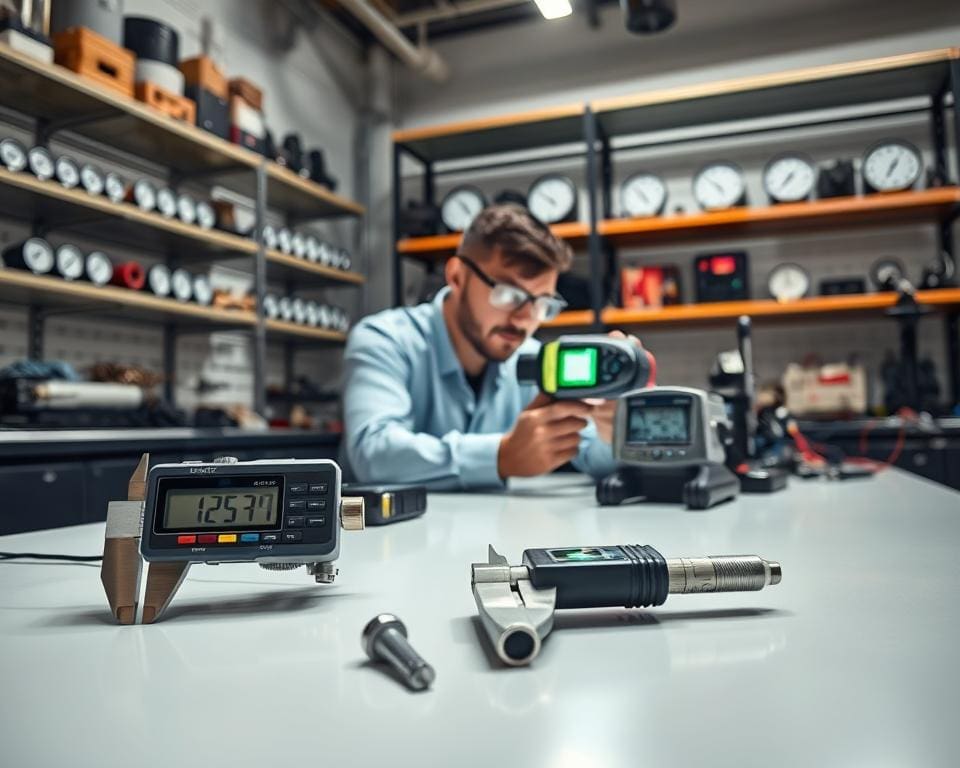
Dimensional inspection tools confirm geometry and tolerances. Examples include coordinate measuring machines (CMMs), calipers and micrometres, plus optical comparators and laser scanners for non-contact measurement.
Material testing devices check mechanical properties. Tensile testers, hardness machines, fatigue rigs and environmental chambers reveal strength, wear resistance and long-term behaviour.
Surface inspection uses machine vision systems, profilometers and roughness testers to spot cosmetic and functional defects. Electrical and electronic testing relies on multimeters, oscilloscopes, automated test equipment and EMI/EMC analysers.
Chemical analysers such as FTIR, XRF and chromatography systems confirm composition and detect contamination. Inspection data systems and quality management tools — MES, QMS and SPC on cloud platforms — collect results, ensure traceability and drive corrective actions.
How device choice affects product consistency and compliance
Picking the right instrument changes how reliably a product meets its specification. For an aerospace component, CMMs and surface roughness measurement are vital for micrometre-level tolerances. For food packaging, vision systems for seal integrity and metal detectors reduce recalls and waste.
Compliance testing devices must offer traceable calibration certificates. Choosing equipment that meets ISO, EN or IEC standards and that can be tested by UKAS-accredited labs lowers regulatory risk and makes audits smoother.
Selecting devices for different industries in the United Kingdom
Automotive and aerospace firms favour high-accuracy CMMs from Zeiss or Hexagon, fatigue testers, environmental chambers and EMI/EMC analysers to meet rigorous standards.
Medical device and pharmaceutical teams rely on texture analysers, moisture metres, FTIR/XRF for material ID and cleanroom-compatible visual inspection systems to protect patient safety.
Electronics manufacturers prioritise oscilloscopes, ATE, thermal imaging and X-ray inspection (CT) for PCB validation and assembly checks.
Food and beverage operations use metal detectors, near-infrared (NIR) analysers, pH and moisture meters plus rapid on-site kits for contaminant screening.
When procuring equipment in the UK, weigh new versus refurbished items, leasing options and service contracts. Check calibration frequency, API or OPC-UA software integration and staff training needs. Thoughtful selection of inspection tools improves product consistency and aligns processes with compliance testing devices required by regulators.
Dimensional inspection devices and metrology instruments
Dimensional inspection devices translate design intent into measurable reality. They ensure parts meet geometric tolerances, form and positional specifications. Choices range from simple handheld tools to advanced multisensor systems used across UK engineering and manufacturing.
Coordinate measuring machines (CMMs): capabilities and best uses
Coordinate measuring machines offer high-precision evaluation of complex geometry. CMM capabilities include tactile probing, optical sensing and laser measurement with repeatability from sub-micron to a few microns depending on model.
Bridge CMMs from Zeiss, Hexagon Metrology and Mitutoyo suit aerospace, engine components, moulds and tooling where GD&T conformity is critical. Typical specifications to check are volumetric accuracy (E0/E1), probing options such as TP20 or TP200 and software like PC-DMIS or Calypso.
Operationally, temperature control, UKAS-traceable calibration and robust fixturing determine real-world performance. Balance throughput and accuracy when creating automated routines for batch inspection.
Calipers and micrometres: affordable precision for small parts
Calipers micrometres remain essential for rapid shop-floor checks and first-article inspection. Digital calipers from Mitutoyo, Starrett and TESA give fast readings while micrometres with ratchet stops support repeatable contact measurement.
These handheld gauges are cost-effective and portable. They demand trained operators and clear measurement procedures to reduce variability and maintain traceability.
Optical comparators and laser scanners: non-contact measurement benefits
Optical comparators and laser scanners in metrology enable non-contact capture of surface geometry. Laser line and structured-light scanners, including systems from Renishaw and Creaform, collect dense meshes for reverse engineering and inspection.
Such technology suits delicate castings, composites and soft polymers where contact could damage finish. Integration with mesh-to-CAD software produces deviation maps and automated reports for rapid decision-making.
When purchasing, match device accuracy and throughput to part tolerances and production volume. Consider whether a controlled metrology lab or portable option better fits the process and check supplier service and calibration offerings in the United Kingdom.
Material testing equipment for strength and durability assessment
Material performance under load and over time shapes product safety and service life. In the United Kingdom, firms rely on material testing equipment UK to measure strength, ductility and toughness. Clear procedures and traceable calibration turn raw data into decisions about design, supplier approval and warranty limits.
Tensile and compression testers: ensuring mechanical performance
Tensile testers and universal testing machines from brands such as Instron, ZwickRoell and Shimadzu report tensile strength, yield and elongation. Benchtop units suit routine checks. Servo-hydraulic systems reach up to 1,000 kN for large structural parts.
Metrics like modulus and compressive strength link directly to standards such as ISO 6892 and ASTM methods. Use these machines for batch validation, supplier qualification and failure analysis to protect safety and reputation.
Hardness testers and impact testers: evaluating wear resistance
Hardness testing covers Rockwell, Brinell and Vickers scales for metals and Shore durometers for polymers. Makers such as Struers and Buehler offer instruments tailored to shop-floor and lab environments.
Impact testers, including Charpy and Izod rigs, measure fracture toughness and notch sensitivity. Results guide coating choices, heat-treatment checks and component life estimations where wear resistance matters.
Fatigue testing rigs and environmental chambers: long-term reliability checks
Fatigue testing rigs from MTS Systems and Instron recreate real-world cyclic loads to predict life to failure. Electrodynamic and servo-hydraulic rigs let engineers understand crack initiation and growth under repeated stress.
Environmental chambers add temperature, humidity and corrosive atmospheres to accelerated ageing programmes. Combined rigs test thermal cycling for electronics and component qualification to MIL-STD and IEC levels.
For reliable results, ensure load cells, extensometers and sensors carry UKAS-traceable calibration. Good sample preparation, controlled methods and operator training keep tests repeatable. Low-volume or highly specialised work often benefits from accredited external labs, while in-house setups need planned maintenance and skilled staff.
Surface inspection and defect detection technologies
Surface integrity shapes how parts perform and how customers perceive a product. Integrating human judgement with automated tools lifts consistency, speeds checks and protects coating adhesion. The right blend of systems prevents rework and keeps production moving.
Visual inspection systems and automated cameras
Line-scan and area-scan cameras from Keyence, Cognex and Teledyne DALSA pair with ring lights and telecentric lenses to give repeatable images. These surface inspection systems inspect assemblies, validate labels and flag scratches or dents on fast-moving lines.
Using automated visual inspection UK solutions lets manufacturers run 100% inspection without tiring operators. That cuts subjectivity and delivers clear pass/fail outputs for downstream control.
Machine vision with AI: detecting micro-defects at speed
Machine vision AI uses convolutional neural networks to spot minute pattern shifts, contamination and surface anomalies. Edge computing makes real-time decisions while cloud platforms support model retraining and fleet management.
Vendors such as Cognex VisionPro and Keyence NV Series supply proven toolchains for image capture and inference. Careful dataset curation and explainability remain vital for regulated industries and for UK data protection when models use cloud services.
Surface profilometers and roughness testers: quantifying finish quality
Contact stylus profilometers and non-contact optical instruments from Taylor Hobson and Mitutoyo measure Ra, Rz, Rt and 3D areal parameters. These profilometers roughness testers are essential for sealing faces, bearings and cosmetic surfaces.
Follow ISO 4287/4288 for sampling length and calibration. Combine in-line vision for high-speed pass/fail with lab profilometry for root-cause analysis. Use SPC charts to track trends, reduce defect rates and maintain traceability.
Electrical and electronic testing devices
Electrical testing sits at the heart of product safety and performance. It verifies circuit function, prevents costly recalls and supports certification for medical devices, automotive ECUs and consumer electronics across the United Kingdom.
Multimeters and oscilloscopes: basic to advanced electrical checks
Handheld and bench multimeters from Fluke and Keysight remain essential for quick checks of voltage, current, resistance and continuity. Look for CAT II–CAT IV safety ratings when testing live equipment on site.
Digital storage oscilloscopes and mixed-signal oscilloscopes from Tektronix and Keysight reveal waveform detail, timing and signal integrity. Accessories such as differential probes, current clamps and isolation transformers expand capability for complex debugging with a multimeter oscilloscope workflow.
Automated test equipment (ATE) and in-circuit testers for PCB validation
ATE platforms from Teradyne and Advantest deliver high-throughput functional checks during production. They ensure each product meets specification before shipping.
In-circuit testers, including bed-of-nails and flying probe systems, confirm PCB continuity, component values and solder joint integrity. Early identification of faults through ATE PCB testing reduces rework and strengthens yield.
Environmental stress testing and EMI/EMC analysers for regulatory compliance
Thermal cycling, temperature–humidity–bias (THB) and vibration chambers expose latent failures. These stress tests improve long-term reliability and reveal weaknesses before field use.
EMI EMC analysers such as spectrum analysers, near-field probes and chamber testing assess radiated and conducted emissions alongside immunity. Brands like Rohde & Schwarz and Keysight support pre-compliance checks to align with CE and UKCA standards and IEC 61000 series limits.
Best practice ties electrical test results into the wider quality management system. Calibrated equipment with traceable records helps correlate electrical failures with process data and supports continuous improvement across production lines.
Chemical and compositional analysis instruments
Accurate chemical and compositional analysis confirms identity, purity and contamination. Laboratories and production floors rely on a mix of portable devices and benchtop systems to keep materials qualified and processes consistent.
Spectrometers and chromatography tools for material identification
FTIR XRF spectrometers provide complementary capabilities. Portable FTIR units from Thermo Fisher Scientific screen organics, coatings and polymers on-site. Handheld XRF from Bruker and Olympus offers rapid, non‑destructive elemental analysis for metals, alloys and RoHS checks.
Chromatography systems such as GC and HPLC separate complex mixtures for precise quantification. Coupling these with mass spectrometry raises sensitivity for trace contaminants in pharmaceuticals and food testing.
pH, titration and moisture control for process assurance
Routine process control uses pH meters and conductivity probes to keep chemical baths and food production within specification. Trusted manufacturers like Mettler Toledo supply portable instruments that support daily quality checks.
Karl Fischer titrators and moisture analysers are essential where even small water levels affect product performance. Automated titration systems improve reproducibility in QC labs and reduce operator variability.
How on-site rapid testing complements lab analysis
On-site rapid testing gives immediate pass/fail data to reduce quarantine and speed decisions. Handheld XRF, portable FTIR and NIR analysers are ideal for triage and high-frequency checks at incoming inspection.
For formal certification and complex cases, send samples to UKAS-accredited laboratories for traceable results. Use on-site tools to screen batches and reserve laboratory time for confirmatory work.
- Keep calibration records and traceable consumables to maintain compliance.
- Adopt a mixed approach: frequent on-site checks with periodic accredited lab validation.
- Invest in chromatography systems and FTIR XRF spectrometers to cover both organic and elemental needs.
Inspection data systems and quality management tools
Inspection data systems UK turn measurement results into clear, actionable intelligence. By linking SPC software and MES for QC with on-floor capture devices, teams gain traceability, trend analysis and faster root-cause insight. This shift moves quality from a final check to an ongoing strategic activity.
Statistical Process Control software offers real-time monitoring, control charts and capability studies (Cp, Cpk) to keep processes stable. Combined with Manufacturing Execution Systems and QMS integration, inspection plans, non-conformance handling and corrective actions are managed in one place using proven platforms such as Siemens Opcenter, SAP QM and MasterControl.
Practical data capture uses handheld barcode and RFID readers, digital tablets and metrology packages like PC-DMIS or Mitutoyo MiCAT. Cloud and IIoT platforms such as PTC ThingWorx and GE Digital provide central dashboards and remote audit trails; see a useful overview at data monitoring in modern manufacturing.
For UK manufacturers, prioritise data integrity, UKAS-accredited calibration records and interoperability via OPC‑UA or REST APIs. Start with pilot lines to show ROI, invest in training, and budget for cybersecurity and retention policies. The right blend of instruments and quality management tools lifts inspection into a competitive advantage based on precision, safety and reputation.